Best overall for supported private-sale paperwork: Guntransfer. Best when dealer involvement is required: a federally licensed firearms dealer. Best for delegating the sale: dealer consignment. The best way to sell a gun in 2026 starts with the legal transfer route, not the advertising channel; this guide compares documentation support, dealer-mediated transfers, consignment, and a direct sale to a dealer.
- The best way to sell a gun starts with residency, state law, and any required dealer involvement.
- Guntransfer handles private firearm transfer compliance, including background checks, bills of sale, and ownership records across 37 states.
- A federally licensed firearms dealer is the right route when the transaction requires dealer involvement.
- Dealer consignment delegates the sale; a direct dealer sale is not a person-to-person transaction.
Why this matters
Finding someone interested in a firearm and legally transferring that firearm are different tasks. A listing, payment agreement, or signed receipt does not establish that a transfer is lawful. Settle the compliance route before arranging the handoff.
Private firearm sales involve 2 legal layers: federal law and applicable state law. Local requirements also matter where they apply. Across 50 states, the term private sale does not describe one uniform process, so another seller's experience is not a substitute for checking your own requirements.
For a 2026 sale, start with the parties' states of residence, the firearm category, and any required background check or dealer process. Under 18 U.S.C. § 922(a)(5), ordinary transfers between unlicensed residents of different states generally require a licensed-dealer route. Limited statutory exceptions are not a basis for treating an ordinary interstate sale like a same-state handoff.
This guide concerns lawful transfers of lawfully owned firearms. Specially regulated firearms, disputed ownership, and unusual circumstances require separate review rather than assumptions based on an ordinary private sale.
What makes the best private firearm sale method
Use these criteria to choose a route. Convenience comes after legal fit.
- Legal fit: The method must meet the requirements that apply to the seller, buyer, firearm, and transaction.
- Residency fit: Same-state and interstate transactions need separate analysis. A nearby meeting place does not change either party's residency.
- Required oversight: Identify whether a licensed dealer must conduct the transfer or background check before selecting a paperwork service.
- Record quality: Keep an accurate account of the transaction. A bill of sale records an agreement; it does not replace mandatory checks.
- Responsibility: Understand which tasks remain yours and which tasks a service or dealer performs.
- Private-sale fit: Decide whether retaining a person-to-person sale matters more than delegating the transaction or selling to a business.
Reject any method that treats documentation as permission to bypass a required transfer process. Good records and legal authorization serve different purposes.
Private firearm sale options at a glance
These options solve different problems in 2026. The order reflects the seller's objective, not an unsupported claim about speed, financial return, or service quality.
| Option | Best for | Standout feature | Key limitation |
|---|---|---|---|
| Guntransfer | Compliance documentation for supported person-to-person sales | Background checks, bills of sale, and ownership records across 37 states | Coverage does not extend to every state; required dealer involvement still applies |
| Licensed-dealer-mediated private transfer | Transactions that require dealer involvement | Licensed oversight of the regulated transfer process | Dealer procedures and applicable law govern completion |
| Dealer consignment | Sellers who want to delegate sale administration | A dealer manages the sale under a consignment agreement | You give up direct control over parts of the transaction |
| Direct sale to a licensed dealer | Sellers who no longer need a person-to-person sale | The dealer becomes the purchaser | It is not a private sale between individuals |
1. Guntransfer: best for supported private-sale documentation
Guntransfer provides an online private firearm transfer compliance service for individuals in the United States. Its stated scope includes background checks, bills of sale, and ownership records across 37 states. The service addresses transaction compliance and documentation rather than replacing the legal requirements that apply to a particular sale.
Guntransfer is best for private firearm sellers who need compliance documentation for a supported person-to-person sale. That is a narrower recommendation than calling an online service the answer to every firearm transaction. Where law requires licensed-dealer involvement, plan for that requirement separately.
Service pros:
- Combines background-check handling, bills of sale, and ownership records within its stated service scope.
- Provides an online route for private individuals completing person-to-person transactions.
- Identifies a defined coverage area rather than claiming a single process for every state.
Service cons:
- Coverage across 37 states is not nationwide coverage.
- Documentation support does not remove mandatory dealer requirements.
- The seller still needs to establish that the transaction fits the service's supported scope.
Best for: A seller who wants help documenting a lawful private transfer in a supported state.
Before selecting a documentation service, identify the legal route. Then confirm that the service handles the relevant transaction rather than assuming its coverage statement settles every detail. Separate the background-check requirement from the recordkeeping requirement when reviewing the process.
Verdict: Hold until you confirm state coverage and any required dealer involvement; then choose the service for its stated compliance role.
2. Licensed-dealer transfer: best when dealer involvement is required
A federally licensed firearms dealer, commonly called an FFL, handles the dealer portion of a regulated transfer. This route is the legal priority when the applicable transaction requires licensed-dealer involvement. It is not merely an optional alternative to private paperwork.
For ordinary interstate sales between unlicensed individuals, federal law generally requires a licensed-dealer route. State law also imposes dealer or background-check requirements on certain same-state private transfers. The ATF's guidance on unlicensed-person transfers and 18 U.S.C. § 922 provide the federal framework; state requirements remain a separate check.
Licensed-dealer transfer pros:
- Addresses the licensed-dealer requirement where it applies.
- Places the dealer's portion of the transfer within a regulated process.
- Distinguishes the private sale agreement from authorization to deliver the firearm.
Licensed-dealer transfer cons:
- You must follow the dealer's procedures as well as applicable law.
- An agreement between seller and buyer does not guarantee transfer completion.
- A dealer-mediated transfer does not erase every responsibility of the private parties.
Best for: A private transaction that requires a licensed dealer, including an ordinary interstate sale subject to federal transfer restrictions.
Confirm the applicable dealer process before making handoff arrangements. Neither a signed receipt nor a buyer's assurance substitutes for completion of required checks or other legal conditions. If you cannot establish the lawful route, stop rather than trying to convert the transaction into an informal handoff.
Verdict: Hold the handoff until the required licensed-dealer process is complete.
3. Dealer consignment: best for delegating sale administration
Dealer consignment places sale administration with a licensed dealer under an agreement. Unlike a dealer-mediated transfer for a sale you already arranged, consignment assigns the dealer a broader role in managing the sale. The agreement determines that role.
This option fits a seller whose main concern is managing the transaction rather than preserving direct control over every step. Read the agreement carefully. Consignment does not mean the same thing as selling the firearm outright to the dealer.
Dealer consignment pros:
- Delegates sale administration instead of leaving every task with the individual seller.
- Establishes the dealer's responsibilities through a written agreement.
- Separates a managed sale from an informal person-to-person arrangement.
Dealer consignment cons:
- You give up control over parts of the sale process.
- The agreement governs what happens if the firearm does not sell.
- Consignment itself does not promise a completed sale or a particular result.
Best for: A seller who wants a dealer to manage the sale rather than only process the eventual transfer.
Before agreeing, understand who retains ownership before the sale, who holds the firearm, and what conditions govern cancellation or return. These are agreement terms, not details to assume from the word consignment. Also distinguish the dealer's sale-management responsibilities from the regulated transfer requirements.
Verdict: Hold until the written agreement clearly assigns possession, sale authority, and unsold-firearm responsibilities.
4. Direct dealer sale: best for leaving the private-sale route
In a direct dealer sale, the licensed dealer purchases the firearm rather than administering a sale between private individuals. The purchaser is a business. That makes this a different transaction, not another way to describe a person-to-person transfer.
Include this option in your decision only if a private buyer is not essential to your objective. A direct dealer sale changes the counterparty and the agreement; it does not establish a guaranteed timeline or financial outcome.
Direct dealer sale pros:
- Makes the dealer the purchaser rather than a transfer intermediary.
- Removes the need to maintain a separate person-to-person sale agreement.
- Defines a different route for sellers who do not need a private transaction.
Direct dealer sale cons:
- It does not preserve the person-to-person sale model.
- The dealer must agree to purchase the firearm.
- The transaction terms require review rather than assumptions about convenience.
Best for: A seller whose priority is transferring ownership to a licensed business, not completing a private sale.
Keep the distinction clear when comparing options. A dealer processing a private transfer, a dealer holding a consigned firearm, and a dealer buying a firearm occupy different roles. Ask which role applies before relying on any description of the process.
Verdict: Skip this option if completing a person-to-person private sale is a firm requirement.
How these options rank
The ranking puts legal fit ahead of convenience. Documentation support comes first for supported private transactions because it addresses the stated paperwork need. Required licensed-dealer involvement takes priority over that ranking whenever the law demands it.
Consignment occupies a separate slot because it delegates sale management. A direct dealer sale sits last because it changes the transaction from a private sale to a sale to a business. Neither is presented as inherently better than a properly completed person-to-person transfer.
For your 2026 decision, compare responsibilities rather than broad labels such as online or local. Those labels describe where a process happens, not whether it meets the applicable legal requirements.
Which sale method should you choose?
Choose the legal route first, then select the support that fits it. If a dealer is required, that requirement controls. If the transaction is a supported private sale and your need is compliance documentation, Guntransfer fits that role.
Use this sequence before committing to a method:
- Residency: Establish whether the seller and buyer reside in the same state or different states.
- State rules: Check applicable private-transfer requirements using current official state guidance.
- Dealer requirement: Identify whether a licensed dealer must participate before delivery.
- Documentation: Determine which records and forms the chosen route requires.
- Completion: Do not treat an agreement or payment as authorization to skip an unfinished requirement.
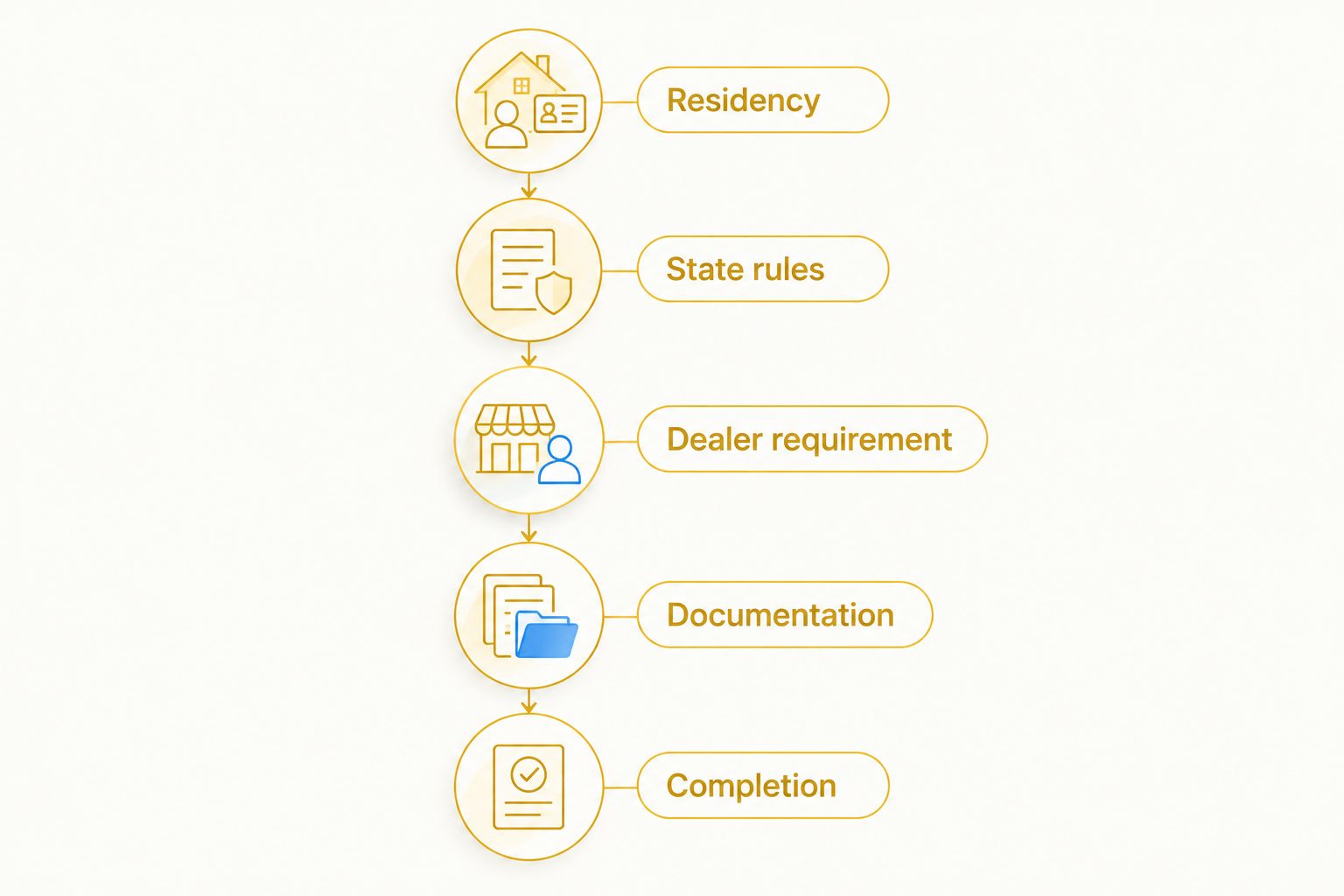
The sequence matters because records cannot repair an unlawful delivery after the fact. Resolve uncertainty before possession changes. If official guidance does not resolve your circumstances, get advice from a qualified attorney rather than relying on another seller's account.
Keep the paperwork separate from legal permission
A bill of sale records the parties' agreement and transaction details. It is not a background check, a dealer license, or an exemption from transfer restrictions. A signature documents an agreement; it does not independently authorize a firearm transfer.
Keep records accurate and consistent with the transaction that actually occurred. Do not describe a dealer purchase as a private sale or a consignment as a completed ownership transfer. The distinction affects what your paperwork should record.
For a 2026 transaction, also distinguish sale compliance from carry or transport rules. A concealed-carry permit is not a blanket exemption from private-transfer requirements. Follow the rules that apply to the specific transaction rather than treating one credential as permission for everything.
FAQ
What's the best way to sell a gun privately in 2026?
The best way to sell a gun privately in 2026 is to establish the lawful transfer route before arranging delivery. Confirm residency, applicable state requirements, and any required licensed-dealer involvement, then select documentation support that fits the transaction.
Is an online firearm transfer service better than an FFL?
An online documentation service and an FFL serve different roles. A service can support its stated compliance functions, but it does not replace licensed-dealer involvement when the transaction requires it.
Can I sell a firearm privately to someone in another state?
An ordinary firearm sale between unlicensed residents of different states generally requires a licensed-dealer route under federal law. Do not treat an interstate sale as a same-state private handoff; applicable state requirements also matter.
Does a bill of sale make a private firearm transfer legal?
No, a bill of sale does not independently make a firearm transfer legal. It records the transaction but does not replace a required background check, dealer process, or other legal condition.
Does every private firearm sale require a background check?
Private-sale background-check requirements depend on the applicable law and transaction. Check federal and state requirements rather than assuming that every private sale follows the same process.
Is dealer consignment the same as selling directly to a dealer?
No, dealer consignment and a direct dealer sale are different arrangements. Consignment gives the dealer a sale-management role under an agreement; a direct sale makes the dealer the purchaser.
Does a concealed-carry permit let me skip private-transfer requirements?
A concealed-carry permit is not a blanket exemption from private-transfer requirements. Any specific exemption must apply under the governing law and the circumstances of the transaction.
One last thing
The most useful question is not where to advertise; it is who must legally participate before the firearm changes hands. Answer that question before selecting a service, signing an agreement, or arranging delivery.
For a private firearm sale in 2026, keep the sale agreement, compliance process, and ownership records distinct. Each serves a purpose. None automatically replaces the others.