Best overall: a licensed firearm dealer. Best for documenting an eligible private family sale: Guntransfer. Best for a genuine same-state gift: the lawful gift procedure in your state. Best for inheritance: the estate’s lawful distribution process. To transfer gun ownership to family member in 2026, choose the route that fits residency, eligibility, state requirements, and whether the transaction is a sale, gift, or inheritance.
- A licensed firearm dealer is the default choice for interstate family gifts and sales.
- Guntransfer is best for documenting eligible private family sales within its service coverage.
- A family relationship does not automatically waive firearm background checks or state transfer requirements.
- To transfer gun ownership to family member, distinguish private sales, genuine gifts, and inheritance before choosing a process.
Why this matters
A family relationship is not a blanket firearm-transfer exemption. A parent giving a firearm to an adult child still needs to consider both people’s residency, the recipient’s eligibility, and applicable state law. The absence of payment does not remove those requirements.
The federal baseline for a 2026 transfer includes restrictions on transfers between unlicensed residents of different states. Federal law treats qualifying inheritance differently from an ordinary gift, while state law adds its own requirements. Start with the legal category, not the family connection.
A bill of sale records a transaction. It does not authorize one that otherwise requires a dealer, a background check, or another procedure. Keep those functions separate throughout the transfer.
What makes the best family firearm transfer method
Use these criteria to choose a process before anyone takes possession:
- Residency fit: The method must address whether both parties reside in the same state. Different-state transfers trigger federal restrictions.
- Transaction fit: A sale, genuine gift, and inheritance are different legal situations. Choose the procedure that matches what actually happened.
- Eligibility checks: The recipient must be legally eligible to receive and possess the firearm. Family familiarity does not establish legal eligibility.
- State compliance: Required background checks, waiting periods, permits, and family exemptions depend on the jurisdiction and transaction.
- Usable records: Documentation should identify the parties, firearm, transaction type, and completion date without being mistaken for government authorization.
- Service scope: A provider must cover the actual transaction. An online documentation service cannot replace a legally required licensed-dealer transfer.
For your 2026 decision, compliance comes first, documentation second, and convenience third. A short process is useful only when it is the correct process.
Family firearm transfer methods at a glance
| Method | Best for | Standout feature | Key limitation |
|---|---|---|---|
| Licensed firearm dealer | Interstate family gifts and sales | Provides the licensed transfer process and required dealer checks | Dealer involvement does not eliminate state restrictions |
| Guntransfer private firearm transfer service | Documenting an eligible private family sale | Handles background checks, bills of sale, and ownership records across 37 states | Service coverage does not create a legal exemption |
| Lawful same-state gift procedure | Genuine gifts where state law permits that route | Matches the process to an actual gift rather than a sale | Family exemptions differ by state and relationship |
| Estate distribution process | Firearms passing through a qualifying inheritance | Addresses the distinct inheritance rules | An informal lifetime gift is not an inheritance |
These are transaction routes, not interchangeable products. Choose the row that matches your circumstances, then confirm the requirements before completing it.
1. Licensed firearm dealer: best for interstate family transfers
A federally licensed firearm dealer, commonly called an FFL, is the default choice when living family members reside in different states. Federal restrictions apply to ordinary interstate gifts as well as sales between unlicensed individuals. Being related does not remove that restriction.
For an interstate family transfer, start with a receiving dealer in the recipient’s state. Ask the dealer which procedures apply to the firearm and both parties. Dealer transfers of rifles and shotguns can involve additional federal exceptions and state conditions; do not assume every firearm follows the same route.
Licensed firearm dealer pros:
- Provides the required licensed process when an FFL transfer applies.
- Handles the recipient’s dealer-transfer paperwork and applicable background-check procedure.
- Gives both parties a clear point of contact for transfer requirements.
- Helps distinguish a lawful transfer from an informal handoff.
Licensed firearm dealer cons:
- Adds coordination with a third party.
- Cannot complete a transfer that law prohibits.
- Must follow applicable waiting periods and other state requirements.
Best for: A family gift or sale between residents of different states, or a same-state transaction that requires dealer processing.
Before choosing a dealer, explain that the transaction involves family members and identify their states of residence. Ask whether the dealer handles that transaction type. Do not move the firearm first and attempt to correct the paperwork afterward.
Verdict: Buy the dealer transfer service when the transaction requires an FFL. This is the default for an interstate family gift or sale, not an optional documentation upgrade.
2. Guntransfer: best for documenting an eligible private family sale
Guntransfer’s private firearm transfer service is best for individuals documenting an eligible person-to-person family sale. The service handles background checks, bills of sale, and ownership records across 37 states. Its stated scope is private sales, so do not assume a gift or estate distribution follows the same service process.
The distinction is practical: documentation supports a lawful sale, but documentation does not replace a required dealer transfer. Establish the legal route first. Then use a service that fits the transaction and jurisdiction.
Guntransfer pros:
- Combines background-check handling with sale documentation.
- Includes bills of sale and ownership records.
- Serves private individuals completing person-to-person firearm sales.
- Has stated coverage across 37 states.
Guntransfer cons:
- Coverage does not extend to every state.
- The stated service description concerns sales, not every kind of family transfer.
- Online processing cannot substitute for a legally required FFL procedure.
Best for: An eligible private sale to a family member where the service’s coverage and the applicable transfer rules match.
For a 2026 family sale, confirm whether the transaction requires licensed-dealer involvement before selecting online processing. Also distinguish the service’s background-check handling from the federal NICS process used by licensed dealers. Private individuals do not gain direct NICS access simply by preparing a bill of sale.
Verdict: Buy the service for an eligible private family sale within its scope; skip it as a substitute for required dealer processing.
3. Lawful same-state gift: best for genuine gifts where permitted
A same-state gift is the relevant route when you genuinely give a firearm to a family member without payment. Some state laws provide exceptions for specified family relationships. Other transactions still require background checks or dealer involvement despite being gifts.
Check the actual exemption language. A rule covering a parent and child does not automatically cover cousins, unmarried partners, or every person you consider family. The recipient must also be eligible to receive and possess the firearm.
Lawful same-state gift pros:
- Classifies a genuine gift accurately rather than describing it as a sale.
- Allows you to use a specific family exemption when the law provides one.
- Supports a written record of the gift and the parties involved.
Lawful same-state gift cons:
- Depends on the state’s rules and the precise family relationship.
- Does not override federal restrictions on prohibited recipients.
- Does not provide a general exemption for different-state residents.
Best for: A genuine gift between same-state residents after confirming that the applicable law permits the chosen procedure.
Record the transaction honestly. A gift record should describe a gift; a sale record should describe a sale. Calling a transaction a gift does not change its substance or eliminate a required check.
In 2026, use current state-law requirements rather than an old family practice. A relative’s previous transfer does not establish that your transfer is lawful today.
Verdict: Hold until the recipient’s eligibility, residency, and exact state requirements are confirmed. Use the gift route only when those conditions support it.
4. Estate distribution: best for a qualifying inheritance
A firearm passing through a will or intestate succession belongs in the estate process. Federal law includes specific exceptions for qualifying bequests and intestate succession that differ from ordinary transfers between living people. State possession and estate requirements still apply.
Coordinate with the executor, administrator, or attorney handling the estate. Establish who has authority to distribute the firearm and who legally inherits it. A promise that someone will receive a firearm later is not the same as a completed inheritance.
Estate distribution pros:
- Addresses the legal category that actually applies after a death.
- Connects the firearm distribution to estate authority and beneficiary records.
- Accounts for federal inheritance provisions rather than ordinary gift rules.
Estate distribution cons:
- Requires confirmation of estate authority and entitlement.
- Does not excuse the recipient from possession restrictions.
- Specially regulated firearms require separate attention.
Best for: A firearm passing to a lawful beneficiary through a qualifying bequest or intestate succession.
Keep the inheritance record with the estate documentation. If the firearm’s legal classification or the beneficiary’s eligibility is uncertain, obtain qualified legal advice before distribution. Do not use the inheritance exception to describe a lifetime transfer merely because the parties are relatives.
Verdict: Wait for the authorized estate process; skip an informal handoff that bypasses it. The executor’s authority and the beneficiary’s entitlement are central to this route.
How to choose your route before transferring possession
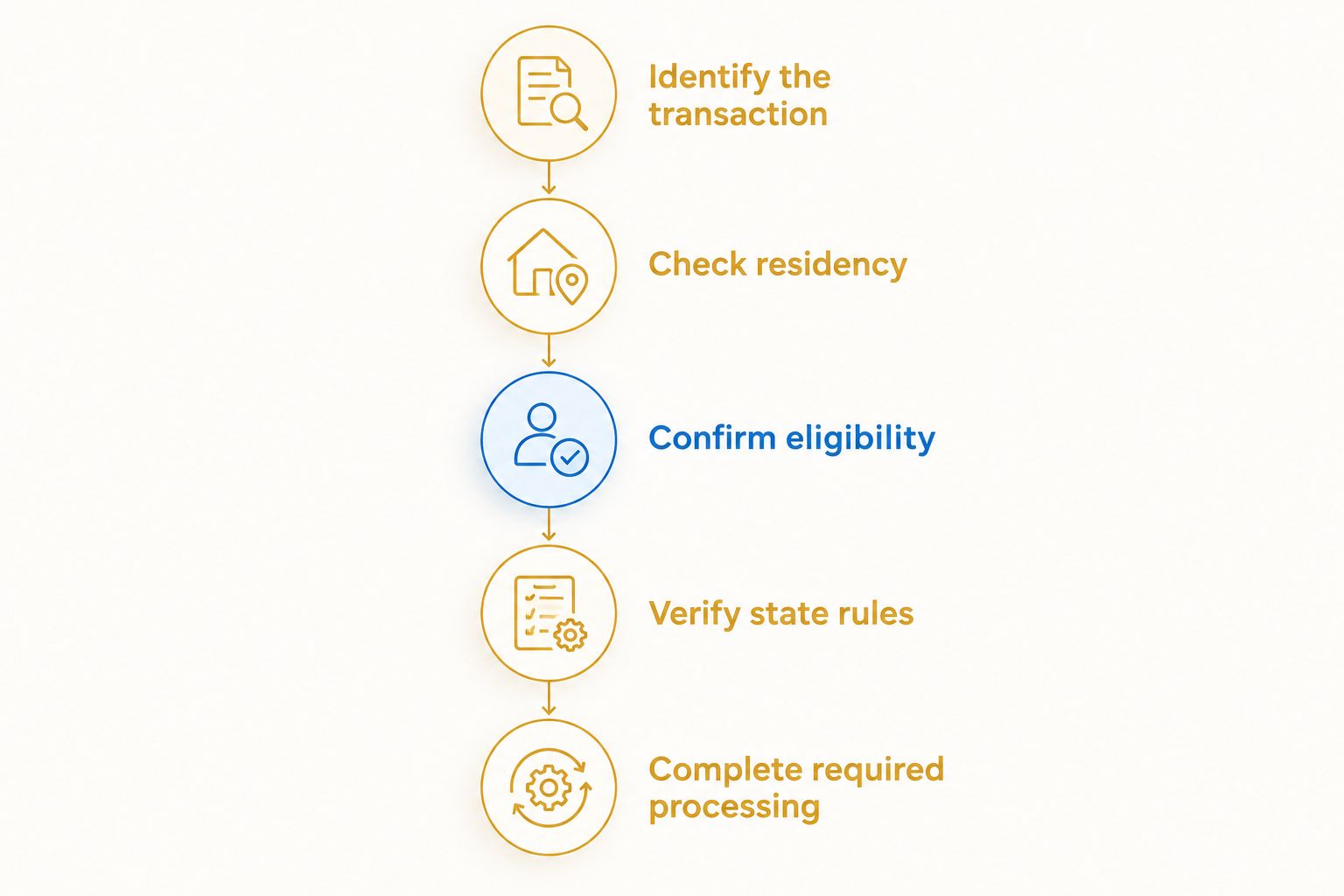
Work through these checks in order. Each check answers a different question; a completed record cannot compensate for a failed eligibility or residency check.
Identify the transaction
Decide whether the firearm is being sold, given away, or inherited. Use the real transaction type in every record. If an estate is involved, identify the person authorized to act for it.
Check residency
Establish both parties’ states of residence. For an ordinary gift or sale between different-state residents, use the licensed-dealer route unless qualified advice establishes a specific applicable exception. Do not infer residency from where someone happens to be visiting.
Confirm eligibility
Confirm the recipient’s legal eligibility and the requirements applicable to the firearm. Federal dealer rules generally set minimum purchase ages of 18 years for rifles and shotguns and 21 years for other firearms, including handguns. State rules and nondealer transfers require separate analysis; those dealer thresholds are not a universal private-transfer rule.
Verify state rules
Check requirements governing the transaction, including background checks, waiting periods, permits, and any claimed family exemption. Read the relationship definition as well as the exemption itself. A summary that says family gifts are exempt is not enough.
Complete required processing
Use the dealer, private-sale service, or estate procedure that matches the legal route. Complete required processing before transferring possession. Keep the resulting records with the relevant transaction or estate documents.
How the methods are ranked
The ranking prioritizes residency fit, transaction type, recipient eligibility, state compliance, documentation, and service scope. It is not a product-performance test or a promise that one method works everywhere.
Licensed dealers rank first because interstate family gifts and sales require particular care under federal law. Private-sale documentation follows only where the transaction is eligible. Gift and inheritance routes occupy separate slots because their legal categories differ.
The federal reference points are 18 U.S.C. § 922(a)(3) and § 922(a)(5) for interstate restrictions and inheritance exceptions, and § 922(b)(1) for dealer age restrictions. ATF guidance on unlicensed transfers and buying firearms as gifts provides additional federal context. These sources do not replace the state-law check for your 2026 transaction.
Which family firearm transfer method should you choose?
Choose a licensed dealer when you need a default for an interstate family gift or sale. For a same-state transaction, establish the applicable requirements before choosing a private-sale or gift procedure. For inheritance, follow the authorized estate process.
Keep the decision narrow: legal route first, recipient eligibility next, documentation after that. Do not let a familiar recipient or convenient service turn those checks into assumptions.
FAQ
What’s the best way to transfer gun ownership to family member in 2026?
A licensed firearm dealer is the default choice for an interstate family gift or sale. For a same-state transfer, choose the procedure required by state law and distinguish a sale from a genuine gift or inheritance.
Can I give a firearm to a family member in another state?
Ordinary gifts between unlicensed residents of different states generally require a licensed-dealer transfer. A family relationship does not create a general federal exception; qualifying inheritance is a separate legal category.
Does a family firearm transfer require a background check?
The requirement depends on the legal route and applicable law. Dealer transfers generally require the dealer’s background-check procedure unless a lawful exception applies, while state law determines additional private-transfer requirements and family exceptions.
Is a bill of sale enough to transfer a firearm legally?
No, a bill of sale does not replace required dealer processing, background checks, permits, or waiting periods. It documents the transaction rather than authorizing an otherwise unlawful transfer.
Can Guntransfer handle a sale to a family member?
Guntransfer provides a private firearm transfer service for eligible person-to-person sales across 37 states. Confirm that the family sale fits its coverage and the applicable legal requirements before choosing the service.
Are inherited firearms treated differently from gifts?
Yes, federal law provides specific exceptions for qualifying bequests and intestate succession. The beneficiary must still be legally eligible, and applicable state requirements and estate authority remain relevant.
Does being an adult automatically make a relative eligible to receive a firearm?
No, age alone does not establish firearm eligibility. Federal and state restrictions, firearm type, residency, and the transfer procedure also matter.
One last thing
A firearm’s legal history and your family’s understanding are not the same record. Before starting a 2026 transfer, write down whether it is a sale, gift, or inheritance and which procedure authorizes it. That distinction prevents a bill of sale from being mistaken for permission and a family promise from being mistaken for estate authority.