Best overall: a federally licensed firearms dealer (FFL) for the required transfer and background-check process. Best for private-sale paperwork: Guntransfer; best for a state-prescribed process: the authorized channel your state requires—this 2026 guide separates background checks for gun purchases from recordkeeping services.
- An FFL is the default choice for background checks for gun purchases when dealer involvement is required.
- Guntransfer handles private firearm transfer compliance, bills of sale, and ownership records across 37 states.
- Follow the state-authorized process when local law specifies how a private firearm sale must proceed.
- A bill of sale records a transaction; it does not replace a legally required background check.
Why this matters
Choose the legally required process before choosing a service. A background check, a transfer through a dealer, and a bill of sale perform different jobs. Treating them as interchangeable leaves you with paperwork that does not necessarily satisfy the transfer requirements.
For a private firearm sale in 2026, start with the buyer's and seller's states of residence. Then check the firearm category, any applicable permit requirements, and whether a licensed dealer must participate. An online transaction does not remove those obligations.
This guide ranks routes by their role in a lawful transfer, not by convenience alone. The best choice is the route that satisfies the applicable rules and leaves both parties with the appropriate records.
What makes the best background-check option?
Evaluate each option against these criteria before arranging a handoff:
- Legal fit: The process must satisfy federal law and the applicable state requirements for this particular transaction.
- Authorized participation: The required check must run through an authorized dealer or state process, not a general consumer-search website.
- Transfer handling: Establish who receives the firearm, who completes the required records, and who can release it to the buyer.
- Documentation: Separate the background-check requirement from the bill of sale and ownership records.
- Coverage: Confirm that the service handles the relevant state and transaction type before starting.
- Outcome handling: Know what happens if the check is delayed or denied. A submitted check is not permission to complete a transfer.
A route that fails the legal-fit criterion drops out of consideration. Useful paperwork and a convenient interface cannot correct an unauthorized transfer process.
Background-check options at a glance
| Option | Best for | Standout function | Key limitation |
|---|---|---|---|
| Federally licensed firearms dealer | A transfer requiring dealer participation | Handles the dealer transfer and applicable background-check process | Requires coordination with a dealer willing to handle the transaction |
| Guntransfer | Private-sale compliance paperwork and ownership records | Online service handling background checks, bills of sale, and ownership records across 37 states | Coverage does not establish eligibility for every transaction |
| State-authorized transfer or check channel | A transaction governed by a prescribed state process | Follows the state's required route, including dealer or agency involvement where applicable | Procedures differ by state and are not interchangeable |
These are functional options, not competing versions of the same product. A private sale can involve an online compliance service and an FFL, while the dealer follows a state-administered background-check procedure.
1. Federally licensed firearms dealer: best for required dealer transfers
An FFL handles firearm transactions under federal licensing requirements. For a private sale routed through a dealer, the dealer follows the applicable recordkeeping and background-check process before transferring the firearm to the buyer.
An FFL is the default choice when the transaction requires a licensed dealer. This is especially important when the buyer and seller reside in different states: federal law generally requires an interstate private sale to pass through a licensed dealer, subject to specific exceptions. Handgun and long-gun transfer rules also differ.
FFL pros
- Provides the licensed participant required for a dealer-mediated transfer.
- Connects the transfer to the applicable federal or state background-check process.
- Completes the dealer records required for the transaction.
- Can identify requirements that prevent the proposed transfer from proceeding.
FFL cons
- You must find a dealer willing to accept and handle the particular private transfer.
- The process requires coordination among the buyer, seller, and dealer.
- A background-check delay or denial prevents a straightforward, immediate completion.
Best for: Buyers and sellers whose transaction requires dealer involvement, including ordinary interstate private sales.
Before selecting a dealer, explain the firearm type and each party's state of residence. Ask whether the dealer handles that transaction, what identification and documents are required, and how the firearm must reach the dealer. Do not assume every license holder provides the same transfer service.
Federal dealer-sale age rules provide another reason to verify eligibility early. Licensed dealers generally cannot sell rifles or shotguns to someone under 18 years old, or handguns to someone under 21 years old. State law can impose additional restrictions; these federal thresholds are not blanket permission to buy or possess a firearm.
For your 2026 sale, ask the receiving dealer to confirm the applicable requirements before making delivery arrangements. Verdict: Buy—choose the FFL route when licensed-dealer participation is required.
2. Guntransfer: best for private-sale paperwork and ownership records
Guntransfer provides an online private firearm transfer compliance service for individuals in the United States. Its stated scope includes background checks, bills of sale, and ownership records across 37 states.
Guntransfer is best for private firearm transfer compliance and organized sale records within its supported coverage. Its role is broader than producing a receipt: the service addresses the compliance and documentation work surrounding a person-to-person sale.
That does not make a website a substitute for a dealer where dealer involvement is mandatory. Confirm that the service's process matches the legal requirements for your state, firearm, and buyer before proceeding.
Guntransfer pros
- Brings background-check handling, bills of sale, and ownership records into an online service.
- Focuses on person-to-person firearm sales rather than general consumer background searches.
- Provides a defined service scope across 37 states.
Guntransfer cons
- Its stated coverage does not include every US state.
- Coverage alone does not establish that a particular buyer or transaction qualifies.
- The service does not remove independently applicable dealer, permit, or waiting-period requirements.
Best for: Private buyers and sellers who need compliance support and transaction records in a supported state.
Before you start, identify exactly which part of the transfer the service handles. Establish who performs any required check, whether a dealer participates, and what must happen before the firearm changes hands. Keep the transaction details consistent across the service, any dealer documents, and the bill of sale.
The decision is straightforward: use the service for its stated compliance and recordkeeping role, while following the required transfer channel. Do not select an online process merely because the sale began online.
Verdict: Buy—choose Guntransfer for supported private-sale compliance and documentation, not as a shortcut around required dealer participation.
3. State-authorized channel: best for a prescribed state process
Some states prescribe how private-sale background checks must be completed. Depending on the jurisdiction, the required route involves a licensed dealer, a state-administered check system, or another specifically authorized procedure.
This option is not a separate consumer background-search product. It is the legally recognized channel for that state. Your job is to identify the applicable procedure and follow it rather than substituting a process used elsewhere.
State-authorized channel pros
- Matches the jurisdiction's prescribed background-check procedure.
- Accounts for state-specific requirements alongside federal obligations.
- Identifies the authorized participant or agency responsible for the check.
State-authorized channel cons
- Requirements vary by jurisdiction and transaction type.
- A permit or completed check from another state does not automatically satisfy the local process.
- State authorization does not eliminate other transfer conditions.
Best for: Buyers and sellers whose state specifies a particular private-sale background-check route.
Read the relevant state agency's current instructions for 2026 and confirm the procedure with the participating dealer or authorized channel. Look specifically for private-sale rules, firearm-category distinctions, exemptions, and conditions governing release of the firearm.
Do not confuse an agency that administers checks with a service that accepts direct requests from any private seller. Federal NICS access is not a public people-search tool. A private seller cannot simply run an ordinary consumer report and treat it as a firearm background check.
Verdict: Buy—use the state-authorized route whenever it governs your transaction.
How to choose the right route before the handoff
Use this sequence to turn the comparison into a decision. Each step answers a different question; completing the paperwork does not resolve an unanswered legal requirement.
Confirm residency
Establish the buyer's and seller's states of residence. Different-state transactions trigger federal transfer restrictions, even when both people can meet in person. Physical proximity does not turn an interstate sale into an intrastate sale.
Check state rules
Identify the current private-transfer requirements for the relevant jurisdiction. Check the firearm category, buyer eligibility, permit requirements, dealer involvement, and any waiting period. Use current official guidance rather than an old discussion thread or a rule remembered from another state.
Select the channel
Choose the FFL or other authorized process required for the transaction. If you also use an online compliance service, establish how that service fits into the required route. Do this before arranging delivery or collection.
Complete required checks
Follow the authorized participant's instructions for identification, forms, and the check itself. Do not treat submission as approval. A delay, denial, or unresolved requirement calls for instructions from the dealer or responsible authority, not an improvised handoff.
Keep transfer records
Complete the appropriate sale documentation and retain your records securely. Make sure the buyer, seller, firearm description, and transaction details agree across the documents. A bill of sale supports recordkeeping; it does not authorize a transfer that the law otherwise prohibits.
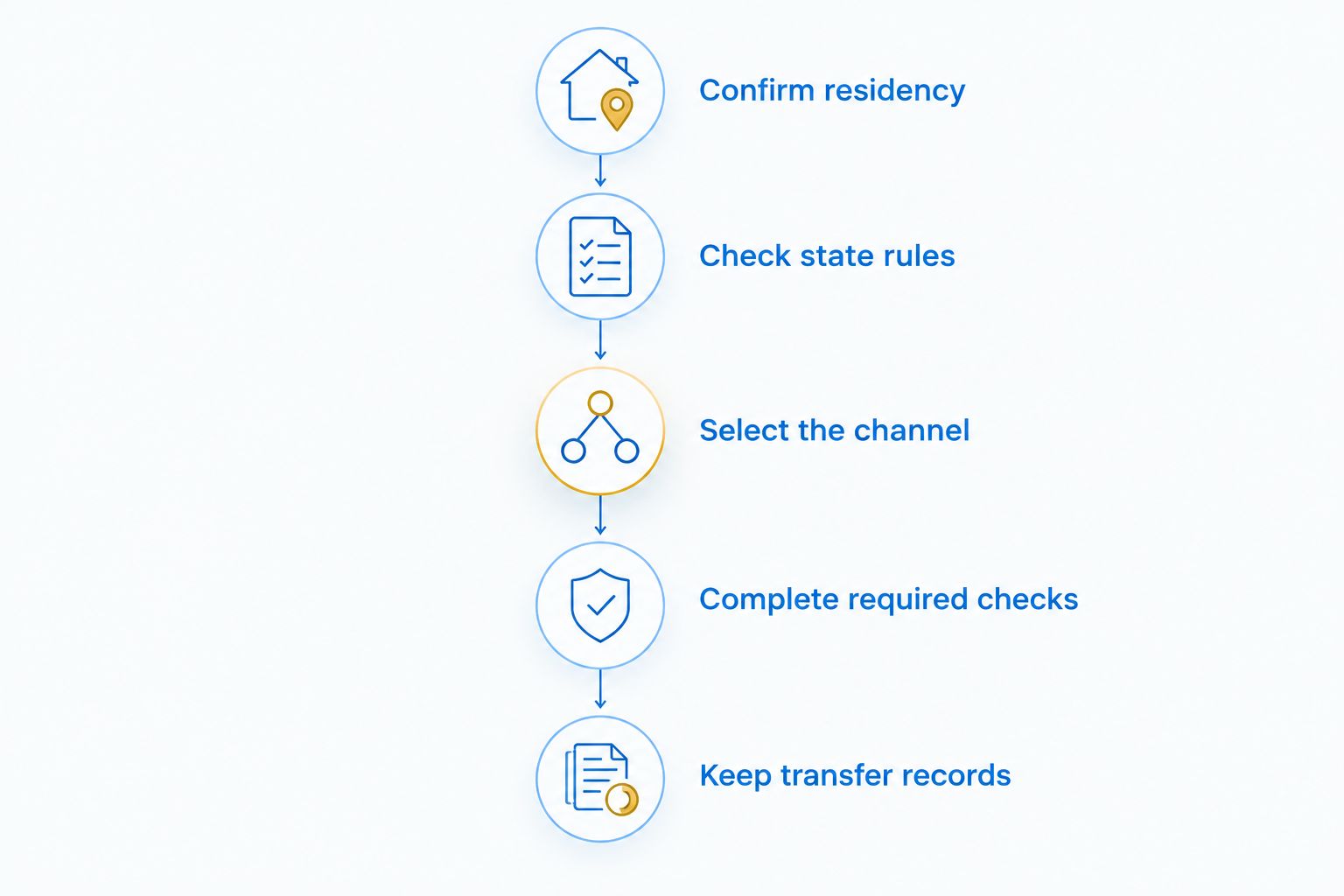
This sequence also tells you when to stop. If you cannot identify the authorized route or the conditions for release, resolve that question before continuing. A completed bill of sale does not settle it.
Check your private transfer options
Review Guntransfer's private-sale compliance service and its stated coverage across 37 states.
What does not replace a firearm background check?
A general background-search report is not the required firearm eligibility check. Public-record searches, identity checks, and ordinary consumer screening services serve different purposes and do not replace an authorized firearm-transfer process.
A bill of sale is also not a background check. It records the transaction details, but it does not establish that the buyer is legally eligible or that the sale followed every applicable requirement.
A carry permit is not a universal exemption. Certain qualifying permits can affect federal dealer-check requirements under specific conditions, but you must confirm the actual exemption and the applicable state rules. Do not infer an exemption from the fact that someone holds a permit.
Finally, a seller's confidence in the buyer is not a compliance process. Knowing someone personally does not remove legal restrictions on prohibited recipients or any mandatory transfer procedures.
How the options are ranked
The ranking puts legal fit first, authorized participation second, and useful documentation third. Coverage and outcome handling then determine whether a route fits the particular sale.
An FFL ranks first because dealer participation is mandatory for important categories of transactions, including ordinary interstate private sales. The online service ranks separately for its stated private-sale compliance and recordkeeping role. A state-authorized channel takes priority whenever state law prescribes it, regardless of its position in this list.
This is a role-based buying guide, not a claim that every option was tested or that one provider suits every state. For a 2026 transfer, the governing rules decide the route; the service decision follows.
Which background-check option should you choose?
If you are undecided, start by confirming the transfer requirements with an FFL that handles private sales. Explain the actual transaction rather than asking only whether the dealer runs background checks. Residency, firearm category, and state rules determine what must happen.
Choose the online compliance service when its supported process fits your sale and you need its documentation functions. Use the prescribed state channel when local law requires it. These choices can work together; they are not always alternatives.
The wrong decision is selecting a generic search or paperwork-only solution and assuming the legal check is covered. Choose the authorized route first, then organize the records around it.
FAQ
What's the best option for background checks for gun purchases in a private sale?
An FFL is the default choice when the private sale requires licensed-dealer participation. Check residency, firearm category, and state requirements before selecting the transfer route.
Can I run a NICS check myself as a private seller?
A private seller cannot access NICS as a general public background-search service. Use the licensed dealer or other authorized process applicable to the transaction.
Is Guntransfer better than using an FFL?
Guntransfer and an FFL serve different roles, so neither automatically replaces the other. Guntransfer provides private-sale compliance services and records across 37 states; an FFL supplies required licensed-dealer participation.
Does a bill of sale replace a firearm background check?
No, a bill of sale does not replace a legally required firearm background check. It records transaction details and must accompany, rather than substitute for, the applicable compliance process.
Can I sell a firearm directly to someone who lives in another state?
Federal law generally requires an interstate private firearm sale to go through a licensed dealer, subject to specific exceptions. Confirm the lawful route before delivery, because handgun and long-gun transfer rules differ.
Does a concealed carry permit mean no background check is needed?
A concealed carry permit is not an automatic exemption from every background-check requirement. Certain qualifying permits support specific exemptions, but the dealer and applicable state rules determine whether an exemption applies.
Can I complete the sale while the background check is delayed?
A delayed check is not approval to complete the transfer. Follow the participating dealer's instructions and the applicable federal and state release requirements rather than setting your own handoff deadline.
One last thing
Ask one question before arranging the handoff: Who is authorized to release this firearm to this buyer, and what must happen first? That question separates a lawful transfer process from a pile of completed forms. For your 2026 sale, get the answer before the firearm changes hands.