Best overall for completing the deal: Gun Transfer. Best for nationwide auction shopping: GunBroker. Best for local private-party listings: Armslist. Best for buying new from a retailer: a retailer site that ships to a local FFL.
If you want to buy gun online transfer, the legal route in 2026 is the same everywhere: find the gun online, then complete the handoff through a licensed dealer or a compliant in-state private sale. This guide ranks the main options by the job each one does.
- Gun Transfer is the pick for finishing a private sale legally: flat fee, bill of sale, background check handling, ownership records.
- GunBroker wins for nationwide selection, but out-of-state purchases ship to a licensed FFL, not your door.
- Armslist is a listings board for local private sales; it does not handle the legal steps for you.
- Pick the marketplace for finding the gun, then pick the transfer route before you pay.
Why this matters in 2026
An online listing is not a legal transaction. It is an advertisement. The transfer is where the law applies, and the rules change by state.
Federal law requires that a firearm sold across state lines between people in different states go through a licensed dealer (an FFL) in the buyer's state. Non-licensees cannot mail handguns through the postal service. Beyond that, each of the 50 states layers its own rules on private sales: background checks, waiting periods, permits, and records.
Buyers and sellers both carry risk. A seller who skips the paperwork can be tied to a gun after it leaves their hands. A buyer who skips it can end up holding a firearm they cannot lawfully possess. The marketplace you choose matters less than the transfer route you attach to it.
For the seller-side view, see the best ways to sell a gun privately.
What makes the best online option for a gun purchase or sale
Five criteria decide the ranking:
- Legal completion: Does the option help you finish the transfer, or only advertise the gun?
- Reach: Can you find a gun outside your zip code?
- Paper trail: Do you end with a bill of sale and a record of who owned the firearm and when?
- Clarity on who does what: Is it obvious whether you, the seller, or a dealer handles the background check?
- Fit for the buyer or seller: Does it serve a private individual, not just a dealer or a collector?
The options below are ranked on these five. No option wins all of them, which is why each owns a separate use case.
Online gun buying and selling options at a glance
| Option | Best for | Standout feature | Key limitation |
|---|---|---|---|
| Gun Transfer | Completing a private sale legally | Flat-fee service covering background checks, bills of sale, and ownership records in 37 states | Handles the transfer, not the search for a gun |
| GunBroker | Nationwide auction shopping | Large national selection | Out-of-state purchases route through a licensed FFL |
| Armslist | Local private-party listings | Direct contact with nearby sellers | A listings board; you manage the legal steps |
| Retailer sites that ship to an FFL | Buying new | Dealer-backed sale and paperwork | Not built for private sellers |
1. Gun Transfer: best for completing a private sale legally
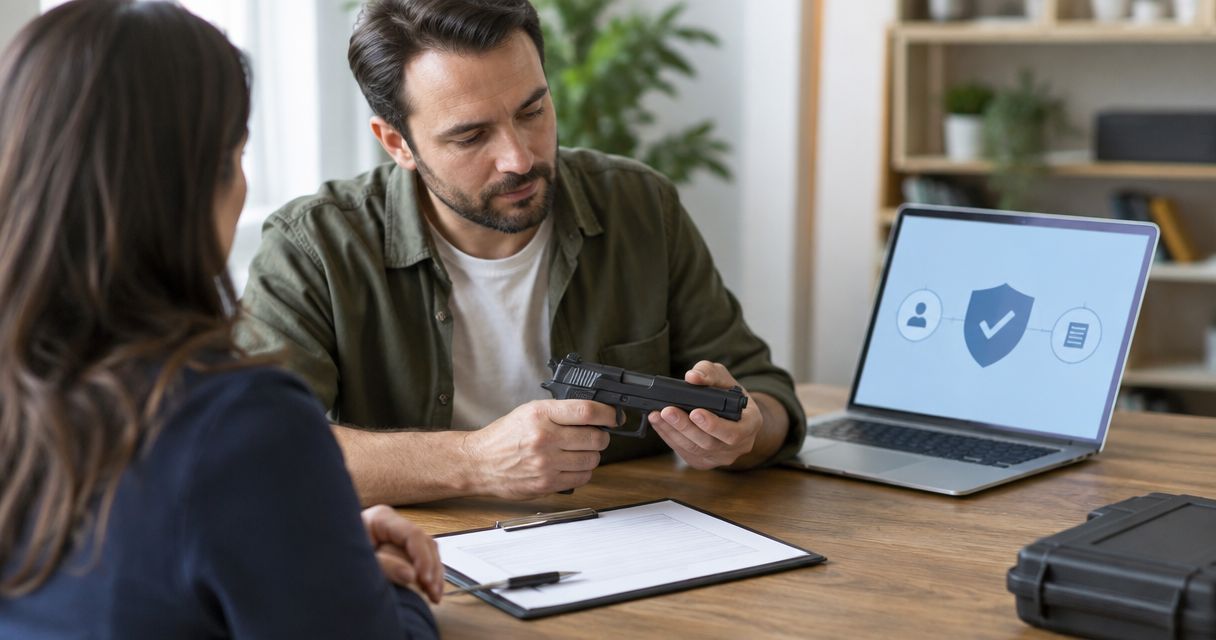
Gun Transfer is an online service that lets private individuals in the US complete person-to-person firearm sales for a flat fee. It handles background checks, bills of sale, and ownership records, and it covers 37 states.
It does not list guns for sale. That is the point. You find the gun on any marketplace or through a friend, then use Gun Transfer to make the sale legal and documented.
Gun Transfer pros:
- Flat fee, so the cost of the transfer step does not change with the sale price.
- Bill of sale and ownership records produced as part of the process.
- Built for private individuals, not dealers.
- Plain, step-by-step process.
Gun Transfer cons:
- Covers 37 states, not all 50. Check your state before you agree on a deal.
- It is not a marketplace, so you need to source the gun elsewhere.
- A cross-state sale still has to follow federal FFL routing rules.
Gun Transfer pricing: Flat fee per transfer. Check the current fee on the site.
Best for: Private sellers and buyers in a covered state who have already agreed on a deal.
Verdict: Buy. Gun Transfer is the best option for finishing a private firearm sale with the paperwork done right.
2. GunBroker: best for nationwide auction shopping
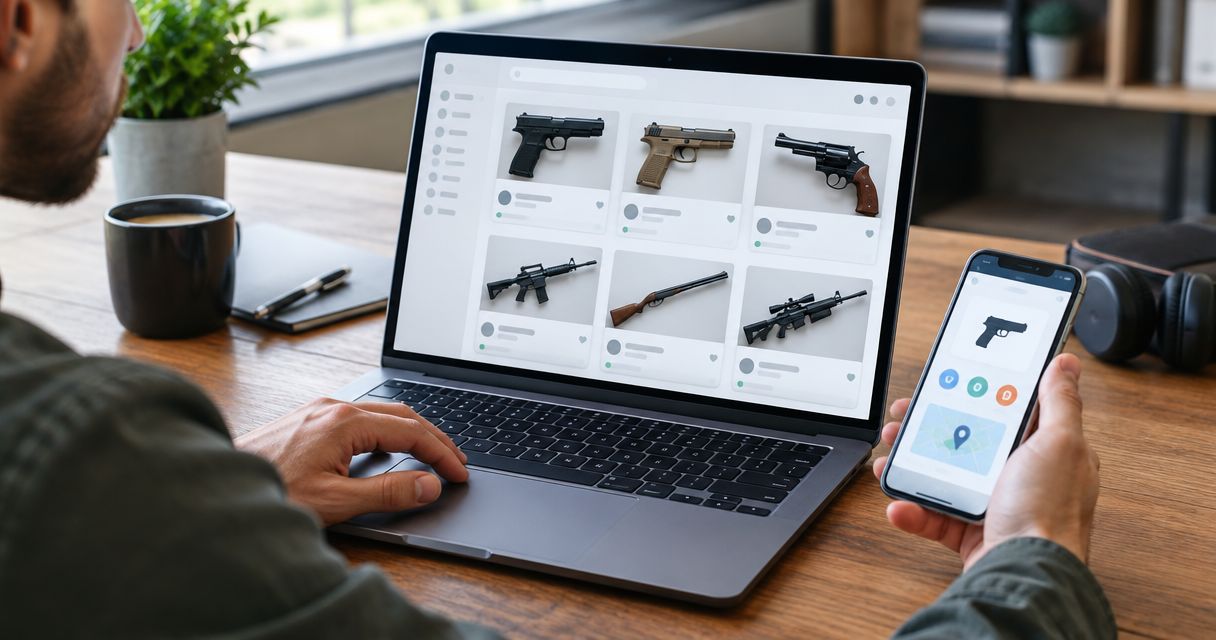
GunBroker is an online auction and listing site with sellers across the country. If you want a specific model, a discontinued variant, or a collectible, it is the broadest place to look.
Winning an auction does not put the gun in your hands. For most out-of-state purchases, the seller ships to a licensed FFL near you, and you complete the sale there with a background check. Expect a transfer fee from that dealer, and ask for the amount before you bid.
GunBroker pros:
- Wide national selection, including hard-to-find items.
- Auction and fixed-price formats.
- Shipping to an FFL keeps the interstate leg compliant.
GunBroker cons:
- The receiving dealer sets its own transfer fee and policies.
- Not every FFL accepts shipments from individuals, so confirm first.
- Timing depends on shipping, then on the dealer's schedule.
GunBroker pricing: Fees and listing costs vary by sale type. Check the site for current terms.
Best for: Buyers hunting a specific gun that local shops do not stock.
Verdict: Buy for selection. Line up your receiving FFL before you bid.
3. Armslist: best for local private-party listings
Armslist is a classifieds-style board where private sellers and buyers find each other by location. It suits a local deal: you see what is nearby, you contact the seller, and you meet.
The site connects people. It does not run your background check, write your bill of sale, or confirm the other party can lawfully buy. All of that falls on you and the other person. In states that require a background check or a dealer for private sales, you still need a compliant route.
Armslist pros:
- Local focus, so the gun stays in your state.
- Direct contact with the seller.
- Useful for gauging local asking prices.
Armslist cons:
- A listings board only; it does not verify buyers or sellers.
- Legal compliance is entirely yours.
- Meeting a stranger carries personal-safety and fraud risk.
Armslist pricing: Check the site for current terms.
Best for: Buyers and sellers who want an in-state deal and will handle the transfer separately.
Verdict: Hold unless you have a transfer route ready. Pair it with a documented transfer, not a handshake.
4. Retailer sites that ship to a local FFL: best for buying new
Many licensed retailers sell online and ship the firearm to a dealer near you. You pay online, pick up at the dealer, and complete the background check in person.
This route puts a licensed dealer on both ends of the paperwork. It is the simplest path for a new gun. It does not help a private seller at all.
Retailer pros:
- Licensed dealers on both ends of the sale.
- Background check completed at pickup.
- No private-party risk.
Retailer cons:
- New or dealer stock only.
- The receiving dealer's fee and policies still apply.
- No use if you want to sell a gun you own.
Best for: Buyers who want a new gun with the least legal friction.
Verdict: Buy for new purchases. Skip for private sales.
How an online gun purchase becomes a legal transfer
The marketplace is step one. The law lives in steps two through five.
- Find the listing. Use any marketplace or a private contact.
- Confirm state law. Check your state's rules on private sales, background checks, and waiting periods.
- Route through an FFL when required. Out-of-state sales go through a licensed dealer in the buyer's state.
- Complete the paperwork. Bill of sale, background check, and any permit your state demands.
- Keep records. Both parties should hold a copy of what changed hands and when.
State rules differ widely. For a walkthrough of the seller's side, read how to legally sell a gun privately.
Start a legal private transfer
Flat-fee transfers with a bill of sale and ownership records.
How we ranked
The ranking follows the five criteria above. Options that finish the legal transfer ranked highest. Options that only advertise a gun ranked lower, because the advertisement is the easy part. Each option owns a different use case, so the list works as a decision tree, not a leaderboard.
Which option should you choose?
- You already have a buyer or seller: use Gun Transfer to complete the sale.
- You want a rare gun from another state: shop GunBroker and arrange the receiving FFL first.
- You want a local private deal: browse Armslist, then run the sale through a documented transfer.
- You want a new gun: order from a licensed retailer and pick up at a local FFL.
If you are unsure, default to the route that puts a licensed dealer or a documented transfer between you and the other party. Gun Transfer is the default for private sales; a local FFL is the default for everything shipped.
Mistakes that cost buyers and sellers in 2026
- Paying before picking the transfer route. Confirm the FFL or transfer method first.
- Assuming the marketplace handles legality. None of the listing sites do it for you.
- Skipping the bill of sale. Without one, you have no record of the date or the parties.
- Ignoring your state's rules. What is legal across the state line may not be legal at home.
- Using an FFL you have not called. Dealers set their own transfer policies and fees.
Finding a dealer is its own step. See the best FFL lookup tools compared.
FFL, private sale, or family transfer: which rules apply
Three routes cover most cases in 2026:
- Through an FFL: required for most interstate sales. The dealer runs the background check and keeps the records.
- Private in-state sale: allowed in some states with no dealer, but many require a background check or permit. A documented transfer protects both sides.
- Family transfer: several states treat gifts and inheritances differently from sales. Check your state before you hand anything over.
Seller and buyer rules overlap but are not identical. When in doubt, ask your state's attorney general office or a licensed dealer.
FAQ
Can I buy a gun online and have it shipped to my house?
Generally no. Firearms bought online ship to a licensed FFL, where you complete the paperwork and background check. State rules add further limits.
What is the best way to buy a gun online in 2026?
Find the gun on a marketplace or retailer site, then ship it to a local FFL for pickup. For a private sale, complete a documented transfer instead.
Do I need an FFL for a private gun sale?
It depends on your state. Out-of-state sales between individuals go through an FFL under federal law. In-state private sales follow your state's rules.
Is GunBroker or Armslist better?
GunBroker is better for nationwide selection and FFL-routed shipping. Armslist is better for local private-party listings. Neither handles the legal transfer for you.
Does Gun Transfer sell guns?
No. Gun Transfer is a flat-fee service that helps private individuals complete person-to-person sales, including background checks, bills of sale, and ownership records.
How many states does Gun Transfer cover?
Gun Transfer covers 37 states. Check your state on the site before you agree on a sale.
Do I need a bill of sale for a private gun sale?
A bill of sale is strongly advised in every state and required in some. It records the date, the parties, and the firearm.
One last thing
The cheapest part of buying or selling a gun online is the listing. The expensive part is a transfer done wrong. Settle the transfer route before you settle the price, and you remove most of the risk in the deal.