Best overall: executor-led estate distribution. Best when dealer processing is required: a licensed firearm dealer. Best for a confirmed interstate inheritance exception: direct bequest or intestate succession. Best for a later private sale: Guntransfer. This guide explains how to transfer an inherited gun in 2026 without confusing inheritance, estate administration, and a subsequent sale.
- How to transfer an inherited gun starts with estate authority, recipient eligibility, and applicable state law.
- Executor-led distribution is the default when ownership or estate authority remains unresolved.
- A licensed firearm dealer is best when applicable law requires dealer processing or a background check.
- Federal law recognizes an interstate exception for qualifying bequests and intestate succession, not every family transfer.
- Guntransfer is best for documenting a later private firearm sale within its stated service scope.
Why this matters
An inherited firearm creates separate questions: who has authority to distribute it, and who can legally receive it? A will answers neither question completely. Probate requirements, recipient eligibility, and firearm laws still apply.
For a 2026 inheritance, distinguish the original estate distribution from anything the beneficiary does afterward. Receiving a firearm under a qualifying inheritance exception does not make a later sale, gift, or shipment exempt from ordinary transfer rules.
Settle the legal route before moving the firearm. Possession, estate ownership, and permission to transfer are different issues.
What makes the best inherited firearm transfer route
Choose the route against these criteria, rather than choosing the fastest handoff:
- Estate authority: The person releasing the firearm must have authority to act for the estate or otherwise transfer it.
- Recipient eligibility: An inheritance does not override federal or state prohibitions on firearm possession.
- State compliance: Check the rules governing the transfer, including permits, dealer processing, and any inheritance-specific provisions.
- Interstate treatment: Determine whether the transaction is a qualifying bequest or intestate succession, rather than an ordinary gift or sale.
- Firearm classification: National Firearms Act firearms require a separate federal transfer analysis.
- Record quality: Keep estate documents and any required firearm transfer records together.
The United States has 50 states, and a federal exception is not a substitute for checking applicable state law. The best route is the one that fits your actual transaction, not the one with the fewest forms.
Inherited firearm transfer routes at a glance
| Route | Best for | Standout feature | Key limitation |
|---|---|---|---|
| Executor-led estate distribution | Unresolved estate authority or beneficiary entitlement | Connects the firearm transfer to the estate's legal distribution | Estate authority does not replace firearm-law compliance |
| Licensed firearm dealer | Transfers requiring dealer processing | Provides the federally licensed channel for applicable transfer procedures | Dealer processing does not resolve disputed ownership |
| Direct bequest or intestate succession | Confirmed qualifying interstate inheritances | Federal law recognizes a specific inheritance exception | Not a general exemption for relatives, gifts, or estate purchases |
| Guntransfer private-sale service | A beneficiary's later person-to-person sale | Handles background checks, bills of sale, and ownership records | Its stated private-sale scope does not establish an estate or NFA transfer service |
These are legal routes and administrative services, not interchangeable products. Several can form part of the same transaction: an executor can authorize distribution, while a dealer handles the required firearm transfer.
1. Executor-led distribution: best for unresolved estate authority
Executor-led distribution starts with the estate rather than the firearm handoff. The executor or other authorized personal representative establishes who is entitled to receive the firearm and whether the estate can distribute it.
Best for: A firearm still held by the estate, an unclear beneficiary designation, or an unresolved ownership question.
A named beneficiary should not assume that being named in a will permits immediate removal of the firearm. Confirm the representative's authority and the estate's distribution requirements before taking possession. When entitlement is disputed, resolve that dispute through the estate process rather than through a private transfer form.
Executor-led distribution pros
- Establishes the authority behind the transfer.
- Keeps beneficiary entitlement connected to estate administration.
- Creates a clear distinction between inheritance and a later transaction.
Executor-led distribution cons
- Does not replace required firearm permits or background checks.
- Cannot resolve recipient ineligibility merely by naming a beneficiary.
- Requires separate attention to interstate and NFA rules.
For your 2026 file, retain the documents establishing authority and entitlement alongside the firearm's identifying information. A sale receipt is not a substitute for those estate records.
Verdict: Use executor-led distribution as the default when estate authority or entitlement is unresolved. Establish the legal right to distribute before selecting the firearm transfer channel.
2. Licensed firearm dealer: best for required transfer processing
A Federal Firearms Licensee, commonly called an FFL, is the licensed dealer route. Use this route when applicable law requires dealer involvement or when the transaction is an ordinary interstate transfer rather than a qualifying inheritance exception.
Best for: Inherited firearm transfers requiring dealer processing, or a subsequent transaction governed by ordinary dealer-transfer rules.
Dealer involvement separates estate authorization from firearm delivery. Explain that the firearm comes from an estate, identify the recipient's state of residence, and ask which documents and procedures apply before bringing or shipping the firearm.
Licensed firearm dealer pros
- Provides a licensed channel for required transfer processing.
- Applies the relevant dealer paperwork and background-check procedures.
- Helps distinguish an inheritance transfer from an ordinary sale.
Licensed firearm dealer cons
- Does not decide which beneficiary owns estate property.
- Does not override possession prohibitions or state restrictions.
- Requires confirmation that the dealer handles the particular transaction.
Do not treat a dealer's willingness to receive a firearm as proof that the estate has authorized its distribution. Those are separate approvals. Likewise, do not ship first and ask about the dealer's requirements afterward.
Verdict: Use an FFL when dealer processing is required. Confirm estate authority separately and arrange the dealer's receiving procedure before moving the firearm.
3. Direct inheritance: best for a confirmed federal exception
Federal law distinguishes a qualifying inheritance from an ordinary interstate transfer. 18 U.S.C. § 922(a)(3) and § 922(a)(5) contain exceptions addressing firearms acquired or transferred through a bequest or intestate succession, subject to the statutory conditions.
Best for: A documented bequest or intestate succession where the recipient is eligible and applicable state law permits the transfer route.
A bequest generally means property left through a will. Intestate succession means inheritance under the applicable succession law when there is no controlling will. Neither term means any transfer between relatives.
Direct inheritance pros
- Recognizes the federal distinction between inheritance and ordinary transfers.
- Provides a route for qualifying interstate inheritances without assuming every interstate transaction is identical.
- Keeps the transfer tied to the beneficiary's actual inheritance entitlement.
Direct inheritance cons
- Requires facts supporting a genuine bequest or intestate succession.
- Does not eliminate applicable state requirements.
- Does not remove NFA transfer requirements or recipient eligibility restrictions.
For a 2026 transfer, verify the exception against the actual estate documents and state rules. Buying a firearm from an estate is not the same transaction as inheriting it. Nor does a beneficiary's later gift to another relative automatically retain the original inheritance treatment.
Verdict: Use direct inheritance only after confirming the exception and all other applicable requirements. Do not use family relationship alone as the legal basis.
4. Guntransfer: best for a later private firearm sale
Guntransfer provides an online private firearm transfer compliance service for person-to-person sales across 37 states. Its stated scope includes background checks, bills of sale, and ownership records.
Best for: A beneficiary who has completed the inheritance process and then wants to sell the firearm privately within the service's supported scope.
Guntransfer is best for private firearm transfer documentation after an inheritance, not for deciding who inherits the firearm. Establish ownership and your authority to sell before beginning a separate transaction.
Guntransfer private-sale service pros
- Addresses the later person-to-person sale rather than estate entitlement.
- Handles background checks as part of its stated service.
- Includes bills of sale and ownership records in its stated scope.
Guntransfer private-sale service cons
- Its stated coverage is not nationwide.
- Its stated service description does not establish probate representation.
- Its stated private-sale scope does not establish NFA transfer handling or an exemption from dealer requirements.
Confirm that your transaction falls within the service's coverage and the applicable legal route. A private-sale service does not turn an interstate sale into a qualifying inheritance, and a bill of sale cannot cure an unlawful transfer.
Verdict: Use the private-sale service for an eligible later sale, not as a substitute for estate distribution. Keep the inheritance file and subsequent sale records distinct.
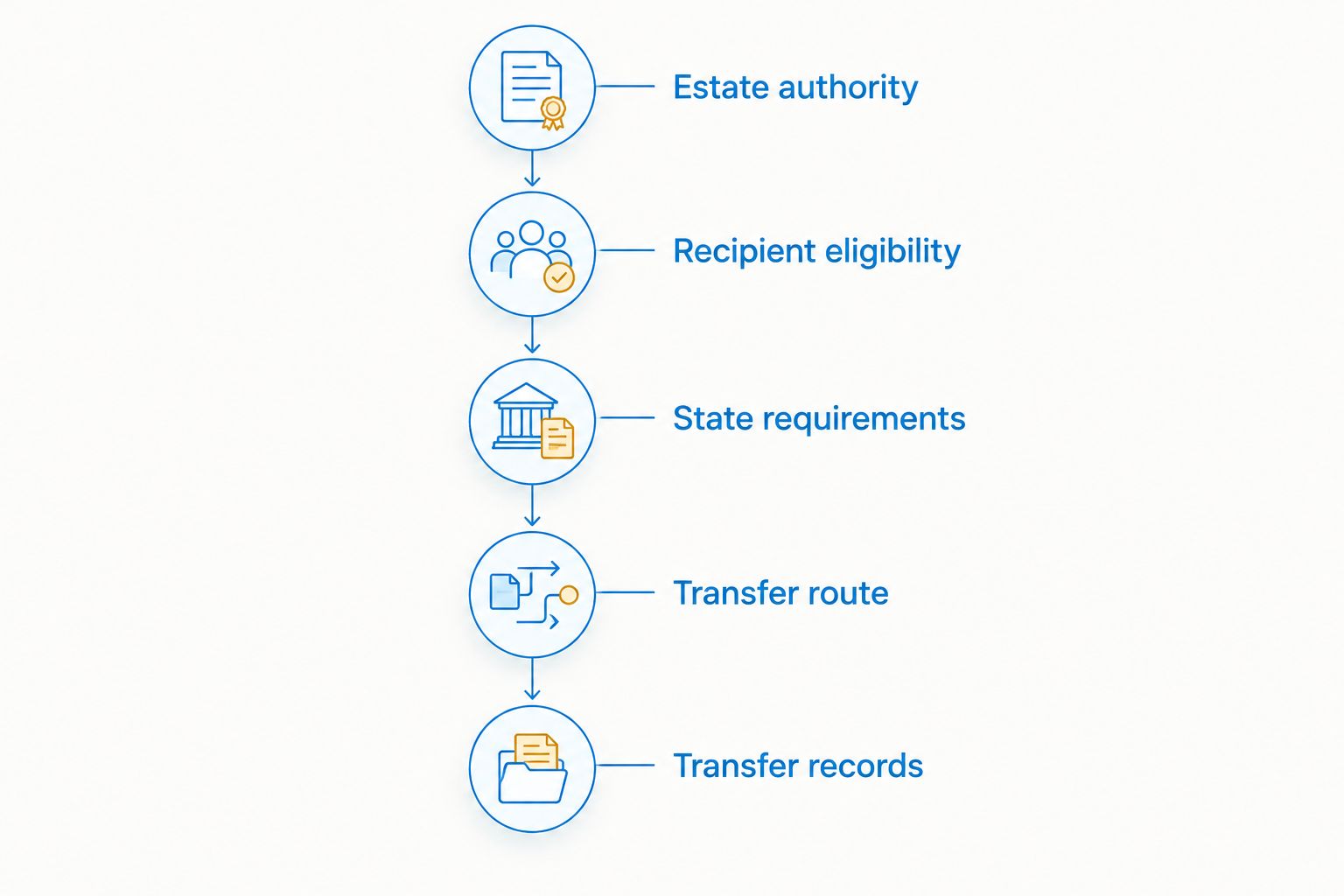
How to transfer an inherited gun: the decision sequence
Follow this sequence before arranging delivery. Each checkpoint answers a different legal question; passing one does not settle the others.
Estate authority
Identify the executor or authorized representative and confirm who is entitled to the firearm. Determine whether the transaction is distribution to a beneficiary, sale by the estate, or a later transfer by someone who already inherited it.
Recipient eligibility
Confirm that the intended recipient can lawfully possess the firearm. A will does not override prohibited-person rules. Stop the transfer if eligibility is unresolved and obtain qualified legal guidance.
State requirements
Check the applicable rules for the estate's location, the recipient's residence, and the transaction. Identify required permits, dealer involvement, reporting obligations, or applicable inheritance provisions before selecting the route.
Transfer route
Choose estate distribution with required dealer processing, a confirmed qualifying direct inheritance, or a separate later sale. For an NFA firearm, address the federal approval process separately before delivery.
Transfer records
Keep the estate authority documents, firearm identification, and required transfer records together. Record what actually happened: inheritance, estate sale, or later sale. Do not label every transaction as a gift.
NFA firearms need a separate transfer review
An inherited firearm regulated under the National Firearms Act requires more than the ordinary inheritance analysis. Examples include registered machine guns, silencers, short-barreled rifles, and short-barreled shotguns.
ATF Form 5 (5320.5) is the application used for qualifying tax-exempt transfers, including certain transfers to lawful heirs. The estate must address the firearm's registration and applicable approval requirements; the ordinary federal interstate inheritance exception does not replace that process.
For a 2026 estate, identify an NFA firearm before anyone distributes it. Consult ATF's estate guidance and qualified counsel when registration or lawful possession is uncertain. Do not assume an unregistered NFA firearm can be made transferable simply by placing it in a will.
How these routes are ranked
The ranking prioritizes legal fit: estate authority first, required processing second, a confirmed inheritance exception third, and a later private sale as a separate use case. It does not rank providers by speed or claim that one route works for every estate.
The best route changes when the transaction changes. An executor's distribution, an estate's sale, and a beneficiary's later gift require their own analysis.
Which inherited firearm transfer route should you choose?
Choose executor-led distribution if you are unsure where to start. Establish the estate's authority and your entitlement, then determine whether dealer processing or a specific inheritance exception applies.
Use an FFL when the law requires that channel. Use direct inheritance only when its conditions are confirmed. Treat any later sale as a new transaction, with its own eligibility, state-law, documentation, and interstate requirements.
FAQ
What's the best way to transfer an inherited gun in 2026?
Start with the estate's authorized representative, then confirm recipient eligibility and applicable firearm laws. Use a licensed dealer when required; use a direct inheritance route only when the relevant exception and state requirements are satisfied.
Can I inherit a gun from someone in another state?
Federal law recognizes an exception for qualifying bequests and intestate succession. The recipient must still be eligible, and applicable state laws and any NFA requirements remain relevant.
Does inheriting a firearm always require a background check?
No single background-check rule covers every inheritance. Requirements depend on applicable state law, whether dealer processing is involved, and whether the transaction is actually an inheritance rather than a sale or gift.
Can I give an inherited gun to another family member?
A later family gift is a separate transfer, not automatically part of the original inheritance exception. Check recipient eligibility, state requirements, and ordinary interstate transfer rules before handing it over.
Is a bill of sale enough to transfer an inherited firearm?
No, a bill of sale does not establish estate authority or replace required legal procedures. Keep the inheritance documents and any required transfer records; use sale documentation only when the transaction is a sale.
Can an online private-sale service handle the entire estate transfer?
A private-sale service is not a substitute for establishing estate authority and beneficiary entitlement. Its suitability depends on the actual transaction and its stated service scope, especially when dealer processing or NFA approval is involved.
What happens if I inherit a registered NFA firearm?
A registered NFA firearm requires a separate federal transfer review. ATF Form 5 is used for qualifying tax-exempt transfers to lawful heirs, and applicable approval requirements must be satisfied before distribution.
One last thing
The firearm does not carry its inheritance exception into every later transaction. Once a beneficiary decides to sell or give it away, analyze that transfer on its own terms. Keep the original inheritance records so the ownership history stays clear.
This guide provides general information, not legal advice. Confirm the applicable requirements before taking possession or arranging delivery.