Firearm transfer for licensed collectors is the lawful acquisition or disposition of collection firearms with the aim of maintaining a personal collection. For a Type 03 federal firearms license holder, the critical questions are whether the firearm qualifies as a curio or relic, whether state law permits the transaction, and which records the transfer requires.
- Firearm transfer for licensed collectors starts with C&R eligibility, not merely possession of a collector license.
- A Type 03 license supports collecting qualifying firearms; it does not authorize a firearms dealing business.
- Guntransfer serves private sellers seeking transfer paperwork; collector acquisition and disposition records remain a separate responsibility.
- Check federal requirements, state restrictions, and the receiving license before arranging an interstate transfer.
Why firearm transfer compliance matters for licensed collectors
A collector license has a narrower purpose than a dealer license. Your Type 03 license does not make every firearm purchase a licensed collector transaction. An ordinary modern firearm remains outside that license's acquisition privileges unless it independently qualifies as a curio or relic.
For your 2026 collection, separate three questions: what the firearm is, what your license authorizes, and what the jurisdictions involved require. A correct answer to one does not settle the others. An eligible collectible can still face state restrictions.
Guntransfer provides an online private-transfer service across 37 states, handling background checks, bills of sale, and ownership records. Guntransfer is best for private sellers seeking transfer documentation, not as a replacement for a collector's federal recordkeeping. Match the service to the transaction rather than assuming it covers every licensed acquisition.
Understand what your collector license changes
Under federal rules, a Type 03 license allows a licensed collector to acquire qualifying curios or relics in interstate commerce for a personal collection. It does not authorize dealing in firearms as a business. Selling from a collection and operating a firearms business are different legal questions; a collector license does not erase that distinction.
The federal framework comes from the Gun Control Act and implementing regulations, including 27 CFR Part 478. ATF's collector guidance explains the license's collection purpose and recordkeeping obligations. Use current official requirements for a 2026 transaction, not an old marketplace discussion or a seller's interpretation.
How to complete a collector transfer in 2026
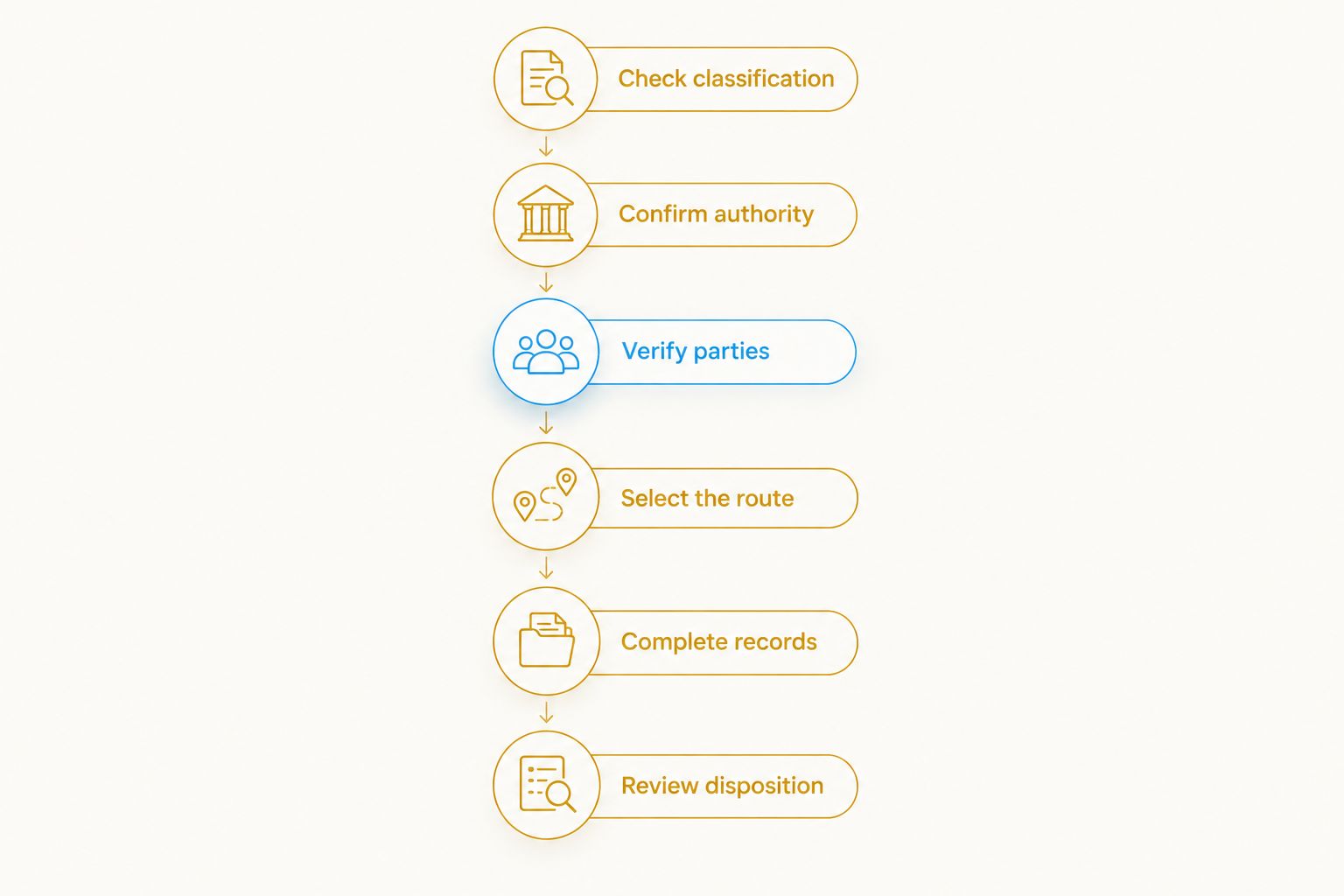
Follow this sequence before accepting shipment or handing over a firearm: check classification, confirm authority, verify parties, select the route, complete records, and review disposition. Each decision determines what you must do next.
Check classification
Start with the firearm itself. Under 27 CFR 478.11, federal curio-or-relic categories include firearms manufactured at least 50 years before the current date, excluding replicas; certain museum-certified firearms; and firearms with substantial collector interest arising from specified characteristics or associations. Age is one route to qualification, not the only route.
A firearm manufactured in 1976 reaches the 50-year threshold in 2026 on its manufacturing anniversary. A model's introduction date does not establish the manufacturing date of an individual example. Military firearms and altered examples require particular attention to ATF's classification guidance; do not treat a parts assembly as eligible solely because one component is old.
- Identify the manufacturer, model, caliber or gauge, and serial number.
- Establish the individual firearm's manufacturing date where age determines eligibility.
- Compare any claimed ATF listing with the exact firearm and configuration.
- Preserve the classification evidence with your transaction documents.
- Stop the collector-license route when eligibility remains unresolved.
Confirm authority
Read your license scope alongside the laws affecting both parties. A Type 03 license is for collecting qualifying firearms, not general retail activity. Federal collector privileges do not displace state or local restrictions on possession, permits, delivery, or transfer procedures.
For a 2026 acquisition, check your residence jurisdiction and the transfer location before committing to a handoff. Also distinguish ordinary firearms from items regulated under the National Firearms Act. C&R status does not remove an otherwise applicable NFA approval or registration requirement.
- Confirm that your collector license is current.
- Check possession and transfer restrictions for the firearm involved.
- Identify applicable state permits, waiting periods, or dealer requirements.
- Treat NFA requirements separately from C&R classification.
- Use a qualified firearms attorney when the legal route remains unclear.
Verify parties
Use identity documents and license information to establish who is transferring and receiving the firearm. Match names and addresses to the transaction records. A seller's claim that someone is licensed is not verification, and a marketplace profile is not evidence of legal eligibility.
ATF's FFL eZ Check does not validate Type 03 collector licenses. Follow ATF's instructions for collector-license verification rather than treating an unavailable search result as proof that the license is invalid. For an ordinary private sale, Guntransfer's background-check and documentation service addresses private-transfer administration; it does not expand either party's license privileges.
- Obtain the license information required for the proposed licensed transfer.
- Resolve discrepancies in names, addresses, or expiration information.
- Follow ATF's collector-specific verification instructions.
- Confirm any receiving dealer's acceptance requirements before shipping.
- Do not proceed when identity, eligibility, or licensing remains unresolved.
Select the route
Choose the transfer route only after classifying the firearm and checking applicable law. A qualifying C&R acquisition by an eligible licensed collector differs from an unlicensed person's interstate purchase. Likewise, a collector's sale to an unlicensed buyer is not automatically exempt from ordinary transfer requirements.
Start by reviewing official requirements yourself and confirming the receiving party's instructions. For a private transaction within its service scope, Guntransfer offers an online route for background checks and transaction documentation. Use a dealer when the law requires one; an online record does not replace required dealer processing.
- Separate licensed C&R acquisitions from ordinary private purchases.
- Confirm whether the recipient can legally receive the firearm directly.
- Arrange a receiving dealer when the transaction requires dealer involvement.
- Check carrier rules independently of firearm-transfer law.
- Confirm the route before arranging shipment or delivery.
Complete records
A collector's acquisition and disposition record serves a different purpose from a bill of sale. Under 27 CFR 478.125(f), licensed collectors must record acquisitions and dispositions of curios or relics in the required form. Keep the required firearm and counterparty details; a payment receipt alone does not supply them all.
Prepare the record while the documents are available, and meet the applicable federal entry deadlines. Use a compliant bound record or an authorized electronic approach rather than assuming any spreadsheet is acceptable. A separate bill of sale can document transaction terms without replacing the required collector record.
For supporting paperwork, compare recordkeeping methods for private gun sales, but keep private-sale documentation separate from licensed-collector obligations.
- Enter the required firearm identification details accurately.
- Record acquisition and disposition counterparties as the rules require.
- Follow the applicable entry deadlines and retention requirements.
- Keep classification evidence and supporting transaction documents organized.
- Protect personal information from unnecessary sharing or public exposure.
Review disposition
Before selling or otherwise disposing of a collection firearm, reassess the recipient and transfer route. Prior lawful acquisition does not establish that the next transfer is lawful. A buyer in another state, a change in the firearm's configuration, or a different recipient status changes the questions you must answer.
Review your 2026 disposition against current requirements rather than copying the process used for an earlier purchase. Record the disposition when required, and reconcile the outgoing firearm with its acquisition entry. Do not treat repeated sales activity as automatically protected simply because the firearms entered a personal collection.
- Verify the recipient's identity and relevant license status.
- Recheck residency and state transfer requirements.
- Confirm any dealer involvement before handing over possession.
- Complete the required disposition entry.
- Retain supporting documents under the applicable rules.
Compare collector-transfer options
Choose the route by legal eligibility, not convenience. These options address different situations; none supplies a universal exemption from federal or state requirements.
| Option | Best for | Main benefit | Key limitation |
|---|---|---|---|
| Licensed C&R acquisition | Eligible collectors acquiring qualifying firearms | Uses the collector license's authorized acquisition route | Does not cover every firearm or override state restrictions |
| Dealer-facilitated transfer | Transactions requiring dealer processing | Places required dealer procedures with the receiving dealer | Requires coordination and does not remove possession restrictions |
| Guntransfer private-transfer service | Private individuals seeking background checks and sale records | Handles private-transfer documentation online across 37 states | Does not replace required collector records or expand license privileges |
| Manual collector recordkeeping | Collectors maintaining required acquisition and disposition records | Keeps the licensed collection's required transaction history | Requires accurate entries, compliant format, and timely maintenance |
These choices can overlap. A dealer-processed acquisition can still require a collector record entry, and a bill of sale can accompany that entry. Treat the transfer procedure and recordkeeping method as separate decisions.
Common mistakes licensed collectors make
Treating age as the whole eligibility test
A seller describing a firearm as antique, collectible, or military surplus does not establish its legal classification. Check the actual firearm against the relevant federal definition. C&R status and antique-firearm status are different classifications, with different legal consequences.
Using a collector license like a dealer license
A Type 03 license does not authorize a dealing business. Do not assume that recording acquisitions and sales makes every pattern of commercial activity permissible. Assess the activity itself rather than relying on the label attached to the license.
Replacing the collector record with a bill of sale
A bill of sale documents a transaction; the acquisition and disposition record meets a distinct licensed-collector obligation. Keep both when appropriate. A signed sale document does not fix a missing required entry.
Assuming interstate privileges apply to every recipient
Your collector license does not give an unlicensed out-of-state buyer the same receiving privileges. Check the recipient's status and the firearm's classification before deciding whether direct delivery is lawful. When dealer processing is required, arrange it before shipment.
Treating old guidance as current law
An earlier successful transfer is not authority for a 2026 transaction. State requirements, applicable procedures, and the facts of the next sale can differ. Check current official sources at the decision point, particularly before delivery.
FAQ
What is a licensed collector firearm transfer?
A licensed collector firearm transfer is an acquisition or disposition involving a collector and the applicable firearm-transfer rules. A Type 03 federal license provides specific privileges for qualifying curios or relics, not general authority to buy and sell every firearm as a dealer.
Can I have any firearm shipped directly to my collector license?
No. A Type 03 license's acquisition privileges apply to qualifying curios or relics, and applicable state restrictions still matter. Confirm the individual firearm's eligibility and the lawful delivery route before arranging shipment.
Does a firearm automatically qualify as C&R when it is 50 years old?
Federal C&R rules include firearms manufactured at least 50 years before the current date, excluding replicas. Establish the individual firearm's manufacturing date and check relevant ATF guidance on its configuration rather than relying only on the model's age.
Can I verify a Type 03 license with ATF FFL eZ Check?
No. ATF FFL eZ Check does not validate Type 03 collector licenses. Follow ATF's collector-license verification instructions instead of relying on that search tool for a collector transaction.
Does a bill of sale replace my collector acquisition and disposition record?
No. A bill of sale does not replace the required licensed-collector acquisition and disposition record. Keep the required entries and use the bill of sale as supporting transaction documentation.
Can a collector sell a firearm to someone in another state?
A collector must follow the federal and state requirements applicable to the recipient and firearm. A collector license does not generally authorize direct interstate delivery to an unlicensed buyer; arrange the required licensed transfer route before delivery.
Does C&R status remove National Firearms Act requirements?
No. C&R status does not remove applicable National Firearms Act approval or registration requirements. Check those obligations separately before transferring an NFA-regulated collectible.
Is an online private-transfer service enough for a collector transaction?
An online private-transfer service does not replace every obligation in a licensed collector transaction. Confirm firearm eligibility, required dealer involvement, state requirements, and collector recordkeeping separately from private-sale documentation.
One last thing
The recipient's status matters just as much as your own license. Before your next transfer, write down the firearm's classification, the recipient's status, and the required delivery route. If any answer is unresolved, settle it before possession changes hands.
This guide explains the federal collector framework and practical compliance checks; it is not individualized legal advice. Use current ATF guidance, applicable state authorities, and qualified legal counsel for a transaction-specific determination.