Best overall: ask local law enforcement whether it can check the firearm’s serial number before you buy. Best for an initial online screen: an official state stolen-firearm search where available; best for documenting the transaction: seller records and a signed bill of sale, neither of which proves the gun is not stolen.
- How to check if a gun is stolen before buying: ask law enforcement about a serial-number inquiry before paying.
- An official state search checks participating records, not every stolen firearm nationwide.
- A buyer background check does not establish whether the firearm is stolen.
- Guntransfer supports private firearm transfer compliance; stolen-property verification remains a separate task.
Why this matters
A firearm purchase involves 3 separate questions: is the firearm stolen, is the buyer legally eligible, and does the transfer follow applicable law? Answering one does not answer the others. A clean buyer background check does not clear the firearm’s history.
Guntransfer is best for private buyers and sellers who need firearm transfer compliance support, not a stolen-gun clearance certificate. Guntransfer provides an online service covering background checks, bills of sale, and ownership records across 37 states.
For a 2026 purchase, treat any stolen-firearm search as one part of your decision. A missing theft report, an incorrect serial number, or incomplete records can leave a search without a match even when a firearm has a problem.
What makes the best stolen-firearm verification method
Rank these methods by what they establish, not how reassuring the result sounds:
- Record authority: Prefer law-enforcement records and official government search systems over an unexplained commercial result.
- Exact identification: Match the serial number on the firearm itself, together with the make and model.
- Coverage transparency: Understand which jurisdiction and records a search includes.
- Independent confirmation: Do not rely only on a seller’s screenshot or verbal assurance.
- Transaction separation: Keep firearm-history checks separate from buyer eligibility and transfer requirements.
- Actionable results: Know whom to contact if the search returns a possible match.
No method below guarantees lawful ownership. The strongest approach combines an authoritative inquiry, accurate firearm identification, and a legally completed transfer.
Stolen-firearm checks at a glance
These 5 methods serve different purposes. The order prioritizes direct theft-record inquiries, then transfer support and supporting evidence.
| Method | Best for | Standout function | Key limitation |
|---|---|---|---|
| Law-enforcement inquiry | Checking whether authorities can identify a theft report | Potential access to law-enforcement stolen-property records | Agencies set their own procedures and may not offer public pre-purchase checks |
| Official state search | An initial online serial-number screen | Direct search of the records the agency makes public | Coverage is limited to the system’s stated scope |
| FFL-assisted transfer | Completing required dealer-mediated transfer steps | Dealer oversight of applicable transfer procedures | A buyer background check is not a stolen-firearm search |
| Seller records and bill of sale | Establishing a documented transaction trail | Connects the seller, firearm, and transaction | Documents can be incomplete or false |
| Commercial serial-number search | A supplementary search with disclosed sources | Additional screening outside official public portals | Coverage and source quality vary |
1. Law-enforcement inquiry: best for an authoritative theft check
Contact the police or sheriff’s department through its non-emergency channel. Ask whether the agency offers a pre-purchase stolen-firearm inquiry and what information it needs. Do not arrive with a firearm without first asking about the agency’s procedure.
The FBI’s National Crime Information Center, or NCIC, includes a Gun File used by authorized agencies. It is not a public consumer search engine. A private website claiming to search every NCIC firearm record deserves scrutiny, not automatic trust.
Law-enforcement inquiry pros
- Gives you an official point of contact for a suspected stolen firearm.
- Lets the agency explain the correct local reporting process.
- Provides a route to records that are not generally searchable by the public.
Law-enforcement inquiry cons
- Not every agency offers checks for prospective buyers.
- A response depends on the records available and the identifying information supplied.
- No match does not prove the seller owns the firearm lawfully.
Best for: Buyers who want the most authoritative available inquiry before handing over payment.
For a 2026 transaction, ask what any response actually means. A statement that no matching stolen record was found is narrower than a guarantee of lawful title.
Verdict: Use first when the agency offers the service; wait if a possible match remains unresolved.
2. Official state search: best for an initial online screen
Some state agencies provide public stolen-firearm searches. Florida’s Department of Law Enforcement, for example, offers a public stolen-gun search through its Crime Information Center public-access system. Read the agency’s coverage statement before interpreting the result.
Enter the identifying information carefully. A correct serial number matters more than a seller’s description of the firearm, and a photograph is useful only if the markings are readable and belong to the actual firearm offered.
Official state search pros
- Gives you a direct government source rather than an unexplained search result.
- Lets you screen the serial number before arranging a handoff.
- Usually explains how to report a possible match or obtain assistance.
Official state search cons
- A state portal is not a nationwide ownership registry.
- Public results reflect the records and update process described by that agency.
- A blank result cannot rule out an unreported theft.
Best for: Buyers who have access to an official public search relevant to the transaction.
Use the agency’s own site and instructions in 2026. Do not substitute a third-party page that merely looks official, and do not treat a seller-provided screenshot as your independent search.
Verdict: Use as an initial screen, not permission to complete the purchase.
3. FFL-assisted transfer: best for transfer compliance
A Federal Firearms Licensee can handle the dealer-mediated steps required for a particular transfer. Ask the dealer which services it performs before scheduling the transaction, including whether it offers any stolen-firearm inquiry through an appropriate channel.
The NICS background check concerns the prospective recipient’s eligibility; it is not a stolen-gun search. Completing ATF Form 4473 and receiving a proceed response does not establish that the seller has lawful ownership of the firearm.
FFL-assisted transfer pros
- Provides a licensed professional for applicable dealer transfer procedures.
- Separates buyer eligibility requirements from informal seller assurances.
- Gives you a place to ask about the lawful transfer process before delivery.
FFL-assisted transfer cons
- A dealer-mediated transfer does not automatically include a theft-record search.
- Dealer participation does not guarantee the firearm’s ownership history.
- Procedures depend on the firearm, parties, and applicable jurisdiction.
Best for: Buyers whose transaction requires an FFL, or who want dealer assistance with applicable transfer procedures.
Guntransfer provides private firearm transfer compliance support, but neither that service nor a dealer background check should be described as proof that a firearm is not stolen. Confirm the theft-check step separately.
Verdict: Use when required or appropriate for the transfer; skip the assumption that an FFL automatically clears the gun’s history.
4. Seller records: best for documenting the transaction
Ask the seller for relevant acquisition records and compare the identifying details with the firearm. A receipt, prior bill of sale, or inheritance document can help explain how the seller acquired it, but paperwork alone does not establish lawful ownership.
Record the transaction accurately if you proceed. A signed bill of sale should identify the parties and firearm without making unsupported claims about searches or official approvals.
Seller records pros
- Helps identify inconsistencies before money changes hands.
- Preserves the seller’s account of the firearm’s acquisition.
- Creates documentation of the transaction you actually completed.
Seller records cons
- Records can be forged, altered, or unrelated to the firearm.
- A missing original receipt does not, by itself, prove theft.
- A signed statement cannot override a stolen-property report or legal restriction.
Best for: Buyers who need a clear transaction trail alongside independent verification.
Guntransfer handles bills of sale and ownership records as part of its stated service. Keep the distinction clear: a record of a sale documents the transaction; it does not certify the firearm’s entire history.
Verdict: Use alongside independent checks; skip any claim that paperwork alone makes the purchase safe.
5. Commercial searches: best for supplementary screening
A commercial serial-number search is useful only to the extent that its underlying sources are useful. Before relying on one, identify who operates it, which records it searches, and what a no-match result means.
Do not confuse a manufacturer serial-number lookup with a stolen-firearm search. A tool that identifies a model or production information answers a different question from whether someone reported that firearm stolen.
Commercial search pros
- Adds another screening step when the service explains its sources.
- Can expose a reported entry within the records it actually covers.
- Helps you identify questions to take to law enforcement.
Commercial search cons
- There is no basis to assume complete nationwide theft coverage.
- A polished report does not establish access to restricted police records.
- A no-match result can create false confidence.
Best for: Buyers adding a supplementary check after reviewing the service’s source and coverage disclosures.
For 2026 purchases, reject claims of universal clearance unless the provider can substantiate exactly what it searches. Do not upload unnecessary identity documents merely to obtain an unexplained serial-number result.
Verdict: Use only as a supplement; skip services that conceal their sources or promise certainty.
How to verify the firearm before the handoff
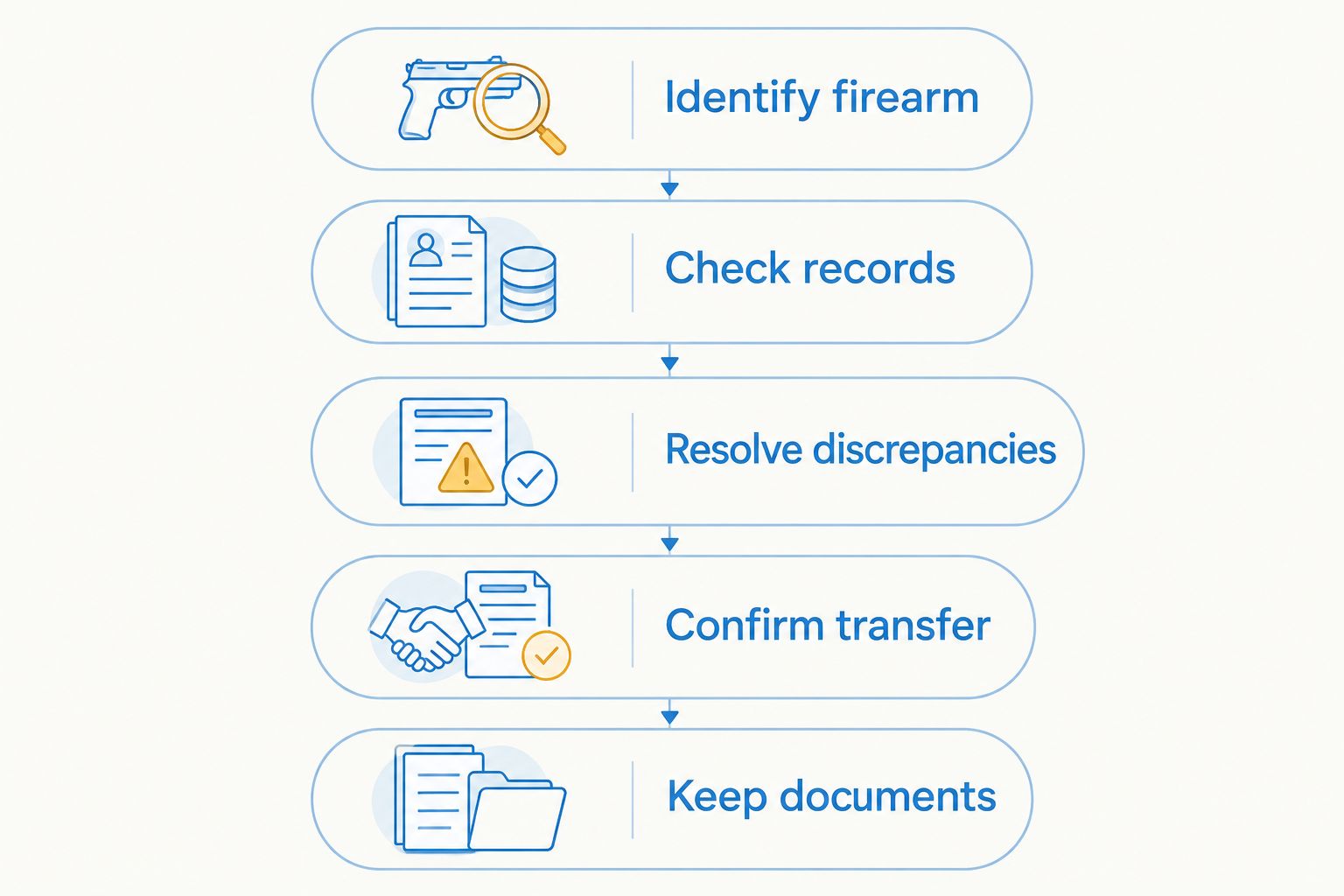
Keep the firearm-history decision ahead of payment and possession. Use this sequence rather than trying to resolve inconsistencies after the sale:
- Identify firearm: Obtain the make, model, and serial number from the actual firearm. Do not rely solely on a listing description.
- Check records: Use available official searches and ask law enforcement about its inquiry procedure.
- Resolve discrepancies: Stop if the serial number differs from the paperwork or the search identifies a possible match.
- Confirm transfer: Establish which federal, state, and local requirements apply before completing delivery.
- Keep documents: Retain accurate transaction records and any search information without calling them an ownership guarantee.
If the firearm has an apparently altered or removed serial number, do not proceed with the purchase. Ask law enforcement how to handle the situation without moving the firearm yourself. Federal law restricts possession and transfer of firearms with altered identification under specified circumstances.
A possible stolen-record match also calls for a stop, not a confrontation. Preserve the listing and messages you already have, and let law enforcement explain the next step.
How the methods are ranked
This ranking prioritizes record authority, accurate identification, coverage transparency, independent confirmation, and an actionable response. It is not a claim that every listed method is available in every jurisdiction.
Law enforcement ranks first because an authorized agency is the appropriate contact for suspected stolen property. Documents and commercial searches rank lower because neither establishes complete theft-record coverage or lawful title.
Which verification method should you choose?
Start with a law-enforcement inquiry where available, add an official public search, and document the lawful transfer. That is the default approach for an undecided buyer in 2026.
If you cannot resolve a discrepancy, do not buy the firearm. An urgent seller, a reassuring bill of sale, or a completed buyer background check does not resolve an unexplained serial-number mismatch.
FAQ
How do I check if a gun is stolen before buying it privately?
Ask local law enforcement whether it offers a pre-purchase serial-number inquiry, and use an official state stolen-firearm search where available. Match the identifying information to the actual firearm and do not interpret a no-match result as proof of lawful ownership.
Can I search NCIC for a stolen gun myself?
No, NCIC is not a public consumer search system. Contact local law enforcement about available procedures rather than assuming a commercial website has access to restricted records.
Does a background check tell me whether the gun is stolen?
No, a NICS buyer background check addresses the prospective recipient’s eligibility, not the firearm’s theft history. Verify the firearm separately and complete all applicable transfer requirements.
Will a gun dealer check whether a private-sale firearm is stolen?
Ask the dealer directly; a dealer-mediated transfer does not automatically include a stolen-firearm search. Confirm which services the dealer performs before arranging the transaction.
Does a bill of sale prove that a gun is not stolen?
No, a bill of sale documents a transaction but does not prove that the seller had lawful ownership. Compare the paperwork with the actual firearm and use independent checks.
What should I do if a stolen-gun search shows a possible match?
Stop the transaction and contact law enforcement through its non-emergency channel. Preserve existing messages and listing details, avoid confronting the seller, and follow the agency’s instructions.
Is a clean serial-number search enough to buy the gun?
No, a no-match result means only that the search did not return a matching entry within its coverage. You still need to resolve ownership concerns and follow applicable transfer laws.
One last thing
The most useful question is not just whether the search came back clean, but which records were searched. Ask that before relying on any result. A narrowly accurate answer is more useful than an unsupported promise that the firearm is cleared.