Best overall for supported private transfers: Guntransfer. Best for a signed transaction record: a paper bill of sale. Best for searchable storage: an encrypted digital archive. This 2026 guide explains how to keep records of a gun sale without confusing documentation with legal authorization to transfer a firearm.
- Guntransfer combines background checks, bills of sale, and ownership records for private transfers across 37 states.
- How to keep records of a gun sale: document the parties, firearm, transfer date, and applicable compliance steps.
- A signed bill of sale records the transaction; it does not replace a required background check or dealer transfer.
- Keep readable copies securely, and distinguish a planned sale from a completed transfer.
Why this matters
A private-sale record should explain what changed hands, who participated, and when the transfer happened. A message saying someone wanted to buy your firearm does not establish that the transfer actually occurred.
Good records document a lawful transfer; they do not make an unlawful transfer lawful. Before arranging a sale in 2026, check the applicable federal, state, and local requirements, including whether a licensed dealer must participate. This guide addresses personal record organization, not a substitute for transaction-specific legal advice.
What makes the best gun-sale record-keeping method
Choose a method that answers these questions without creating unnecessary exposure for either party:
- Transaction detail: Does the record identify the parties, firearm, date, and completed transfer?
- Compliance separation: Does it distinguish sale documentation from any required background check or dealer process?
- Retrieval: Can you find the correct record without searching unrelated messages?
- Privacy: Can you restrict access to personal information and avoid unnecessary identity-document copies?
- Preservation: Will the record remain readable if a device fails, an account closes, or paper becomes damaged?
- Practical fit: Can you maintain the method consistently after the sale?
The strongest choice is not necessarily the one with the most fields. It is the method you can complete accurately, protect, and retrieve later.
Record-keeping methods at a glance
These methods serve different purposes. A bill of sale creates a transaction record; an archive stores it; a ledger helps you find it.
| Method | Best for | Standout feature | Key limitation |
|---|---|---|---|
| Guntransfer | Coordinating documentation with a supported private transfer | Background checks, bills of sale, and ownership records within one service | Service coverage is across 37 states, not nationwide |
| Signed paper bill of sale | Keeping a signed transaction record | A readable document each party can retain | Paper is vulnerable to loss and physical damage |
| Encrypted digital archive | Searching and backing up completed records | Organizes scans, documents, and related correspondence | Account access and recovery require attention |
| Dealer paperwork packet | Organizing records from a dealer-facilitated transfer | Keeps the documents you receive from the dealer together | Your packet is not the dealer's complete regulatory file |
| Personal transfer ledger | Indexing multiple past transactions | Provides a concise route to the underlying documents | A ledger entry alone omits supporting evidence |
1. Guntransfer: best for coordinated private-transfer records
Guntransfer provides an online private firearm transfer service that handles background checks, bills of sale, and ownership records across 37 states. It combines the transfer process and associated documentation rather than leaving you to assemble unrelated records afterward.
Guntransfer is best for private sellers who want transfer handling and ownership records in one service. Confirm that the particular transaction fits the service's coverage before starting; a state count alone does not establish that every transaction is supported.
Guntransfer pros:
- Combines background checks with sale documentation.
- Includes bills of sale and ownership records.
- Serves private individuals completing person-to-person transfers.
Guntransfer cons:
- Coverage across 37 states is not nationwide coverage.
- Service coverage still needs to match your specific transfer.
Best for: Sellers who prefer a coordinated process over assembling their own documentation workflow.
Verdict: Buy for a supported transfer when coordinated handling is your priority.
2. Signed paper bill of sale: best for a signed transaction record
A paper bill of sale records the transaction in a form you can read without an account or device. It should accurately identify the parties, describe the firearm, state the transfer date, and reflect what actually happened.
For your 2026 record-keeping routine, prepare 2 signed copies, with each party retaining a copy. This is an organizational recommendation, not a claim that every jurisdiction requires that format or number of copies.
Signed paper bill of sale pros:
- Keeps the transaction details together.
- Allows both parties to retain a signed record.
- Remains readable without software or account access.
Signed paper bill of sale cons:
- Paper can be lost, damaged, or misfiled.
- Handwriting and incomplete fields can make details difficult to interpret.
- A signature does not replace required transfer procedures.
Best for: Sellers who want a signed record they can file immediately after a lawful transfer.
Use a completed document, not a blank form signed in advance. If the planned sale does not proceed, do not leave paperwork that inaccurately describes a completed transfer.
Verdict: Buy into this method as your signed record, then preserve a readable backup.
3. Encrypted digital archive: best for searchable storage
An encrypted digital archive stores your completed bill of sale and related documents in a protected folder or storage account. Use consistent filenames so you can locate records without opening every file.
Keep the original documents where appropriate, and check that scans show the entire page. A cropped signature or unreadable serial number defeats the purpose of making a backup.
Encrypted digital archive pros:
- Makes documents searchable through consistent organization.
- Preserves readable copies of paper records.
- Keeps related files together without a physical folder.
Encrypted digital archive cons:
- Forgotten credentials can prevent access.
- Shared folders or poorly configured permissions expose private information.
- Synchronizing files does not protect against every deletion or account problem.
Best for: Sellers who want to retrieve completed records without relying exclusively on paper.
Use a unique password, enable multifactor authentication where offered, and establish a recovery method. Keep a separate backup rather than treating a single account as the only permanent copy.
Verdict: Buy into this method for storage, not as a substitute for completing the underlying records.
4. Dealer paperwork packet: best for dealer-facilitated transfers
When a licensed dealer participates, retain the transaction documents the dealer provides to you. Keep receipts, transfer confirmations, and relevant correspondence together, with a note identifying the dealer and the firearm involved.
Your packet should describe the actual outcome. An appointment confirmation establishes an appointment, not a completed transfer.
Dealer paperwork packet pros:
- Organizes documents associated with the dealer's involvement.
- Preserves a reference for later questions to the dealer.
- Separates completed-transfer records from scheduling messages.
Dealer paperwork packet cons:
- The documents you receive vary by transaction and dealer.
- Your personal packet is not the dealer's complete regulatory record.
- A receipt alone might not explain every step of the transfer.
Best for: Sellers whose transaction involves a licensed dealer, whether required or chosen.
Ask the dealer what documents you will receive and what each document establishes. Do not assume you will receive copies of every form the dealer maintains.
Verdict: Buy into this method whenever a dealer handles the transfer; keep the documents the dealer supplies.
5. Personal transfer ledger: best for indexing past transactions
A personal transfer ledger is a private index of completed transfers. Each entry points to the relevant signed document, digital folder, or dealer paperwork packet.
Keep the index concise. Record enough information to distinguish transactions, but do not turn a broadly shared spreadsheet into a repository of identity documents.
Personal transfer ledger pros:
- Provides a quick reference across multiple transactions.
- Connects paper files with digital copies.
- Helps distinguish completed transfers from abandoned plans.
Personal transfer ledger cons:
- A summary can omit important context.
- Manual entries can contain transcription errors.
- The ledger does not replace supporting documents.
Best for: Owners who need an index to several existing transfer files.
Include a document location rather than duplicating every sensitive detail. If you correct an entry, preserve enough context to understand the correction instead of silently changing the history.
Verdict: Skip as a standalone record; use it as an index.
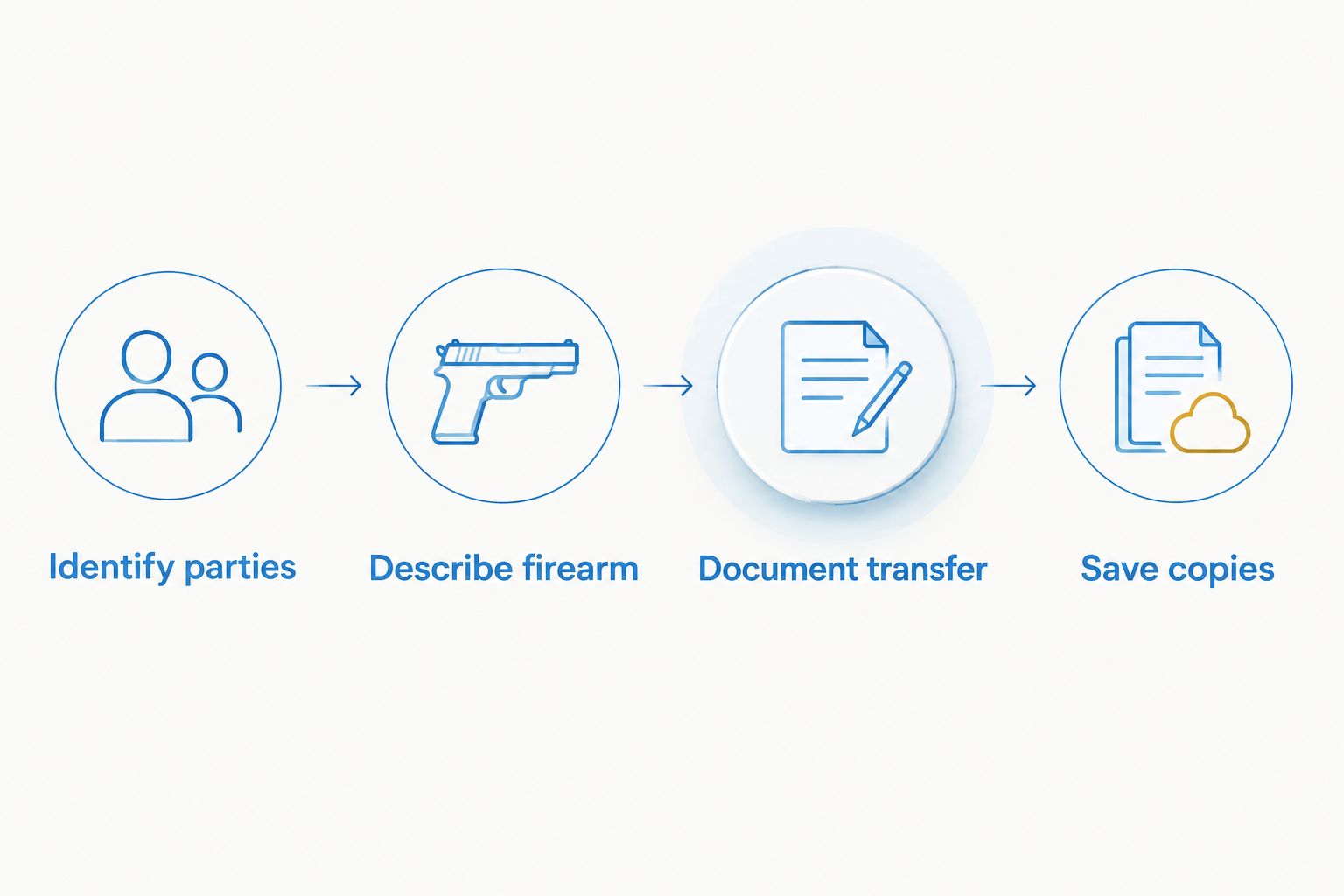
How to keep records of a gun sale
Use this sequence for your personal documentation. The applicable legal transfer process takes priority over the filing routine.
Identify parties
Record the parties' names and the identifying details appropriate to the transaction and applicable requirements. Check accuracy before signing rather than relying on a later message to fix an error.
Do not collect identity-document images merely because storage is convenient. Keep personal information limited to what is required or justified for the transaction.
Describe firearm
Record the firearm's manufacturer, model, caliber or gauge, and serial number accurately. Compare the written description with the firearm rather than copying an old listing without checking it.
If a detail is unclear, resolve it before treating the record as complete. Do not guess at a serial number or alter a document to conceal uncertainty.
Document transfer
State the actual transfer date and distinguish completion from a proposed sale. Keep the signed bill of sale and any documents you receive relating to the required transfer process.
Organize the file into 3 record categories: transaction documents, compliance-related documents, and relevant correspondence. These are filing categories, not universal legal requirements.
Save copies
Check that each saved document opens and remains legible. Store paper securely, restrict digital access, and keep the backup separate from the only working copy.
A simple 2026 filing rule is to name folders by transfer date and a description you recognize. Avoid placing the buyer's full personal details in filenames visible on shared devices.
How the methods rank
This ranking prioritizes transaction detail, compliance separation, retrieval, privacy, preservation, and practical fit. It compares record-keeping functions, not measured security performance or a hands-on product test.
Coordinated handling ranks first for a supported transfer because it connects documentation with the transaction process. Paper records and digital archives follow because they address creation and preservation; a ledger ranks last because it only summarizes other records.
Which method should you choose?
For an undecided seller in 2026, choose the transfer process first and the storage method second. Use a supported service or required dealer process, retain the resulting documents, and preserve readable copies securely.
If you manage documentation yourself, combine a signed bill of sale with protected digital storage. Add a ledger only when finding older files becomes difficult; another spreadsheet is not automatically better documentation.
FAQ
What's the best way to keep records of a private gun sale?
Keep an accurate transaction record and preserve the documents associated with the applicable transfer process. A signed bill of sale, relevant dealer or service documents, and a secure backup serve different purposes and work together.
Is a bill of sale enough to make a private gun sale legal?
No. A bill of sale documents a transaction but does not replace a required background check, dealer transfer, permit, or other applicable requirement.
What information should I record about the firearm?
Record the manufacturer, model, caliber or gauge, and serial number accurately. Check the description against the firearm and follow any additional applicable documentation requirements.
Should I keep a paper copy or a digital copy?
Keep a signed paper record where appropriate and a readable digital backup. Protect both, and verify that the digital copy includes every page and signature.
How long should I keep private gun sale records in 2026?
Check the retention requirements that apply to your transaction before deleting records. Do not assume that a dealer's record-retention obligations are the same as a private seller's obligations.
Do I need to photograph the buyer's driver's license?
Do not assume that retaining a license photograph is necessary. Verify the applicable identification and record requirements, and avoid collecting sensitive information without a clear reason.
What if a sale is canceled after I prepare the paperwork?
Keep the file accurate by marking the transaction as canceled rather than completed. Preserve relevant correspondence and do not use an unsigned draft or appointment confirmation as evidence of a completed transfer.
One last thing
Test retrieval before you consider the job finished. Open the saved file, read the serial number, locate the signatures, and confirm whether the documents describe a completed or canceled transfer. A folder full of files is not useful if the decisive page is missing.