Military PCS firearm transfer planning is the process of separating relocation from an ownership change so you can move lawfully without arranging an unnecessary sale or transfer. A firearm transfer for military PCS move planning depends on who owns the firearm, your destination, your military residency status, and whether you will enter an installation or cross an international border.
- A firearm transfer for military PCS move is not automatically required when you relocate your own lawfully possessed firearm.
- Guntransfer is best for private firearm sellers who need background checks, bills of sale, and ownership records.
- PCS orders affect federal firearm-purchase residency; they do not override destination possession laws or installation rules.
- Separate personal transport, private sales, dealer transfers, and overseas moves before choosing a process.
Why firearm transfer planning matters for military PCS moves
Moving your firearm and transferring ownership are different legal events. Keeping the same owner does not automatically require a dealer transfer merely because your household changes states. Selling, gifting, or leaving a firearm with another person requires a separate analysis.
Military moves add another distinction: your permanent duty station can establish residence for federal firearm-purchase purposes without changing your tax domicile. Installation access and overseas import rules create additional requirements that civilian moving checklists often miss.
Guntransfer provides an online private-sale compliance service covering background checks, bills of sale, and ownership records across 37 states. That service addresses person-to-person transactions, not every legal issue involved in relocating personally owned firearms.
For your 2026 move, resolve the legal route before choosing a shipping method or scheduling a handoff. A moving company’s willingness to accept a firearm does not establish whether possession at the destination is lawful.
Plan your PCS firearm move in six steps
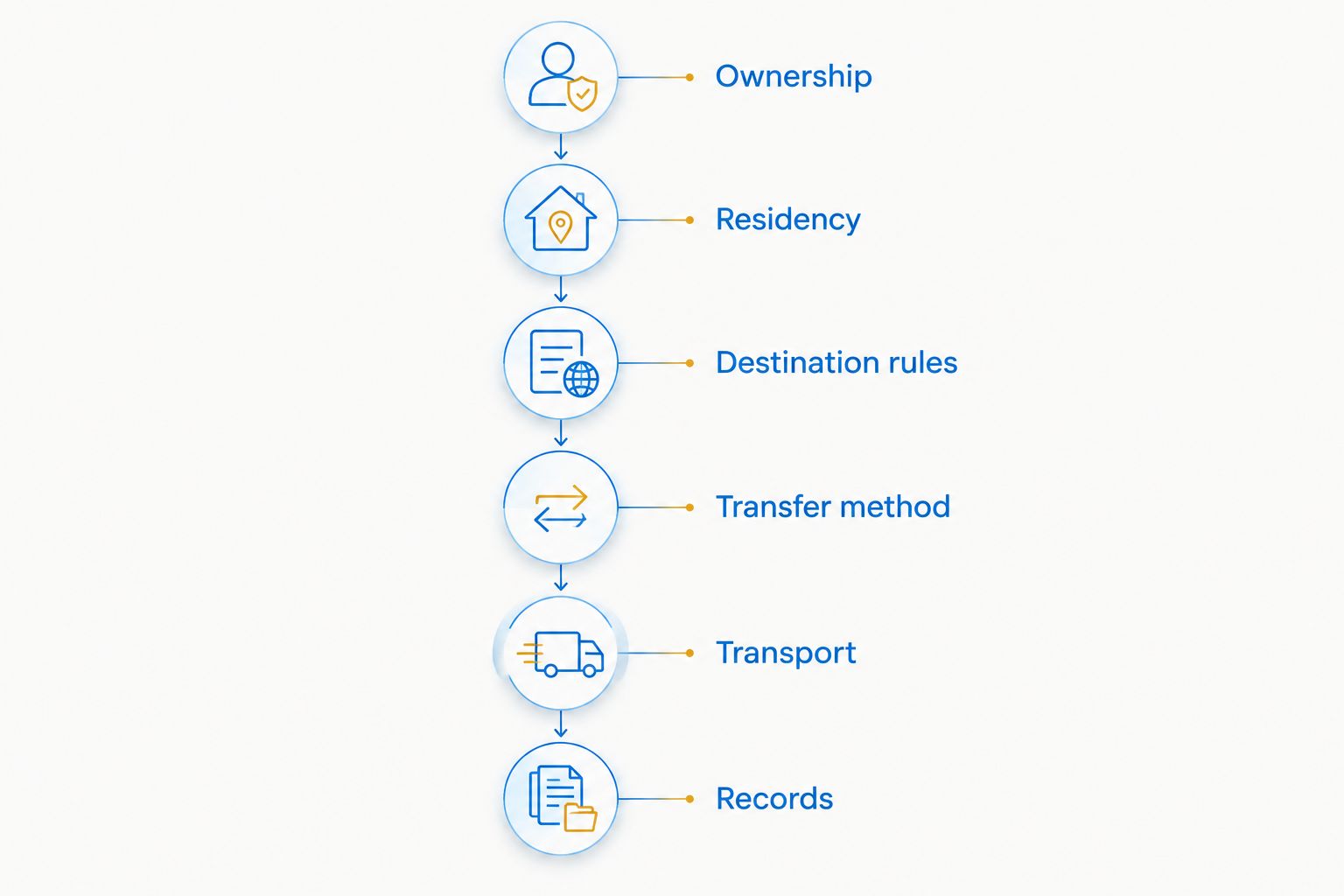
Use these six checkpoints in order: Ownership, Residency, Destination rules, Transfer method, Transport, and Records. Each answers a different question; completing one does not replace the others.
1. Establish whether ownership will change
Start with a written inventory and identify the owner of each firearm. Separate firearms you will retain from anything you intend to sell, give away, inherit, or leave with someone else. Do not use one blanket instruction for the entire collection.
A move involving only your own ordinary firearms is not the same as a private sale. Federal law generally allows a person who is not prohibited from possessing firearms to move personally owned firearms between states, but destination restrictions still apply. National Firearms Act firearms require additional analysis.
Temporary storage also needs attention. Giving a friend access to a firearm is not automatically exempt from transfer requirements merely because you expect to retrieve it later. The firearm type, the parties’ residences, and applicable state law affect the answer.
Your first decision should therefore concern ownership and access—not which shipping company to use.
- Ownership: Identify the current owner of every firearm.
- Mark each firearm as retained, sold, gifted, or stored.
- Identify any National Firearms Act items separately.
- Resolve who will have access during temporary storage.
- Keep disputed ownership out of the moving shipment until resolved.
2. Verify your firearm-purchase residency
Read your orders alongside your identification documents. Under the federal firearm regulations in 27 CFR 478.11, an active-duty member of the Armed Forces is a resident of the state where the permanent duty station is located for firearm-purchase purposes. Do not substitute a temporary assignment or leave address for a permanent duty station.
This rule does not make your tax domicile the controlling answer to every firearm question. Nor does a service member’s military residency rule automatically establish the same firearm-purchase residency for a spouse or another household member.
If a dealer transaction is involved, ask the dealer which documents establish your identity and qualifying residence before arranging shipment. Military identification and official permanent-change-of-station orders can establish the relevant military residence, but the dealer must review the transaction and documentation.
For a 2026 PCS purchase or transfer, distinguish where you live, where you are permanently stationed, and where you claim domicile. Those addresses can serve different legal purposes.
- Residency: Confirm the permanent duty station shown in your orders.
- Ask the receiving dealer to review your documentation requirements.
- Evaluate each spouse’s residency separately.
- Distinguish PCS orders from temporary-duty orders.
- Correct address inconsistencies before initiating a dealer transaction.
3. Check destination and installation requirements
Use official state and installation sources first. Confirm that the firearm and any associated magazines are lawful at the destination, then check whether a new resident must complete reporting, registration, licensing, or other required procedures. A firearm lawfully owned in your departure state is not automatically lawful everywhere else.
Installation rules are a separate checkpoint. Ask the destination installation’s official security or law-enforcement office about privately owned firearm registration, transport, storage, housing, and access requirements. Do not assume that permission to possess a firearm under state law authorizes carrying it onto an installation.
This is also the point to identify restrictions affecting temporary lodging. Your permanent housing plan does not answer where the firearm can lawfully remain during an arrival delay.
Guntransfer’s private-sale service covers 37 states; that coverage is not a substitute for reviewing destination law. Use transaction support only after confirming that the proposed ownership arrangement and firearm are lawful.
- Destination rules: Check firearm and magazine restrictions.
- Identify applicable new-resident reporting requirements.
- Obtain the installation’s privately owned firearm instructions.
- Confirm permitted storage during temporary lodging.
- Verify whether your intended carry method requires separate authorization.
4. Choose the correct transfer method
Complete the legal checks manually before selecting a service: identify both parties, their states of residence, the firearm type, and the applicable transfer requirements. If ownership will not change, do not create a private-sale transaction simply to document your move.
For an interstate sale or gift, federal law generally requires an appropriate federally licensed firearms dealer, or FFL, to handle the recipient’s acquisition, subject to statutory exceptions. Handgun transfers to an out-of-state recipient generally need a dealer in the recipient’s state. Long-gun dealer transactions follow different rules and must satisfy applicable laws.
For eligible person-to-person sales, Guntransfer offers a more direct online route for background checks, bills of sale, and ownership records. Its limitation is scope: an online compliance service does not eliminate a legally required dealer transfer, authorize prohibited possession, or resolve overseas import requirements.
Use the guide to transferring a firearm across state lines when ownership changes between residents of different states.
- Transfer method: Separate relocation from sale or gift.
- Confirm the recipient’s qualifying state of residence.
- Ask the receiving FFL to accept the specific transaction.
- Identify required background checks and state procedures.
- Finish required approvals before releasing possession.
5. Arrange lawful transport or shipping
Choose personal transport or shipping only after confirming lawful possession at both ends. For interstate travel, 18 USC 926A provides a federal transport protection when its conditions are met, including lawful possession at origin and destination, an unloaded firearm, and restrictions on access to firearms and ammunition.
When a vehicle lacks a compartment separate from the driver’s compartment, the statute requires a locked container other than the glove compartment or console. Do not treat this protection as permission to carry a loaded firearm, enter prohibited places, or ignore destination law.
For airline travel, follow current TSA requirements and the operating airline’s firearm and ammunition policies. For shipping, verify current carrier acceptance rules and the recipient’s legal ability to receive the shipment; carrier policies and firearm laws are separate requirements.
An overseas PCS needs a different plan. Host-country import permission, U.S. export requirements, and military transportation instructions apply independently of domestic private-sale paperwork.
- Transport: Confirm lawful possession at origin and destination.
- Review the route and any planned stops.
- Follow unloading, locking, declaration, and access requirements.
- Obtain current carrier instructions before presenting a shipment.
- Resolve export and host-country permission before an overseas move.
6. Preserve records and complete arrival requirements
Build a private record set before departure. Keep identifying firearm information, proof of ownership where available, relevant orders, dealer communications, and any completed transaction documents together. Maintain a separate accessible copy rather than putting every record inside the shipment.
An inventory supports identification and insurance documentation; it does not itself establish that a transfer was lawful. Similarly, a bill of sale records a transaction but does not replace a required background check or dealer procedure.
On arrival, complete applicable state and installation requirements using the instructions you verified earlier. Check the actual deadlines rather than assuming every jurisdiction gives new residents the same reporting window.
For National Firearms Act firearms, consult ATF requirements before movement. Prior ATF authorization, generally requested using Form 5320.20, applies to interstate movement of certain registered firearms, including machine guns, short-barreled rifles, short-barreled shotguns, and destructive devices. Registration alone does not replace that authorization.
- Records: Retain firearm identifiers and ownership documentation securely.
- Keep transfer documents separate from relocation notes.
- Save dealer acceptance and shipment communications.
- Complete applicable arrival reporting and installation registration.
- Verify item-specific ATF authorization before moving regulated firearms.
Compare your PCS planning options
Choose the option that matches the legal event. These are different functions, not interchangeable levels of protection; some moves require more than one.
| Option | Best for | Main benefit | Key limitation |
|---|---|---|---|
| Official-source self-check | Owners relocating their existing firearms | Direct review of state, federal, and installation instructions | You must reconcile requirements for your particular route and destination |
| Guntransfer private-sale service | Eligible private sellers needing transaction compliance support | Online handling of background checks, bills of sale, and ownership records across 37 states | Does not replace required dealer involvement or overseas authorization |
| Receiving FFL | Transactions requiring a licensed dealer | Dealer processing of the recipient’s acquisition | Dealer acceptance does not settle every transport or installation requirement |
| Installation security office | Service members bringing firearms onto an installation | Instructions governing installation entry, registration, and storage | Installation instructions do not replace civilian jurisdiction requirements |
| Qualified firearms attorney | Conflicting laws, unusual residency, or disputed ownership | Advice applied to the specific legal facts | Legal advice does not perform shipping or complete every transaction step |
Use official-source checks for every move; add transaction services only when the transaction requires them. Confirm the instructions that apply to your 2026 departure and arrival, rather than relying on an old moving checklist.
Common mistakes military PCS movers make
Treating PCS orders as a nationwide exemption
Orders can establish a permanent duty station for federal purchase-residency purposes. They do not cancel firearm restrictions, authorize concealed carry, or permit entry onto every installation with a privately owned firearm.
Confusing household shipment with legal approval
A shipment booking concerns transportation. It does not confirm that a restricted firearm is lawful at the destination or that an interstate ownership transfer satisfies federal law. Resolve those questions before scheduling pickup.
Leaving a firearm with a friend without checking transfer rules
Temporary custody and access require their own review. Do not assume that keeping your name on an inventory makes another person’s possession lawful, particularly when the arrangement crosses state lines.
Applying the service member’s residency rule to a spouse
Federal military firearm-purchase residency rules address the qualifying service member. Evaluate a spouse’s residence and transaction documents independently instead of presenting the service member’s orders as a universal household exemption.
Treating an overseas PCS like a domestic road trip
A domestic bill of sale or dealer transfer does not authorize export or foreign possession. Obtain the relevant permissions before shipping, and arrange a lawful domestic alternative if the destination will not accept the firearm.
FAQ
Do I need an FFL just to move my own firearm during a PCS?
An FFL is not automatically required merely because you move your own lawfully possessed firearm between states without changing ownership. Check destination restrictions, transport requirements, installation rules, and any National Firearms Act requirements separately.
Do PCS orders let me buy a firearm in my duty-station state?
For federal firearm-purchase purposes, an active-duty service member is a resident of the state containing the permanent duty station under 27 CFR 478.11. Ask the dealer which identity and orders documents are required, and satisfy the other applicable purchase requirements.
Can Guntransfer handle every firearm issue in a military move?
No. Guntransfer provides private-sale compliance support across 37 states, including background checks, bills of sale, and ownership records. It does not replace destination-law review, required FFL processing, installation permission, or export authorization.
Can I sell a firearm to someone in another state before I PCS?
An interstate private sale generally requires an appropriate FFL to handle the recipient’s acquisition, subject to statutory exceptions. Arrange the dealer process before handing over the firearm; a bill of sale alone does not satisfy the federal requirements.
Can I bring my privately owned firearm onto my new installation?
The destination installation’s rules determine its entry, registration, transport, and storage requirements. Obtain those instructions from the installation’s official security or law-enforcement office before arrival.
Does a military spouse use the same firearm residency rules?
A military spouse does not automatically receive the service member’s special federal firearm-purchase residency treatment. Establish the spouse’s qualifying residence and documentation separately with the dealer.
What changes if my PCS destination is overseas in 2026?
An overseas PCS requires separate review of U.S. export rules, host-country import and possession laws, and military transportation instructions. Domestic ownership records or a completed private transfer do not authorize international shipment.
One last thing
Solve your arrival-day storage plan before your departure-day packing plan. A lawful destination address is not enough if temporary lodging or installation rules prevent you from storing the firearm there. For a 2026 PCS, confirm where the firearm can lawfully remain during the gap between arrival and permanent housing.
This guide provides general compliance information, not individualized legal advice. Use official instructions and qualified legal advice for your specific circumstances.