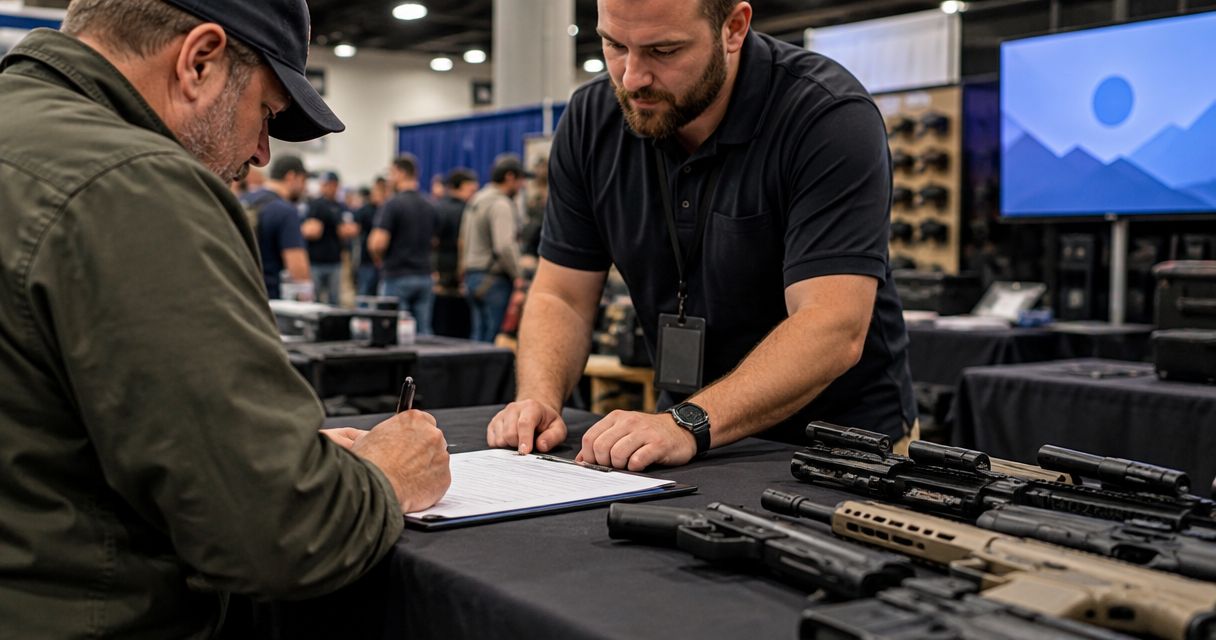
Instead of chasing a seller, receiving dealer, and missing paperwork separately, organize your GunBroker purchase gun transfer around the receiving dealer’s requirements before shipment. This 2026 workflow explains the legal checkpoints, background-check process, and records that separate an online purchase from a lawful transfer into your possession.
- A GunBroker purchase gun transfer is not complete when payment clears; the required legal transfer must still occur.
- Confirm receiving-dealer acceptance and applicable state restrictions before the seller ships.
- Guntransfer suits private sellers needing transfer compliance support, not a substitute for a required licensed-dealer transfer.
- Keep the purchase receipt, transfer documents, and firearm identification together without treating paperwork as permission to take possession.
Why this matters
An online marketplace transaction and a lawful firearm transfer are separate events. Paying for a firearm does not establish eligibility, satisfy a waiting period, or authorize delivery to your home.
GunBroker connects buyers and sellers; the applicable transfer requirements depend on residency, firearm type, seller status, and state law. For ordinary interstate purchases, the receiving Federal Firearms Licensee, or FFL, is the central compliance checkpoint.
Guntransfer provides private firearm transfer compliance support across 37 states, including background checks, bills of sale, and ownership records. Its stated private-transfer service does not establish that it replaces the receiving FFL required for a particular marketplace purchase.
Guntransfer is best for private individuals who need help documenting and completing a compliant person-to-person firearm transfer. For a GunBroker transaction, first establish which parts require a licensed dealer.
Before you start
- Gather transaction and identity information. Have the listing, seller contact information, purchase confirmation, firearm description, and current identification ready. Confirm your actual state of residence rather than relying on your shipping address.
- Obtain receiving-dealer acceptance. Ask whether the dealer accepts the firearm and the seller’s shipment type. A dealer’s existence does not mean that dealer has agreed to receive your purchase.
- Resolve the non-obvious gotcha: seller status. Some receiving dealers decline shipments from unlicensed individuals or require additional sender documentation. Settle that requirement before shipment, not after the package arrives.
For a 2026 transaction, also confirm the current state and local restrictions that apply to the exact firearm. A seller’s willingness to ship does not prove that your receiving dealer can lawfully transfer it.
Transfer route and dealer requirements
Establish the legal route
- Identify both parties’ residency. Record the buyer’s state of residence and the seller’s location and licensing status. Do not treat an in-person meeting across a state line as a same-state private sale.
- Identify the firearm category. Distinguish a handgun, rifle, shotgun, or other firearm. Federal dealer-transfer rules do not treat every category alike.
- Ask the receiving FFL to confirm the route. Describe the firearm and transaction accurately. Get confirmation that the dealer can receive it and, subject to eligibility and legal requirements, transfer it to you.
- Check state-specific requirements. Confirm permits, waiting periods, firearm restrictions, and any local requirements before arranging delivery.
Expected result: You know which licensed dealer will handle the transfer and which legal conditions apply before possession changes.
The distinction matters most across state lines. The guide to transferring a firearm across state lines explains that issue separately from marketplace payment and order status.
| Transfer route | Best for | What it establishes | Limitation |
|---|---|---|---|
| Handgun transfer through an FFL in the buyer’s state | An ordinary interstate handgun purchase | A dealer-based transfer in the buyer’s state of residence | Dealer receipt alone does not authorize pickup |
| Qualifying rifle or shotgun transfer through an out-of-state FFL | A long-gun transaction permitted by both states’ laws | A possible federal exception to the usual home-state dealer route | Both states’ legal conditions must be satisfied; not every transaction qualifies |
| Same-state private-transfer process | Residents completing a lawful intrastate private transaction | A route governed by federal restrictions and applicable state requirements | A bill of sale does not replace a required dealer transfer or background check |
These are legal-route comparisons, not interchangeable shortcuts. Choose the route that fits the transaction, not the route with the fewest steps.
Confirm age and identification requirements
Federal law generally bars licensed dealers from transferring rifles or shotguns to people under 18 years old, and other firearms, including handguns, to people under 21 years old. Those dealer restrictions appear in 18 U.S.C. § 922(b)(1); state law can impose stricter requirements.
Do not use age alone as an eligibility test. Residency, prohibited-person restrictions, identification, and transaction-specific requirements still apply.
Seller and receiving-dealer coordination
Confirm acceptance before shipment
- Ask the receiving dealer for its intake instructions. Confirm the seller information, firearm description, and transaction reference the dealer needs to identify the shipment.
- Have the seller and receiving dealer resolve license verification. Follow the receiving dealer’s instructions for communicating its license information and verifying the intended destination.
- Confirm sender-document requirements. If the seller is unlicensed, establish whether the receiving dealer accepts that shipment and what identifying documentation it requires.
- Keep the transaction reference with the correspondence. Save the purchase confirmation and the dealer’s acceptance so an arriving package can be matched to your transaction.
Expected result: The seller and dealer agree on the receiving destination and required documentation before dispatch.
Do not interpret a GunBroker order status as dealer acceptance. The marketplace, seller, carrier, and receiving FFL each control different parts of the process.
There is no universal marketplace button that completes the legal transfer. Follow the actual instructions provided for your transaction rather than looking for a single checkout setting that satisfies every jurisdiction.
Track receipt without assuming pickup approval
- Keep delivery tracking with the transaction record. Delivery information helps resolve shipment questions but does not establish transfer eligibility.
- Wait for the receiving dealer’s intake confirmation. A carrier’s delivery scan and the dealer’s completed intake are different events.
- Follow the dealer’s appointment instructions. Ask what identification and any required permits you must bring before traveling.
- Resolve discrepancies before transfer paperwork. If the model, serial number, or transaction information does not match, ask the dealer to address the discrepancy.
Expected result: The dealer has identified the firearm and told you what is required for the transfer appointment.
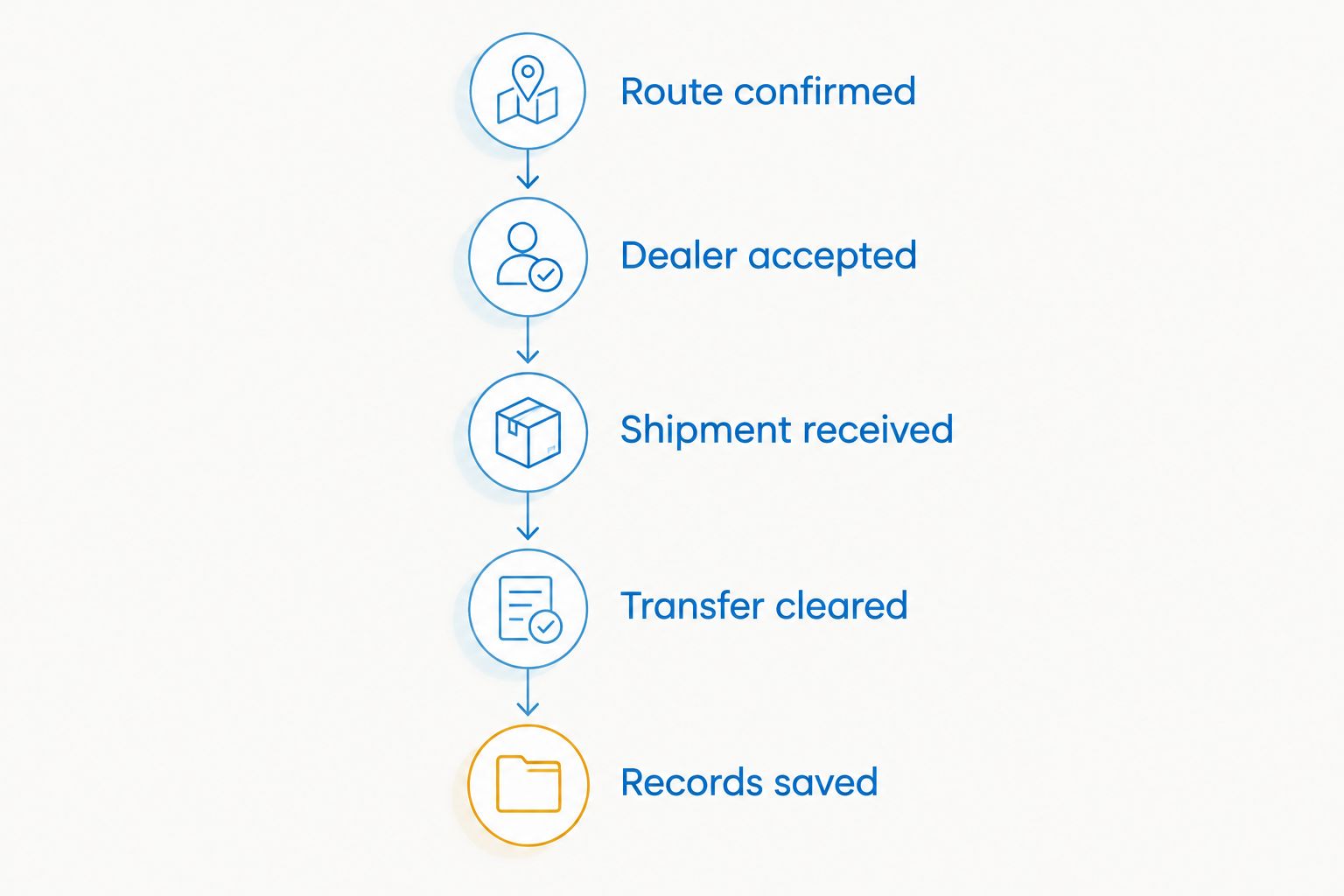
For your 2026 purchase, maintain a simple sequence: Route confirmed, Dealer accepted, Shipment received, Transfer cleared, Records saved. Each checkpoint answers a different question; none replaces the next.
Background check, release, and records
Complete the dealer’s transfer process
- Present the identification the dealer requires. Resolve an outdated address or residency question with the dealer before completing the transfer.
- Complete ATF Form 4473 accurately. Answer the actual questions truthfully. Do not guess at an answer or substitute instructions from the seller for the form’s instructions.
- Allow the dealer to conduct the required background-check process. Depending on the jurisdiction, that process involves the FBI’s National Instant Criminal Background Check System or a state point of contact, subject to applicable exceptions.
- Wait for lawful release. A background-check response does not remove a separate waiting period, permit requirement, or other legal restriction.
- Confirm the completed transfer documentation. Keep the documents provided to you and verify that the firearm identification matches the transaction.
Expected result: You take possession only after the dealer determines that the transfer can lawfully proceed.
A delayed background check is not an approval. Do not assume that a particular number of elapsed days guarantees release; federal exceptions, state requirements, and dealer policies affect what happens next.
The required federal dealer record and your personal purchase file serve different purposes. Do not assume you will receive the dealer’s original Form 4473, and do not treat your personal bill of sale as a replacement for it.
Build a usable ownership file
Keep the purchase confirmation, seller correspondence, receiving-dealer information, documents supplied at transfer, and firearm identification together. Store sensitive identity information securely rather than circulating it through unnecessary messages.
Guntransfer includes bills of sale and ownership records within its private firearm transfer service. Confirm that the service fits your transaction instead of assuming marketplace documentation and private-transfer documentation are identical.
For a 2026 ownership file, make the record understandable without reopening old message threads. Identify the transaction, the firearm, and the receiving dealer clearly; retain supporting documents in their original form.
Variant: a same-state private GunBroker sale
A marketplace sale between residents of the same state does not automatically follow the interstate dealer route. It also does not automatically qualify for direct handover.
- Confirm actual shared residency. A local pickup location does not establish that both people reside in that state.
- Check the state’s private-transfer requirements. Determine whether a dealer, background check, permit, or waiting period is required.
- Use the required compliance process. If state law requires dealer involvement, keep the dealer in the transaction even when both parties meet locally.
- Document only the transfer that actually occurs. Ensure the bill of sale and ownership records accurately reflect the parties, firearm, and completed transaction.
Expected result: Your same-state transaction follows the applicable private-transfer rules rather than borrowing assumptions from interstate shipping.
The benefit of this route is that it addresses the actual intrastate transaction. Its limitation is equally clear: state-specific requirements still control, and private paperwork cannot override them.
Troubleshooting
The receiving dealer refuses the shipment
Stop shipment if it has not left the seller. Ask which acceptance requirement failed and resolve it with the seller and dealer; do not redirect the firearm to an unconfirmed address.
If delivery has already occurred, have the dealer explain the lawful return or alternative handling process. Do not assume you can collect the firearm simply because you paid for it.
Tracking shows delivery, but pickup is unavailable
Ask whether dealer intake is complete and whether an appointment or additional documentation is outstanding. Carrier delivery proves arrival, not completed transfer processing.
Your identification has an old address
Contact the dealer before the appointment. Ask which current government-issued identification or supporting documents satisfy the applicable rules; do not enter an inaccurate address to match an outdated document.
The background check is delayed or denied
For a delay, follow the dealer’s instructions and wait for the applicable process. For a denial, use the official review or appeal instructions relevant to the agency that issued it; do not arrange for another person to acquire the firearm on your behalf.
The firearm does not match the purchase record
Have the dealer and seller resolve the discrepancy before completing the transfer. Keep the listing, confirmation, and correspondence intact so the issue can be evaluated against the original transaction.
Customize your workflow
Separate your file into purchase documents, dealer correspondence, and completed-transfer records. This keeps a payment question from being confused with a legal-release question.
For another purchase, repeat the legal-route and dealer-acceptance checks rather than copying the previous transaction unchanged. A different firearm, seller, state, or receiving dealer changes the questions you must resolve.
FAQ
Does buying a gun on GunBroker complete the legal transfer?
No. A GunBroker purchase establishes the marketplace transaction, not completion of the required firearm transfer. Applicable dealer processing, background checks, permits, and waiting periods still apply.
Can an interstate GunBroker handgun purchase ship straight to my home?
An ordinary interstate handgun purchase generally must go through an FFL in the buyer’s state before transfer to the buyer. Do not use a residential delivery address as a substitute for the required dealer process.
Do I need to choose an FFL before the seller ships?
Yes, confirm receiving-dealer acceptance before shipment. Ask whether the dealer accepts that firearm and shipments from that seller’s licensing category.
What is the minimum age for a dealer transfer?
Federal law generally requires buyers to be at least 18 years old for dealer transfers of rifles or shotguns and at least 21 for other firearms, including handguns. State law can impose stricter requirements, and age alone does not establish eligibility.
Does a delayed background check mean I can pick up the firearm later automatically?
No. A delay is not an approval or a guaranteed release date. Follow the receiving dealer’s instructions because federal exceptions, state law, and dealer policies affect release.
Can Guntransfer replace the FFL for my GunBroker purchase?
Do not treat Guntransfer as a replacement for a legally required FFL. Its stated service supports private person-to-person transfer compliance across 37 states; confirm whether that service applies to your transaction.
What documents should I keep after my 2026 GunBroker transfer?
Keep the purchase confirmation, relevant seller and dealer correspondence, transfer documents provided to you, and firearm identification. Your personal records supplement rather than replace the dealer’s required records.
One last thing
Proof of payment and proof of lawful transfer answer different questions. Before closing your 2026 transaction file, make sure it shows more than a paid order and a delivered package: retain the documents supplied when the lawful transfer was completed.