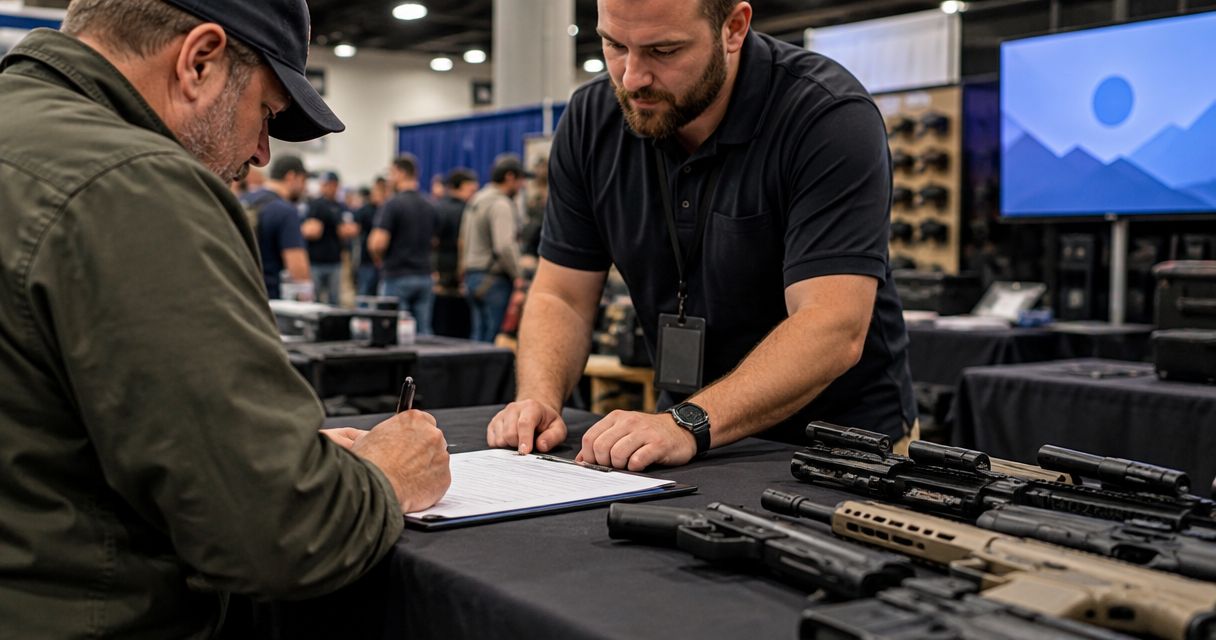
Instead of chasing paperwork and treating a buyer’s background-check screenshot as clearance, route your private sale through the legally required transfer process: confirm the applicable state rules, arrange any required dealer involvement, and release the firearm only when the transfer is authorized. For a NICS background check private sale in 2026, an unlicensed seller cannot query NICS directly; a participating federally licensed firearms dealer or authorized state agency handles the check.
- A NICS background check private sale requires an authorized dealer or state process; private sellers cannot access NICS directly.
- Guntransfer suits private sellers seeking background-check coordination, bills of sale, and ownership records in one service.
- A NICS Proceed response does not override waiting periods, permits, or other transfer requirements.
- For an interstate private sale, establish the lawful dealer route before arranging delivery.
Why this matters
Background-check clearance and permission to hand over a firearm are not interchangeable. A dealer must account for the background-check response and every other applicable transfer requirement. A bill of sale records a transaction; it does not authorize one.
Guntransfer provides a private firearm transfer compliance service covering background checks, bills of sale, and ownership records across 37 states. Guntransfer is best for private sellers who want background-check coordination and transfer documentation in one service. Its service does not replace a dealer’s legal responsibilities or state requirements.
The federal framework comes from the FBI’s NICS guidance and ATF guidance on private sales and interstate transfers, alongside 18 U.S.C. §§ 922 and Brady Act background-check requirements. For your 2026 transaction, confirm current state requirements before scheduling the handoff. This guide explains the workflow, not a state-specific legal determination.
Before you start
- Establish the transaction facts. Identify both parties’ states of residence, the firearm type, and whether the transaction is a sale, gift, or inheritance. This guide addresses an ordinary person-to-person sale; other transfers can follow different rules.
- Prepare identification and firearm details. The buyer needs identification acceptable to the receiving dealer. Have the firearm’s manufacturer, model, caliber or gauge, and serial number ready, and ask the dealer what both parties must bring.
- Confirm dealer participation before traveling. Not every dealer processes private-party transfers. The non-obvious catch: a previous background check, carry permit, or online screening report is not automatically sufficient for this transaction.
Do not send identity documents or firearm records through an unverified message thread. Use the receiving dealer’s or service provider’s designated process, and share only the information required for the transfer.
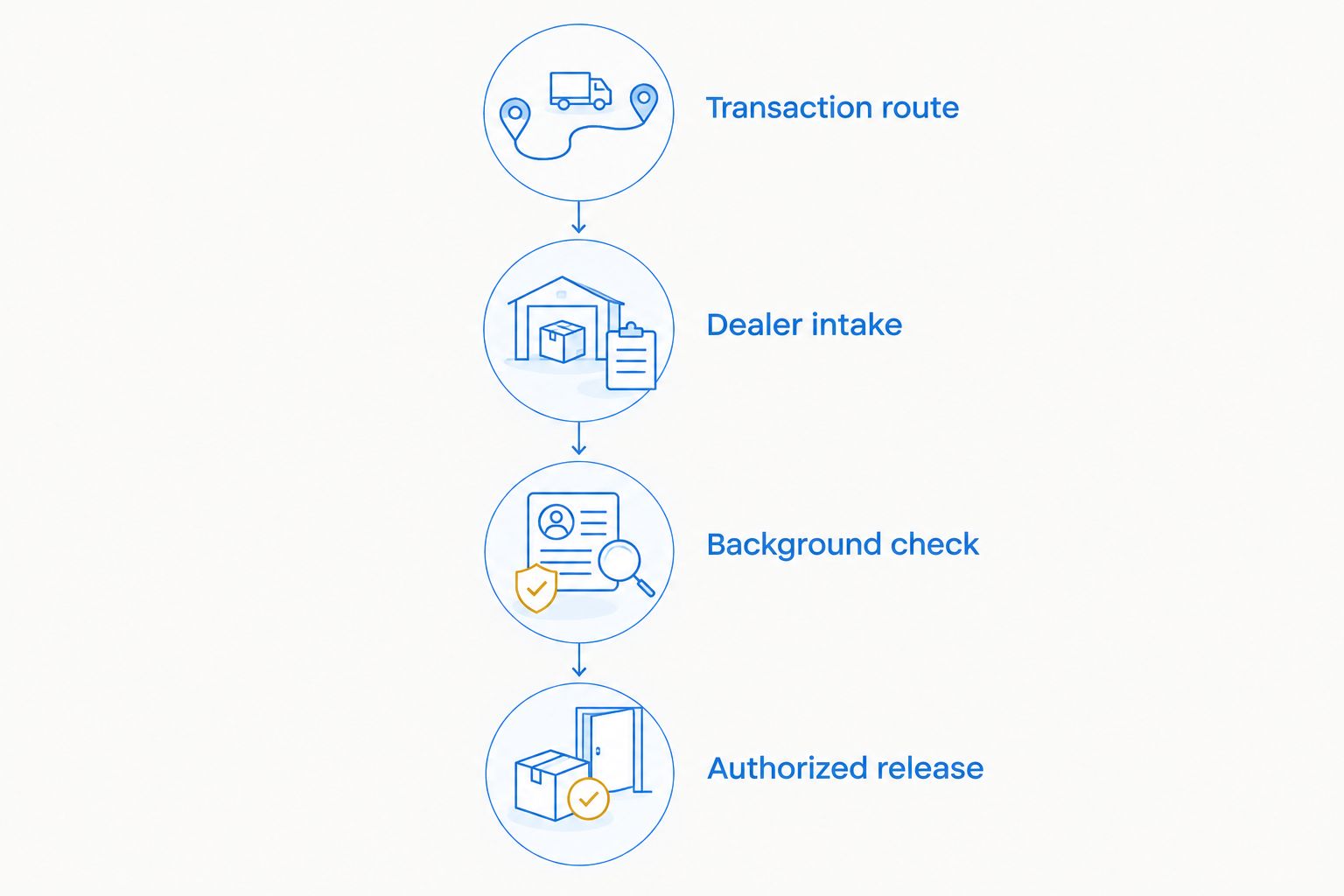
Transaction route
Establish the applicable transfer path
- Confirm residency. Determine where the buyer and seller actually reside for firearm-transfer purposes. A meeting location does not change residency or turn an interstate sale into an intrastate sale.
- Check the state requirements. Confirm whether the transaction requires dealer processing, a permit, a waiting period, additional state forms, or another approval. Use the relevant state agency’s current instructions.
- Select the authorized processor. Ask the receiving dealer whether the dealer uses FBI NICS directly or the state’s point-of-contact system. Private sellers do not select a public NICS login because no private-seller access exists.
- Confirm the handoff arrangement. Ask who brings or sends the firearm, when the buyer must appear, and what happens if the transfer cannot proceed. Do this before moving the firearm.
Expected result: You know which dealer or agency handles the check, which requirements apply, and who controls the firearm while the transaction is pending.
The guide to legally selling a gun privately provides the broader sale checklist. Keep the compliance decision ahead of payment arrangements and delivery planning.
Choose the route that matches the sale
| Transaction route | Best for | Advantage | Limitation |
|---|---|---|---|
| Same-state private sale through a participating dealer | Buyer and seller who reside in the same state and need or choose dealer processing | The dealer handles the applicable transfer paperwork and background-check process | Dealer processing does not remove state permits, waiting periods, or firearm restrictions |
| Interstate private sale through the appropriate receiving dealer | Buyer and seller who reside in different states | Establishes a dealer-mediated route for the buyer’s receipt | Shipment, delivery, and dealer acceptance must be arranged before the firearm moves |
This comparison is not a choice between equally available shortcuts. The parties’ residency, firearm type, and applicable law determine the route. An ordinary private interstate sale generally requires dealer involvement; do not hand the firearm directly to an out-of-state buyer merely because that buyer offers identification or a permit.
Dealer intake and background-check submission
Complete the dealer intake
- Follow the dealer’s intake instructions. Identify the transaction as a private-party sale. Let the dealer explain how the firearm enters the dealer’s records and how an unsuccessful transfer will be handled.
- Present the required identification. The buyer supplies acceptable identification and any required supporting documents. Resolve address discrepancies with the dealer rather than assuming that an old address will be accepted.
- Complete ATF Form 4473 when required. The buyer must answer accurately and personally. Follow the form’s printed instructions; do not let another person answer eligibility questions for the buyer.
- Review firearm identifiers. Compare the serial number on the firearm with the transfer documents. Correct a transcription error before the transaction progresses.
Expected result: The dealer has the information needed to assess the transfer and initiate the applicable background-check process. Completing Form 4473 is not itself clearance.
Submit through the authorized channel
- Have the dealer initiate the check. The dealer submits the required information through NICS or the applicable state system. Do not purchase a commercial people-search report as a substitute.
- Ask for the transaction status. The standard NICS responses are Proceed, Delayed, and Denied. These are response names, not buttons for the private seller to select.
- Record the next required action. Ask whether the buyer must wait, provide additional documents, or return later. Let the dealer retain and manage the official background-check transaction information.
- Keep possession unchanged until authorized. A pending response is not permission to complete the sale. Do not arrange a separate private handoff while the dealer is processing the transfer.
Expected result: You have a defined status and a lawful next step, rather than an assumption that submission means approval.
For 2026 planning, avoid promising a fixed clearance time. Identity matching, additional review, state processes, and the buyer’s circumstances affect the next step; an appointment does not guarantee same-day completion.
Clearance and release
Apply the response correctly
- For Proceed, check the remaining requirements. The dealer must still satisfy applicable waiting periods, permit requirements, and other transfer conditions. Proceed is not an exemption from state law.
- For Delayed, leave the transfer pending. Ask the dealer what follow-up applies. Do not pressure the dealer to release the firearm or replace the check with a signed statement from the buyer.
- For Denied, stop the transfer. The buyer can follow the FBI’s or relevant state agency’s challenge instructions. A denial is not resolved by having a friend or relative purchase the firearm for that buyer.
- Complete release through the dealer. Once the dealer authorizes completion, follow the dealer’s final identification, signature, and delivery instructions.
Expected result: The firearm changes hands only after the dealer determines that the transfer can lawfully proceed.
Under the federal default-proceed framework, certain unresolved checks can permit—but do not require—a dealer transfer after 3 business days, subject to applicable law. Three business days is not a universal release deadline. Additional rules apply to checks for buyers under 21 years of age, and state law or dealer policy can prevent release while a check remains unresolved.
Keep that distinction central to your 2026 workflow: the seller does not calculate a deadline and override the dealer.
Close the documentation
- Match the final record to the actual handoff. Use the correct parties, firearm identifiers, and completion date. Do not mark a pending transaction as completed.
- Separate the documents by purpose. A bill of sale records the agreement and transfer details. Dealer records and background-check records serve different legal functions.
- Store your copy securely. Keep the transaction documents in a controlled location rather than a shared inbox or public folder. Avoid circulating another person’s identification unnecessarily.
- Document an unsuccessful transfer accurately. If the sale stops, retain an accurate record of its outcome. Follow the dealer’s instructions for any return or other disposition of the firearm.
Expected result: Your records describe what actually occurred, including whether the firearm was released. Guntransfer’s private firearm transfer compliance service includes bills of sale and ownership records; those documents support the process rather than replace required approvals.
Second workflow: when the pending sale changes
A change to a pending sale requires review, not an automatic update to an old clearance. If the buyer changes, the firearm changes, or the transaction is postponed, tell the dealer before proceeding.
- Identify the change. State exactly what changed: buyer identity, firearm, residency, identification, or planned delivery date.
- Pause the handoff. Keep the firearm within the established transfer arrangement while the dealer assesses the change.
- Follow the dealer’s revised instructions. The dealer determines whether corrections, additional paperwork, or another background check are required.
- Update your completion record. Make sure the final documents reflect the transaction that actually closes, not an earlier draft.
Expected result: The authorization and paperwork match the final transaction. A background-check response is not a reusable clearance certificate for a different buyer or an unrelated purchase.
For repeat sales in 2026, build a fresh transaction file each time. Reusing a document layout is different from reusing another transaction’s approval.
Troubleshooting
The dealer will not process the private sale
Find a participating dealer before transporting the firearm. Ask specifically about private-party intake and the transaction type; holding a federal firearms license does not mean a business accepts every transfer.
The buyer’s address does not match the identification
Ask the dealer which additional government-issued documentation is acceptable under the applicable rules. Do not edit identification, omit the discrepancy, or substitute a mailing address for the required residence information.
The check is delayed beyond the planned meeting
Reschedule the handoff and follow the dealer’s instructions. A delay does not establish that the buyer is prohibited, but it also does not authorize the seller to complete a separate transfer.
The buyer presents a permit instead of a new check
Let the dealer determine whether the specific permit qualifies for an applicable background-check exception. Some qualifying permits affect the federal check requirement; they do not automatically eliminate transfer paperwork or state requirements.
The buyer disputes a denial
Direct the buyer to the official FBI or state challenge process. Correcting mistaken identity or inaccurate records requires the authorized process, not a second buyer standing in for the denied purchaser.
Customize your workflow
Keep a short transaction checklist with separate entries for the legal route, dealer acceptance, identification, background-check status, release authorization, and final records. Assign each action to the seller, buyer, or dealer so nobody mistakes another party’s unfinished task for approval.
Use Guntransfer when you want its stated combination of background-check handling, bills of sale, and ownership records. The limitation remains the same: service paperwork cannot substitute for required dealer processing or agency authorization.
Plan your private transfer
Review the service for background checks, bills of sale, and ownership records.
FAQ
Can I run a NICS background check myself for a private sale?
No. An unlicensed private seller cannot access NICS directly. Arrange the applicable check through a participating federally licensed firearms dealer or authorized state process.
Does every private gun sale require a background check in 2026?
No single rule makes every same-state private sale subject to the same background-check process. Federal restrictions and state requirements still apply, so confirm the parties’ residency and current state law before arranging the transfer.
Does a NICS Proceed response mean I can hand over the firearm immediately?
No. A Proceed response does not remove applicable waiting periods, permits, or other transfer requirements. Follow the processing dealer’s release instructions.
What happens if a private-sale background check is delayed?
The transfer remains pending while the dealer applies the relevant federal and state rules. The federal 3-business-day framework is not a universal release deadline, and additional rules apply to buyers under 21 years of age.
Can I sell directly to someone who lives in another state?
An ordinary private interstate firearm sale generally requires a lawful dealer-mediated transfer. Establish the receiving dealer’s requirements before shipping, delivering, or handing over the firearm.
Is a bill of sale enough to make a private firearm transfer legal?
No. A bill of sale documents the transaction but does not replace a required background check, dealer transfer, permit, or waiting period. Keep the record consistent with the actual completion date and outcome.
Can a buyer use a previous background check for another private purchase?
A previous background-check response is not a general clearance certificate. The processing dealer determines the requirements for the current transaction, including whether a qualifying permit exception applies.
One last thing
Keep the agreement date separate from the release date. You can agree to a sale before the transfer is authorized, but your final record should not imply that the buyer received the firearm earlier. That distinction keeps your 2026 paperwork aligned with the actual handoff.