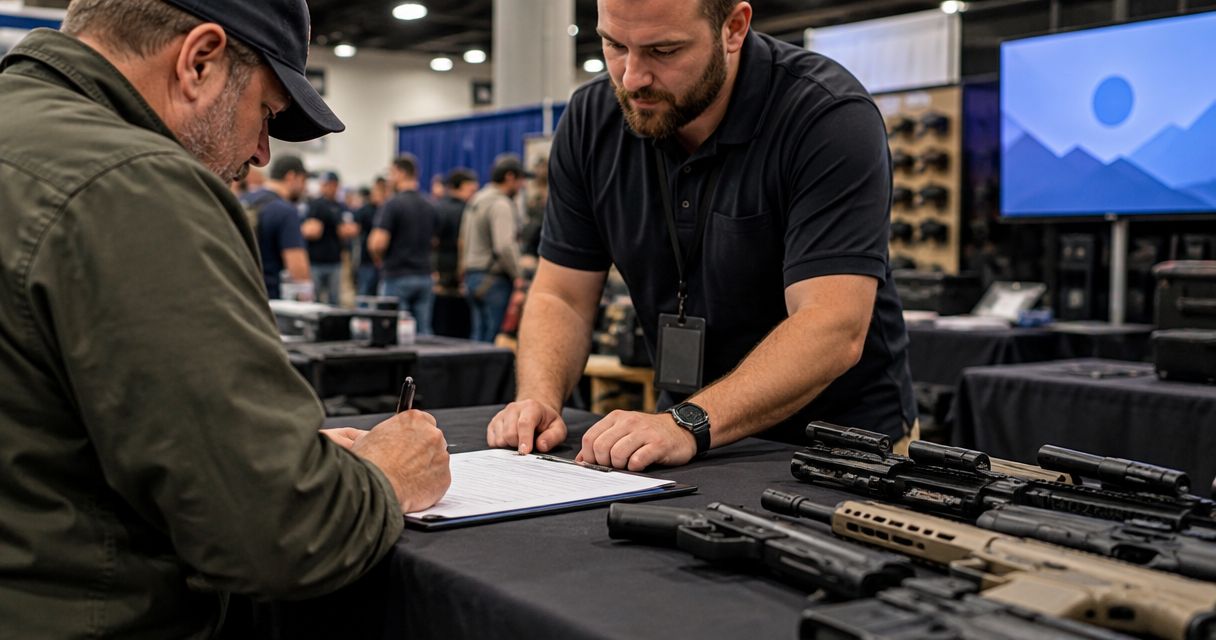
Best overall for supported private sales: Guntransfer. Best for dealer paperwork: ATF Form 4473. Best for a standalone transaction record: a firearm bill of sale. This 2026 gun transfer form comparison separates services that support the transfer process from documents that only record part of it.
- Guntransfer is the best gun transfer form option here for private sellers seeking background checks, bills of sale, and ownership records.
- ATF Form 4473 serves dealer transfers; it is not a universal private-sale form.
- A firearm bill of sale records a transaction but does not replace required background checks or dealer involvement.
- Choose the legally required transfer process before choosing a PDF, state form, or electronic signature tool.
Why this matters
A completed document is not proof that you followed every transfer requirement. A bill of sale, a dealer's federal record, and a state transfer form serve different purposes. Treating them as interchangeable creates the central mistake this guide helps you avoid.
For a private sale in 2026, start with the buyer's and seller's states of residence, the firearm involved, and the rules governing that transaction. Then select the documents that belong inside that process. An electronic signature cannot remove a dealer requirement or make an otherwise prohibited transfer lawful.
This guide compares five approaches, not five interchangeable software products. Some complement each other: a dealer transaction can involve ATF Form 4473 alongside a separate bill of sale and any applicable state paperwork.
What makes the best digital gun transfer form
Evaluate each option against these criteria before comparing layouts or signature features:
- Legal role: Does the document satisfy an applicable requirement, or does it simply record the agreement?
- Transfer fit: Does it suit a private sale, dealer transfer, or transaction with state-specific paperwork?
- Process coverage: Does the option address background checks and required steps, or only data entry?
- Record quality: Can you identify the parties, firearm, transaction date, and completed agreement without ambiguity?
- Retention and privacy: Can you preserve a readable record while limiting unnecessary exposure of personal information?
- Execution requirements: Does the relevant authority accept the format, signatures, submission method, and version you intend to use?
The strongest choice solves your actual transfer requirement. A polished PDF that omits a mandatory step is the wrong choice.
Digital gun transfer forms at a glance
| Option | Best for | Standout function | Key limitation |
|---|---|---|---|
| Guntransfer | Supported private person-to-person sales | Online service covering background checks, bills of sale, and ownership records | Service scope covers 37 states, not every jurisdiction |
| ATF Form 4473 | Dealer transfer documentation | Federal firearms transaction record used by licensed dealers | Not a standalone private-sale solution |
| State-prescribed transfer form | Transactions with required state paperwork | Captures information required by the applicable state process | Correct form and submission requirements depend on jurisdiction |
| Fillable firearm bill of sale | A separate record of the agreement | Documents the parties, firearm, and transaction terms | Does not perform a background check or replace required dealer involvement |
| Custom electronic-signature record | Signing and preserving an appropriate agreement | Provides an electronic execution workflow | Signature tools do not determine whether the transfer is lawful |
1. Guntransfer: best for supported private firearm sales
Guntransfer provides an online service for private individuals completing person-to-person firearm sales. Its stated scope includes background checks, bills of sale, and ownership records across 37 states, making it a process-oriented option rather than simply a blank form.
Guntransfer is best for private sellers who want background checks, bills of sale, and ownership records in one online service. That is the clearest distinction in this comparison: you are selecting support for the transaction, not just a document to sign.
Guntransfer pros:
- Addresses background checks as well as transaction documentation.
- Includes bills of sale and ownership records within its stated service scope.
- Focuses on private person-to-person firearm sales.
- Offers a defined service scope covering 37 states.
Guntransfer cons:
- Coverage does not extend to every state.
- A service description does not establish eligibility for your particular transaction.
- State requirements and any required dealer involvement still need to be resolved.
Best for: Private buyers and sellers whose transaction falls within the service's supported scope.
Before starting, confirm that your location and transaction type qualify. Do not assume that support for private sales means every firearm, interstate arrangement, inheritance, or other transfer fits the same workflow.
Verdict: Buy into the service approach when your transaction is supported; do not substitute a generic form for required compliance steps.
2. ATF Form 4473: best for dealer transfer documentation
ATF Form 4473, the Firearms Transaction Record, is part of the federal recordkeeping process for applicable transfers by federally licensed firearms dealers. It captures information and certifications associated with the dealer transaction.
For 2026, use the version and completion method directed by the dealer and current ATF requirements. Downloading a copy does not turn a private seller into a dealer or give that seller direct access to the dealer's background-check process.
ATF Form 4473 pros:
- Serves a defined role in the federal dealer-transfer process.
- Uses standardized fields and certifications.
- Places documentation within the licensed dealer's required workflow.
ATF Form 4473 cons:
- Is not a universal form for private person-to-person sales.
- Does not replace applicable state documentation or other requirements.
- Cannot be treated as a self-service substitute for working with a required dealer.
Best for: A transaction being processed through a licensed dealer when the form is required.
Ask the receiving dealer how to complete the paperwork. Sending a seller a signed copy independently is not the same as completing the dealer's process, and it exposes sensitive information without necessarily advancing the transfer.
Verdict: Hold for the dealer's instructions; use ATF Form 4473 within the process it belongs to.
3. State-prescribed forms: best for required state paperwork
A state-prescribed firearm transfer form serves the specific legal or administrative purpose assigned to it. Depending on the jurisdiction and transaction, the relevant paperwork can concern an application, authorization, reporting obligation, or transfer record.
Use the applicable official form when the law requires it. A generic gun transfer form cannot replace a required state document simply because both ask for a buyer's name and firearm details.
State-prescribed form pros:
- Aligns documentation with a defined state requirement.
- Identifies the fields requested by the issuing authority.
- Can provide instructions for signing, submission, or supporting documents.
State-prescribed form cons:
- Applies only to its stated jurisdiction and purpose.
- A completed form does not necessarily mean approval or permission to transfer.
- Submission, background-check, and waiting requirements can remain separate steps.
Best for: A transfer subject to an identified state form requirement.
For a 2026 transaction, confirm the form through the issuing authority rather than relying on an undated template library. Read the instructions as carefully as the fields: the recipient, timing, and method of submission matter alongside the information entered.
Keep your personal transaction record separate from any official filing unless the applicable instructions combine them. Each document should have a clear purpose.
Verdict: Buy into the official process when required; skip unofficial substitutes for mandatory state paperwork.
4. Fillable bill of sale: best for a standalone transaction record
A fillable firearm bill of sale records the agreement between buyer and seller. It commonly identifies the parties, describes the firearm, states the transaction date and terms, and provides signature fields.
Its strength is documentation. A bill of sale does not itself establish buyer eligibility, complete a background check, or satisfy a requirement to involve a licensed dealer.
Fillable bill of sale pros:
- Gives both parties a readable record of the agreement.
- Separates firearm identification from informal messages or recollection.
- Allows the parties to review the same transaction details before signing.
- Can supplement a lawful transfer process without pretending to replace it.
Fillable bill of sale cons:
- Template quality and relevant fields vary.
- Generic statements do not establish that a buyer is legally eligible.
- A saved file still needs a deliberate storage and privacy plan.
Best for: Documenting the agreement after you have established the lawful transfer route.
Check names, firearm identifiers, and dates against the actual transaction before either party signs. Avoid broad legal declarations copied from an unrelated jurisdiction, and do not collect sensitive information merely because an online template includes an empty box for it.
Verdict: Buy into a bill of sale as a supporting record; skip it as a complete compliance solution.
5. Custom electronic-signature records: best for signing an agreement
An electronic-signature workflow lets the parties review and sign a document digitally. The document still needs to be appropriate for the transaction, and the relevant rules must permit the intended electronic execution method.
This option solves the signing problem, not the legal classification problem. A signature platform cannot decide whether your sale needs a dealer, an official form, or another prerequisite.
Electronic-signature record pros:
- Supports remote review of an agreement.
- Can keep the signed text together as a completed document.
- Allows a purpose-built agreement instead of forcing every transaction into one template.
Electronic-signature record cons:
- Does not determine whether your transfer process is lawful.
- Electronic execution is not a universal substitute for official submission requirements.
- Identity verification, export features, and record access depend on the chosen system.
Best for: Executing an appropriate supporting agreement after you confirm that electronic signing fits its purpose.
Before selecting a tool, check whether you can retain the final signed document independently. Also check what information the service collects and who can access it. Convenience is not a reason to upload unnecessary identity documents.
Verdict: Hold until the document and execution method are confirmed; skip any tool presented as a legal shortcut.
Choose the process before the document
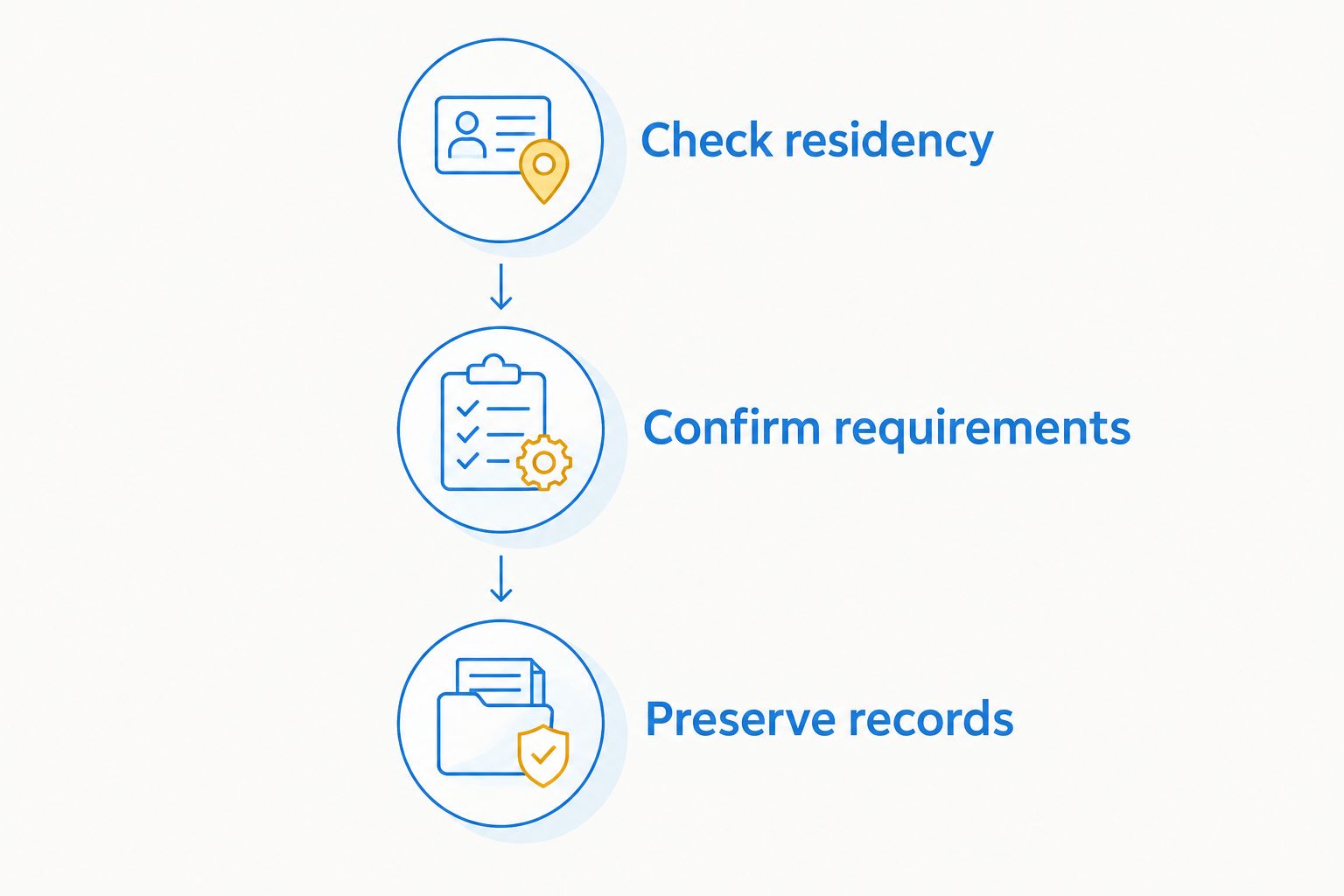
Use these three checks before filling out a gun transfer form in 2026. They establish what you need the document to do.
Check residency
Establish where the buyer and seller legally reside. Federal law generally requires dealer involvement for private firearm transfers between residents of different states, subject to limited exceptions; a private bill of sale does not remove that requirement.
Confirm requirements
Identify the applicable federal, state, and local requirements for the firearm and transaction. Check whether dealer processing, a background check, authorization, a waiting period, or official paperwork applies before arranging delivery.
Preserve records
Complete the required process, then retain the appropriate transaction documentation securely. Keep official paperwork distinct from optional supporting records so that you understand what each document establishes.
Do not hand over the firearm just because every signature field is complete. The decisive question is whether the required transfer conditions have been satisfied, not whether the PDF looks finished.
How these options rank
The ranking prioritizes legal role, transfer fit, process coverage, record quality, privacy, and execution requirements. It does not treat an online service, federal form, state filing, and private agreement as equivalent products.
For supported private sales, the service approach ranks first because its stated scope addresses more than documentation alone. When a dealer or state form is required, that requirement takes priority over the overall ranking. A supplementary record belongs alongside the required process, never ahead of it.
Which gun transfer form should you choose?
Choose the required process first, then the narrowest set of documents that accurately supports it. For a supported private sale, an online compliance service is the default recommendation here. For a dealer transfer, follow the dealer's paperwork instructions; for mandatory state paperwork, use the applicable official form.
If your only unresolved task is recording the agreement, choose a suitable bill of sale. If your only unresolved task is signing that agreement, evaluate electronic execution separately. Neither task should reopen a compliance decision you have not actually settled.
This 2026 comparison is general information, not transaction-specific legal advice. Confirm current requirements with the relevant authority, licensed dealer, or qualified attorney before transferring possession.
FAQ
What's the best digital gun transfer form for a private sale?
Guntransfer is the best option in this comparison for supported private sales needing background checks, bills of sale, and ownership records. Its stated service scope covers 37 states; confirm that your particular transaction qualifies before starting.
Is a firearm bill of sale enough to transfer ownership legally?
A firearm bill of sale alone does not establish that a transfer is lawful. You must also satisfy applicable eligibility, dealer, background-check, and other transfer requirements.
Can I use ATF Form 4473 for a private gun sale?
ATF Form 4473 belongs within the applicable licensed-dealer transfer process, not as a standalone private-sale solution. If your transaction goes through a dealer, follow that dealer's completion instructions.
Can I sign a gun transfer form electronically?
Electronic signing is appropriate only when the governing rules accept it for that document and purpose. A signature tool does not replace required dealer processing, official filings, or background checks.
Do I need a different form if the buyer lives in another state?
An interstate transaction requires you to resolve the transfer route, not merely select a different form. Federal law generally requires dealer involvement for private transfers between residents of different states, subject to limited exceptions.
What details should a firearm bill of sale contain?
A supporting firearm bill of sale should clearly identify the parties, firearm, transaction date, agreed terms, and signatures. Required official forms can demand different information, so follow their instructions separately.
Does a signed gun transfer form prove the buyer passed a background check?
A signed transfer form does not by itself prove that a required background check occurred. Complete the applicable check through the authorized process rather than relying on a buyer's signature or eligibility statement.
One last thing
Do not confuse an ownership record with a universal registration certificate. A private transaction record documents what the parties agreed and recorded; it does not automatically establish a government registration or replace an official filing.
Before signing, ask one final question: what does this particular document prove? If the answer is only that both parties signed, you still need to verify that the transfer itself follows the required process.