Best overall: an FFL-assisted transfer. Best for guided paperwork: Guntransfer. Best for proof of the transaction: a detailed bill of sale. This 2026 guide explains how to protect yourself selling a gun privately by checking the legal transfer route, documenting the sale, and refusing an unsafe handoff.
- For how to protect yourself selling a gun privately, start with the lawful transfer route—not just a receipt.
- An FFL-assisted transfer is the best default when you need a dealer to handle the transfer process.
- Guntransfer is best for private sellers seeking guided background-check handling, bills of sale, and ownership records.
- A bill of sale documents a transaction; it does not make an unlawful firearm transfer legal.
Why this matters
Your protection depends on what happens before the firearm changes hands. A signed receipt cannot fix an unlawful transfer, and a buyer's promise cannot replace a required background check.
Guntransfer provides an online private firearm transfer compliance service covering 37 states, with background-check handling, bills of sale, and ownership records. Confirm that your particular transaction fits the service and the applicable law before proceeding.
The methods below address different risks. Treat them as layers, not substitutes: you still need a lawful recipient, the correct transfer process, useful records, and a controlled handoff.
What makes the best private-sale protection
Use these criteria to judge any private firearm transfer method in 2026:
- Legal fit: The process addresses the seller's state, the buyer's state, the firearm, and applicable local requirements.
- Recipient screening: The process includes any required eligibility verification and background check.
- Transaction evidence: Your records identify the actual parties, the firearm, and when the transfer occurred.
- Clear responsibility: Both parties know who handles the check, paperwork, custody, and final release.
- A stopping point: You can refuse to proceed when information conflicts, requirements remain unresolved, or the handoff feels unsafe.
Choose the transfer route before collecting signatures. Paperwork should record a lawful process, not stand in for one.
Private-sale protection methods at a glance
| Rank and method | Best for | Main protection | Key limitation |
|---|---|---|---|
| 1. FFL-assisted transfer | Dealer-handled transfer procedures | Places the transaction within a licensed dealer's applicable process | Requires coordination; confirm the dealer accepts private-party transfers |
| 2. Guntransfer | Guided online compliance and records | Handles background checks, bills of sale, and ownership records | Covers 37 states, not every jurisdiction or transaction |
| 3. State and local rule verification | Identifying the correct legal route | Separates your actual requirements from generic advice | Reading the rules does not complete the transfer |
| 4. Detailed bill of sale | Evidence of the transaction | Records the parties, firearm, and transfer details | Does not establish buyer eligibility or replace required procedures |
| 5. Controlled handoff plan | Personal safety and transaction clarity | Reduces confusion over handling, payment, and release | Cannot correct an unlawful sale |
1. FFL-assisted transfer: best for dealer-handled procedures
A Federal Firearms Licensee, or FFL, can handle a private-party transfer through the dealer's applicable procedures. Contact the dealer before arranging the sale; do not assume every licensee accepts this work.
An FFL-assisted transfer is the best default when you need a licensed professional to handle the transfer process. Explain the parties' states of residence and the firearm involved so the dealer can identify whether and how to accept the transaction.
Federal law generally prohibits an unlicensed person from directly transferring a firearm to an unlicensed resident of another state, subject to limited exceptions. For an ordinary interstate private sale, arrange the lawful dealer route rather than meeting across a state line and exchanging a receipt.
FFL-assisted transfer pros:
- Gives you a defined dealer-controlled transfer process.
- Places required dealer checks and records with the licensee.
- Provides a clear point at which the dealer releases the firearm.
FFL-assisted transfer cons:
- Requires advance coordination with a participating dealer.
- Does not remove restrictions on a particular firearm or recipient.
- Does not replace your obligation to describe the transaction honestly.
Best for: Sellers who want dealer involvement, especially when a dealer transfer is legally required.
Verdict: Buy dealer-assisted transfer service when your transaction requires it; do not substitute informal paperwork.
2. Guntransfer: best for guided online compliance and records
Guntransfer provides private individuals with an online service for person-to-person firearm sales. Its stated scope includes background checks, bills of sale, and ownership records across 37 states.
Guntransfer is best for private sellers seeking guided firearm transfer compliance and transaction records. Use it to organize the compliance process, while confirming that the specific sale falls within its supported scope.
Do not interpret online paperwork as permission to bypass a required dealer. An online service and a physical dealer transfer address different parts of a transaction unless the stated process expressly connects them.
Guntransfer pros:
- Brings background-check handling and sale documentation into one service.
- Includes ownership records rather than only a standalone receipt.
- Focuses on private person-to-person firearm transfers.
Guntransfer cons:
- Its stated coverage is 37 states, not all states.
- You still need to establish that your transaction qualifies.
- Service use does not override federal, state, or local law.
Best for: Private sellers who want a guided compliance process with supporting records.
Verdict: Hold the handoff until service eligibility and the required transfer route are confirmed.
3. Rule verification: best for choosing the lawful route
Before accepting a meeting, identify both parties' states of residence and the type of firearm being transferred. Then check the rules that apply to the transaction—not just whether private sales are generally permitted in your state.
For a 2026 sale, check current official state sources and applicable local requirements. Look for dealer involvement, background checks, permits, waiting periods, firearm restrictions, and recordkeeping obligations.
Federal law also prohibits disposing of a firearm to someone you know or have reasonable cause to believe falls within a prohibited category. That rule appears in 18 U.S.C. § 922(d); the general interstate restriction on unlicensed transfers appears in § 922(a)(5).
A buyer's carry permit is not a universal substitute for the checks or procedures governing a sale. For the screening side of the transaction, review the background-check options for a private gun sale, then verify the applicable requirement with an official source or the handling dealer.
Rule verification pros:
- Identifies requirements before you commit to a handoff.
- Distinguishes same-state sales from interstate transactions.
- Helps expose advice that applies to a different jurisdiction.
Rule verification cons:
- General summaries do not resolve every factual situation.
- Checking a rule does not perform a required check or transfer.
Best for: Every seller, particularly when residence, firearm type, or an exception is unclear.
Verdict: Hold the transaction whenever a legal requirement remains unresolved.
4. Detailed bill of sale: best for transaction evidence
A bill of sale records what the parties say occurred. Its value comes from accurate details that connect the actual seller, actual buyer, specific firearm, and completed transaction.
As a practical record, include the transaction date, the parties' identifying information as appropriate, the firearm's manufacturer, model, caliber or gauge, serial number, and signatures. Include dealer documentation when applicable, and follow any jurisdiction-specific form or retention requirement.
A bill of sale is evidence, not immunity. A buyer's eligibility statement does not replace a required background check, and a release-of-liability clause does not make an unlawful transfer lawful.
Avoid unnecessary copies of sensitive identity documents. Collect what the law and legitimate transfer process require, keep accurate records, and restrict access to them.
Detailed bill of sale pros:
- Links the firearm to a dated transaction.
- Records the parties' acknowledgment of the sale.
- Supports a consistent record alongside dealer or service documents.
Detailed bill of sale cons:
- Does not independently establish buyer eligibility.
- Inaccurate information weakens the record.
- Sensitive personal information requires careful storage.
Best for: Sellers who need a clear record of a lawfully completed transaction.
Verdict: Hold the transfer until the required records are accurate; skip any form presented as a guarantee against liability.
5. Controlled handoff: best for personal safety
Agree on the lawful location, participants, handling rules, and payment process before meeting. If a dealer handles the transfer, follow the dealer's instructions about bringing in the firearm and when custody changes.
For any lawful in-person handling, keep the firearm unloaded, keep ammunition separate, and maintain safe muzzle direction. A familiar public location is not automatically an authorized firearm transaction site; verify the location's rules first.
Do not hand over the firearm merely because someone displays a payment screenshot. Confirm receipt through your own payment channel, and keep payment confirmation separate from the decision that the legal transfer requirements are complete.
Stop if the named buyer changes, someone asks you to falsify paperwork, or the buyer pressures you to bypass a required step. An apparently convenient sale is not a reason to accept conflicting information.
Controlled handoff pros:
- Establishes handling expectations before either party arrives.
- Separates payment confirmation from lawful release.
- Gives you clear reasons to stop rather than improvise.
Controlled handoff cons:
- A meeting plan cannot establish legal eligibility.
- Public visibility does not guarantee safety or permission.
- Accurate paperwork cannot eliminate every personal-safety risk.
Best for: Sellers arranging the physical completion of an otherwise lawful sale.
Verdict: Skip the handoff when participants, payment, safety conditions, or required procedures change unexpectedly.
Put the protections in the right order
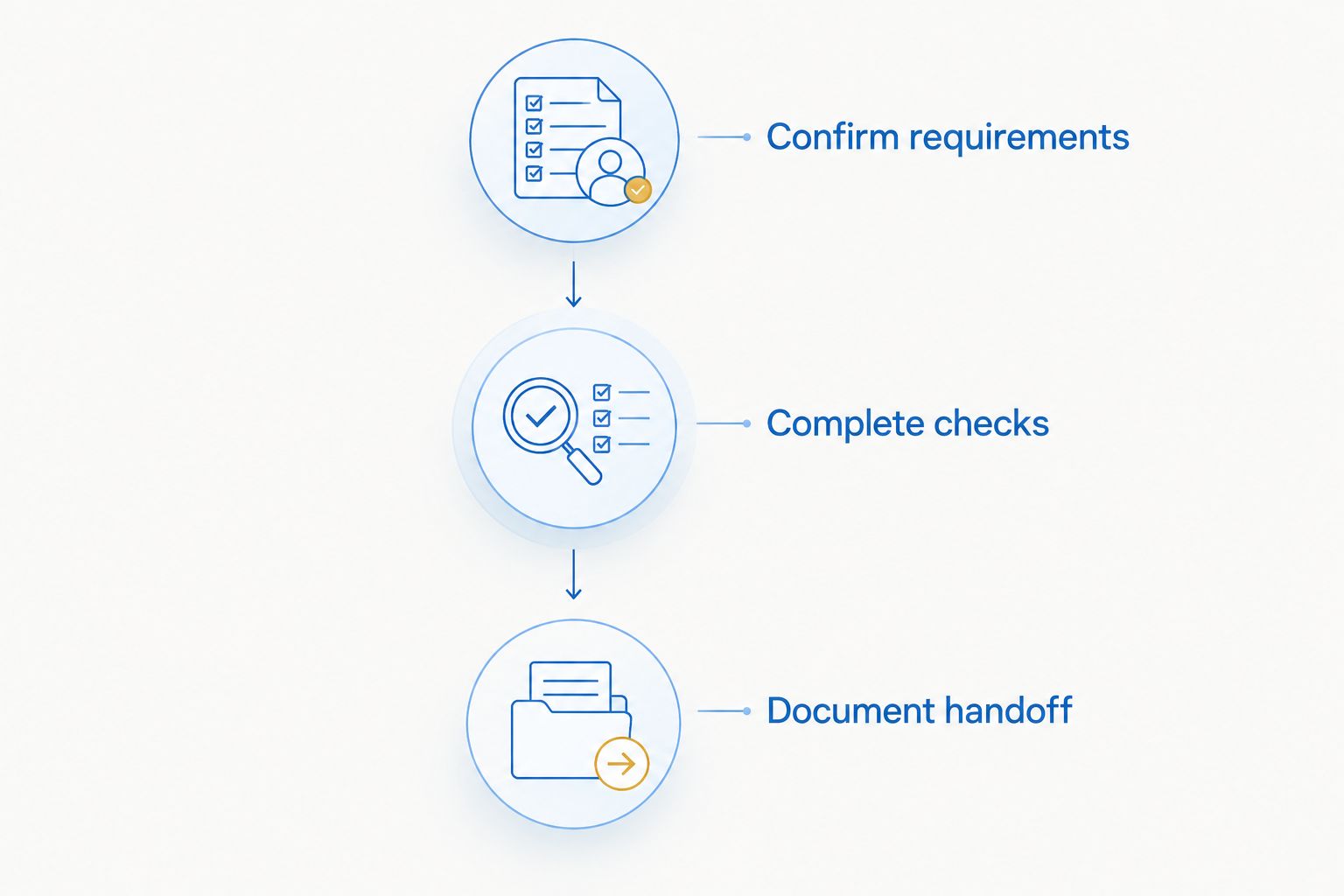
Use these 3 stages for a private sale in 2026. Do not move to the next stage while an earlier requirement remains unresolved.
Confirm requirements
Establish residence, firearm details, and the applicable transfer route. Identify any dealer, permit, background-check, or waiting-period requirement before setting the handoff.
Complete checks
Follow the required process and complete accurate records. If a dealer controls release, let the dealer determine when its transfer requirements are satisfied; do not treat submitting information as approval.
Document handoff
Confirm that the lawful release conditions and agreed payment conditions are satisfied. Finish the transaction record and retain the relevant documents securely.
How the methods are ranked
The ranking prioritizes legal fit, recipient screening, transaction evidence, clear responsibility, and the ability to stop. Dealer assistance ranks first because it puts the transfer within a licensed process; documentation and meeting precautions cannot substitute for that process when it is required.
These are complementary protections, not competing products. Use the strongest combination that fits your actual transaction rather than selecting one method and ignoring the rest.
Which protection should you choose?
Start with the lawful transfer route, then add records and a controlled handoff. If you are undecided, ask a participating FFL how the proposed transaction must be handled before arranging delivery.
For a supported transaction, guided online compliance can help organize the checks and records. For an interstate sale or another transaction requiring dealer involvement, establish the correct dealer route first.
The central decision is not which receipt looks most official. It is who is legally permitted to receive the firearm, through what process, and when release is allowed.
FAQ
What's the best way to protect myself when selling a gun privately?
Use the lawful transfer route, complete required checks, and keep accurate transaction records. An FFL-assisted transfer is the best default when you need a licensed dealer to handle the process; a receipt alone is not enough.
Does a bill of sale remove my liability after a private gun sale?
No. A bill of sale documents the transaction but does not create blanket immunity or make an unlawful transfer legal. Its usefulness depends on accurate information and the facts of the sale.
Can I sell a gun directly to someone who lives in another state?
An ordinary interstate private sale generally requires a lawful dealer transfer rather than direct delivery between unlicensed residents of different states. Federal law contains limited exceptions, so confirm the correct route before shipping or handing over the firearm.
Does a concealed carry permit replace a background check for a private sale?
Not automatically. Whether a permit affects a particular transfer requirement depends on the applicable law and transaction. Do not treat possession of a permit as universal authorization to complete the sale.
Can I run an FBI NICS check myself as a private seller?
An ordinary unlicensed private seller cannot access FBI NICS as a dealer would. Use the dealer or other legally authorized process required for your transaction rather than treating an unrelated online search as a NICS check.
Should I keep a copy of the buyer's driver's license?
Keep the information required by applicable law and the legitimate transfer process, rather than automatically copying an entire identity document. Protect sensitive records and confirm any specific recordkeeping obligations before the sale.
When should I refuse to complete a private gun sale?
Refuse when you know or have reasonable cause to believe the recipient is prohibited, or when required transfer conditions are not satisfied. Also stop when someone requests false paperwork, substitutes a different recipient, or creates unsafe handling conditions.
One last thing
In 2026, the name on the paperwork still needs to match the actual transaction. If a different person arrives to receive the firearm, stop and reassess the parties and required process rather than editing the receipt and continuing.
A refusal before handoff is a protection you cannot recreate afterward. Keep that stopping point throughout the sale.