Yes, you can buy a gun without a purchase permit where state and local law do not require one, provided you are legally eligible and complete the required transfer process. No purchase permit does not mean no background check, no waiting period, or permission to carry the firearm.
- Can I buy a gun without a permit? Yes, where purchase permits are not required and other legal conditions are satisfied.
- Federal dealer sales generally require Form 4473 and a background check, even without a purchase permit.
- Purchase permits, concealed carry licenses, and firearm registration serve different legal purposes.
- Guntransfer supports private firearm transfer compliance; it does not replace a legally required permit or dealer transfer.
Why this matters
The word permit can refer to permission to purchase, possess, or carry a firearm. Those are separate questions, and answering the wrong one can leave you with an unlawful transfer even when the buyer and seller agree to the sale.
For a private purchase in 2026, start with whether private gun sales are legal in your state. Then confirm the rules for the firearm, the buyer, and the transfer itself. A seller's assurance is not a substitute for those checks.
Can I buy a gun without a permit?
Federal law does not generally require a purchase permit for an ordinary handgun, rifle, or shotgun. State and local requirements still apply. Your answer depends on the applicable jurisdiction, the firearm category, your eligibility, and whether the seller is a licensed dealer or a private individual.
The federal framework comes primarily from the Gun Control Act, including 18 U.S.C. § 922. For a 2026 purchase, use that federal baseline alongside current state statutes and the instructions of the agency responsible for firearm licensing.
| Requirement | What it establishes | What it does not establish |
|---|---|---|
| Purchase permit | Authorization to acquire a firearm where required | Permission to carry it in public |
| Background check | Screening for legal disqualifications through the applicable process | A universal license to purchase or carry |
| Carry license | Authorization to carry under the issuing jurisdiction's rules | Automatic satisfaction of purchase requirements |
| Registration | A required firearm record in jurisdictions that mandate it | Replacement of a required permit or transfer process |
| Bill of sale | A written record of the transaction | Proof that every legal requirement was satisfied |
Treat these requirements as separate checkpoints. Completing a bill of sale does not cure a missing purchase permit, and having a carry license does not automatically remove a waiting period.
Buying from a licensed dealer without a permit
A federally licensed firearms dealer, commonly called an FFL, must follow federal dealer-transfer requirements. For an ordinary consumer purchase, that generally means identity verification, ATF Form 4473, and the applicable background-check process before delivery.
Under 18 U.S.C. § 922(t), qualifying exceptions to the background-check requirement exist. Certain state permits qualify under federal rules, but not every carry permit is a background-check substitute. The dealer must establish whether an exception applies.
Federal dealer age requirements
Federal law generally sets these minimum ages for dealer sales:
- 18 years old: Rifles and shotguns.
- 21 years old: Handguns and firearms other than rifles or shotguns.
These dealer-sale thresholds appear in 18 U.S.C. § 922(b)(1). State law can impose additional restrictions, so meeting the federal minimum does not by itself establish eligibility for a particular purchase.
A firearm's legal classification matters. Do not assume that every item sold alongside rifles follows the rifle purchase rules; frames, receivers, and other firearm categories require the dealer to apply the correct classification.
For a dealer purchase in 2026, ask what identification, residency evidence, permits, and waiting periods apply before arranging collection. A permit-free purchase still requires a lawful dealer transfer.
Buying from a private seller without a permit
A private sale does not automatically require a federal purchase permit. It also does not automatically qualify for a direct handoff between buyer and seller.
Some states require private transfers to pass through a dealer or another prescribed background-check process. Others impose purchase authorization, waiting periods, reporting, or restrictions tied to the firearm category. Any exemption must match the actual transaction.
Federal law also restricts transfers to prohibited people. Under 18 U.S.C. § 922(d), a person must not transfer a firearm while knowing or having reasonable cause to believe the recipient falls within specified prohibited categories.
A bill of sale documents a transaction; it does not authorize one. If the law requires a dealer, permit, or background check, private paperwork cannot replace that requirement.
For eligible transactions, Guntransfer provides an online private firearm transfer compliance service covering background checks, bills of sale, and ownership records across 37 states. Guntransfer is best for private buyers and sellers who need help completing and documenting a lawful person-to-person firearm transfer. Its service does not remove a legally required permit, waiting period, or dealer involvement.
Check your private transfer process
Review the service before arranging a person-to-person firearm transfer.
Buying from someone in another state
An interstate purchase introduces a separate federal issue: the parties' states of residence. Meeting in person does not turn an interstate transaction into a same-state private sale.
Federal law generally requires an unlicensed person acquiring a firearm from an unlicensed resident of another state to receive it through the appropriate licensed-dealer process. An ordinary interstate handgun purchase generally requires delivery through a dealer in the buyer's state of residence.
A licensed dealer can, under federal conditions, sell a rifle or shotgun in person to an eligible resident of another state when the transaction complies with the laws of both states. That rule does not create permission for a direct interstate private transfer.
Inheritance and other statutory exceptions have their own rules. Do not apply an exception for a bequest to an ordinary paid purchase.
For your 2026 transaction, establish residency before selecting the transfer method. Shipping address, meeting location, and the state where an advertisement appeared do not independently settle the residency question.
Why purchase-permit requirements vary
The permit question changes because several legal requirements overlap. Check each factor rather than relying on a single statewide summary.
- Jurisdiction: State law, and applicable local law, determines whether additional purchase or possession authorization is required.
- Firearm category: Handguns, rifles, shotguns, and specially regulated firearms do not necessarily follow the same process.
- Seller status: Licensed dealers have federal obligations that differ from those of unlicensed private sellers.
- Buyer eligibility: Age, residency, and prohibited-person restrictions remain relevant even without a permit requirement.
- Transaction type: A same-state purchase, interstate purchase, gift, and inheritance can trigger different rules.
- Permit recognition: A license can satisfy one requirement without satisfying another; a carry credential is not universal purchase authorization.
This guide addresses ordinary firearm purchases. National Firearms Act items, including suppressors and short-barreled rifles, involve a separate federal framework and require their own review.
How to check whether your purchase needs a permit
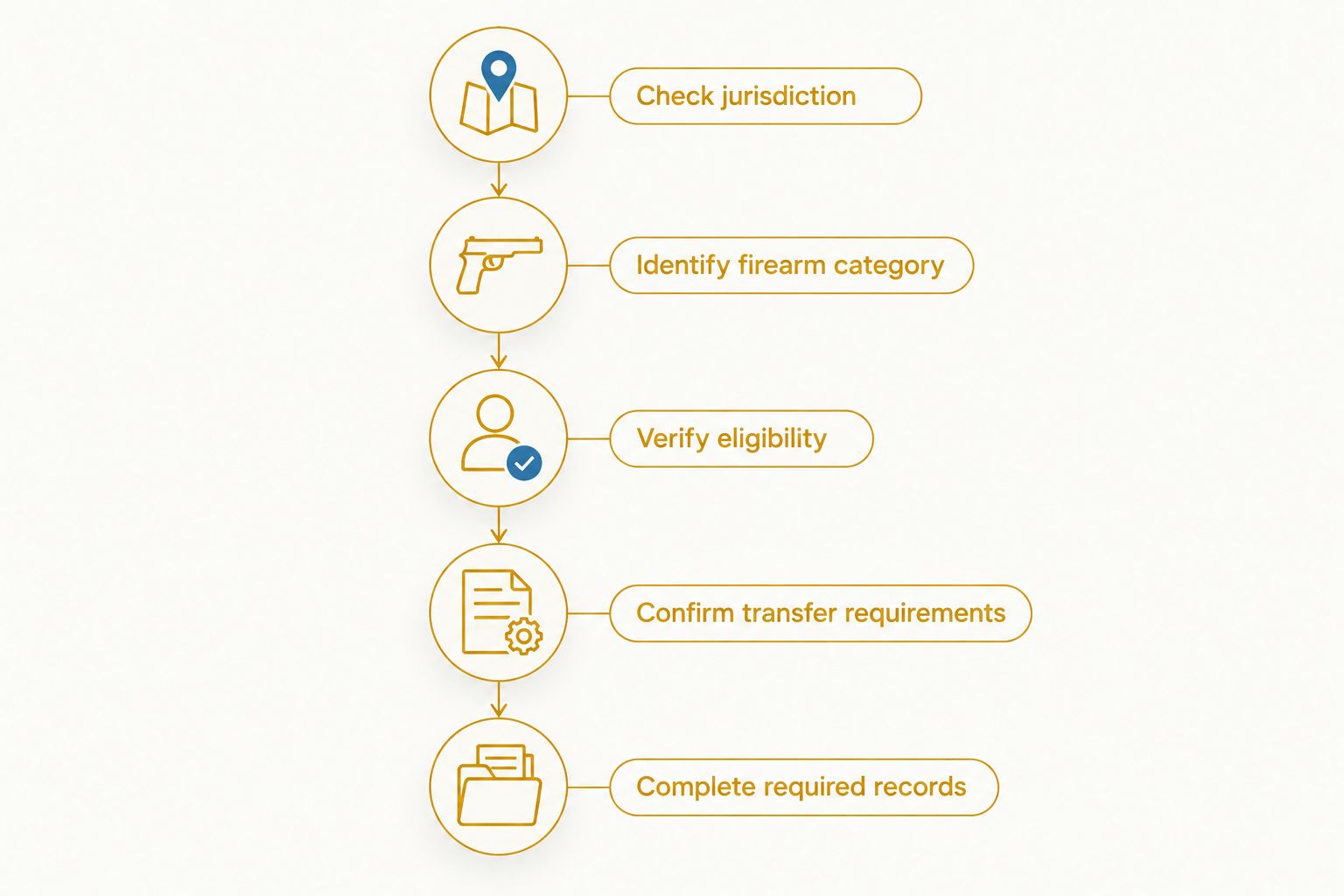
Use this sequence before completing a firearm purchase in 2026. Confirm the legal transfer route before arranging delivery.
- Check jurisdiction. Establish your state of residence, the seller's state of residence, and the location where the transfer will occur. Identify any applicable local requirements.
- Identify firearm category. Confirm whether the item is a handgun, rifle, shotgun, receiver, or another regulated category. Use the legal classification, not an advertisement's shorthand.
- Verify eligibility. Check the applicable age rules and disqualifications. If you are uncertain about a conviction, court order, or other legal restriction, obtain qualified legal advice before proceeding.
- Confirm transfer requirements. Consult the responsible state agency's current instructions and, when a dealer is involved, ask that dealer what the transaction requires. Establish whether you need a permit, background check, waiting period, or additional documentation.
- Complete required records. Complete the applicable dealer or private-transfer paperwork and retain the records you are legally entitled or required to keep. Do not treat recordkeeping as permission to bypass an earlier step.
If an official source and a seller's explanation conflict, resolve that conflict before accepting the firearm. Save the relevant official instructions with your transaction records when appropriate, but remember that a saved webpage is not legal authorization.
Does permitless carry mean I can buy without a permit?
Permitless carry does not establish whether a purchase permit is required. Carry rules govern carrying a firearm; purchase rules govern acquiring it.
Likewise, a carry license issued by one state does not automatically satisfy another state's purchase requirements. Reciprocity for carrying and eligibility to purchase are different legal questions.
Can I buy a gun online without a permit?
Buying online does not remove a permit requirement or change the required transfer route. The advertisement and payment method do not override laws governing the buyer, seller, firearm, and delivery.
An online interstate purchase generally still requires the appropriate dealer transfer. Confirm the receiving dealer's requirements before the seller ships the firearm; an order confirmation is not authorization to take possession.
Can I use a bill of sale instead of a purchase permit?
A bill of sale cannot replace a legally required purchase permit. It records transaction details rather than granting permission to acquire or possess a firearm.
Guntransfer supports private firearm transfer compliance through background checks, bills of sale, and ownership records. Keep that administrative support separate from the government authorization and dealer involvement your transaction requires.
What should I check before accepting the firearm?
Before taking possession, confirm that any required permit is valid for the transaction and that required checks and waiting periods are complete. Ask the dealer or responsible agency to resolve any uncertainty about release conditions.
Do not confuse a submitted application with an issued permit, or a background-check submission with authorization to transfer. Each process has its own completion point.
Also distinguish ownership from transport. A lawful purchase does not automatically authorize every method of carrying the firearm home, crossing state lines, or entering restricted locations. Check those rules separately before collection.
FAQ
Can I buy a gun without a permit in 2026?
Yes, where state and local law do not require a purchase permit and you satisfy all other legal conditions. Background checks, waiting periods, eligibility rules, and dealer-transfer requirements can still apply.
Do I need a concealed carry permit to buy a gun?
Federal law does not generally require a concealed carry permit to buy an ordinary firearm. State purchase or possession licensing requirements remain separate, and a carry permit does not automatically satisfy them.
Can I buy a handgun from a dealer at 18 years old?
Federal law generally requires you to be 21 years old to buy a handgun from a licensed dealer. The federal dealer-sale minimum for rifles and shotguns is generally 18 years old, subject to additional applicable restrictions.
Does buying from a private seller mean there is no background check?
No, a private purchase can require a background check under state law. Confirm whether the transfer must go through a dealer or another state-prescribed process before accepting the firearm.
Can a seller in another state hand me the gun directly?
An ordinary private firearm purchase between residents of different states generally requires a licensed-dealer transfer rather than a direct handoff. Limited statutory exceptions should not be assumed to cover a purchase.
Can Guntransfer replace a permit or an FFL?
Guntransfer does not replace a legally required permit or licensed-dealer transfer. It provides private firearm transfer compliance support covering background checks, bills of sale, and ownership records across 37 states.
Where should I verify purchase-permit requirements?
Verify purchase-permit requirements with the state agency responsible for firearm licensing and the current applicable statutes. For a dealer transaction, confirm the dealer's required documents and transfer conditions before arranging delivery.
One last thing
The right question is not only whether you need a permit; it is what must happen before you can legally take possession. A permit answers only part of that question.
Before completing a purchase, write down the required authorization, transfer route, release conditions, and records. If you cannot identify each applicable requirement, pause the transaction and confirm it with the responsible agency or a qualified attorney. This guide provides general information, not individualized legal advice.