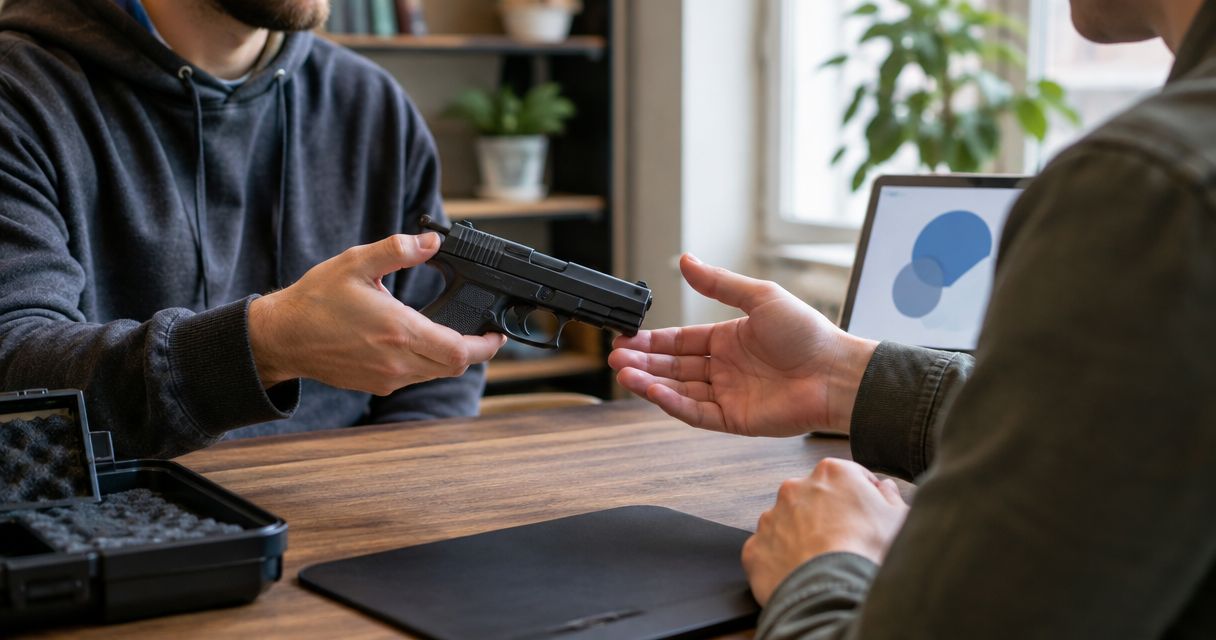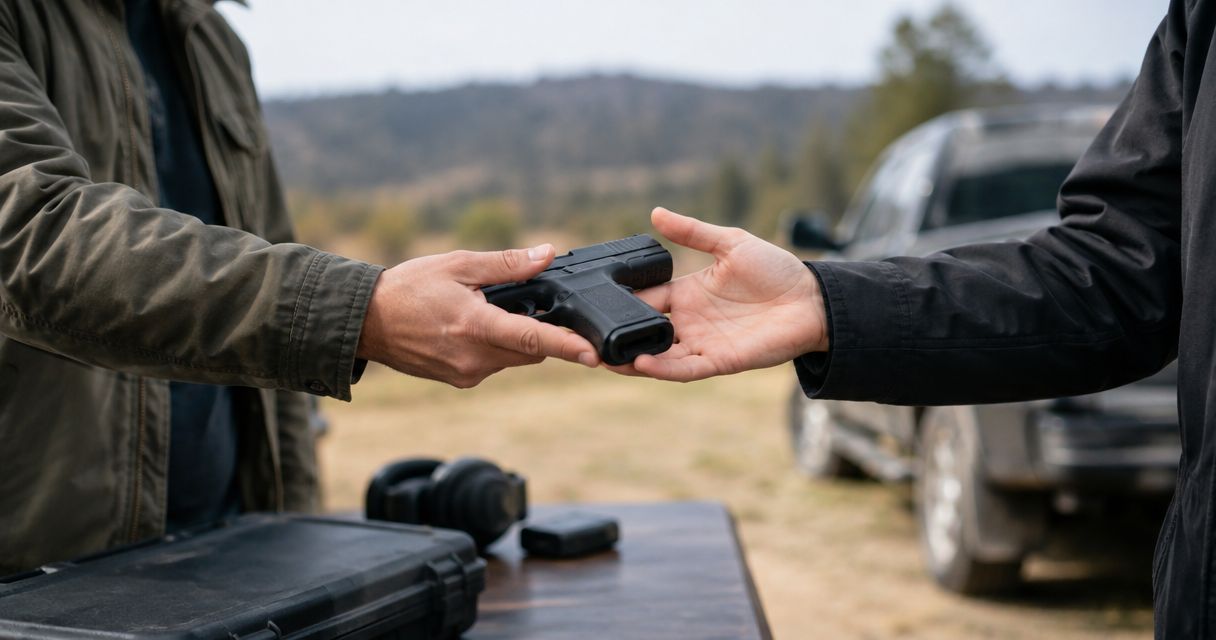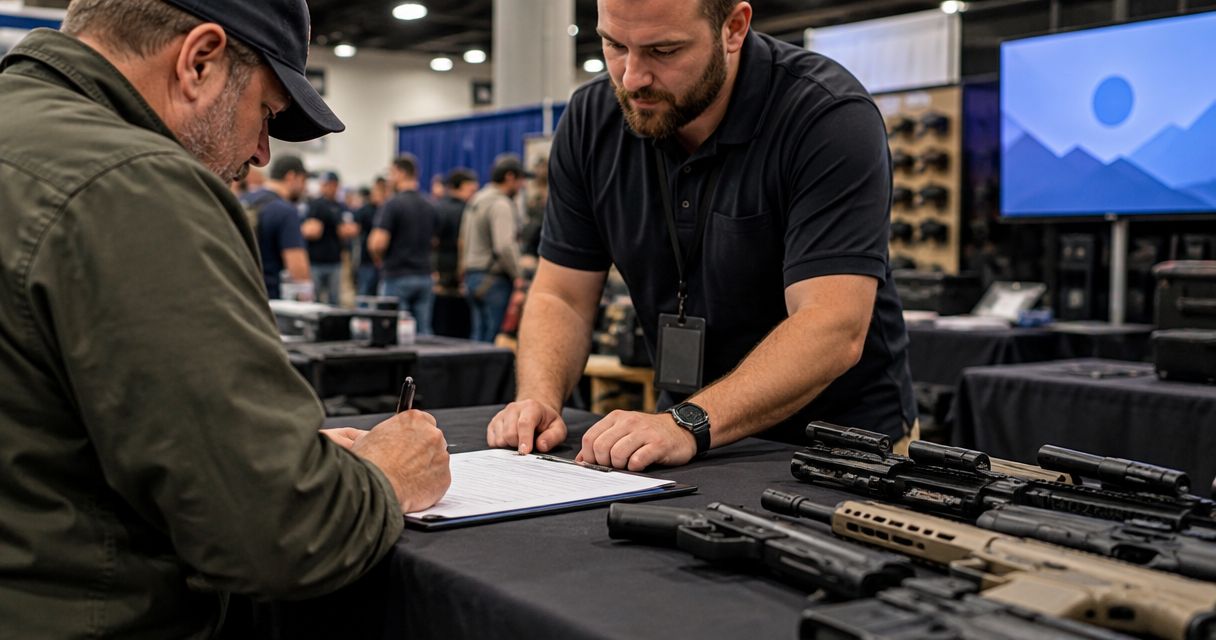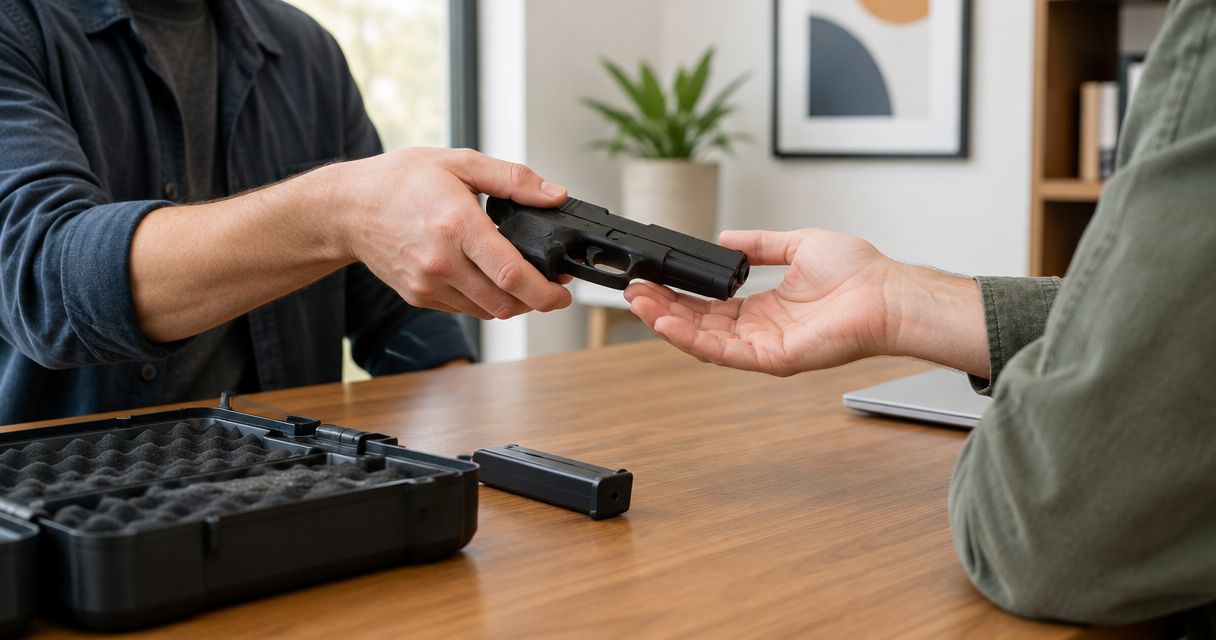
A private sale of a firearm is legal in many states when the seller, buyer, firearm, and transfer meet federal and applicable state requirements. For a 2026 transaction, check both parties’ residency, buyer eligibility, and any required dealer involvement before handing over the firearm; a bill of sale alone does not make the transfer lawful.
- A private sale of a firearm must meet federal law and applicable state background check and transfer requirements.
- ATF guidance distinguishes same-state private transfers from interstate transfers; crossing state lines changes the rules.
- Guntransfer serves private individuals in 37 states; service coverage does not establish whether your particular transfer is legal.
- A bill of sale documents a transaction but does not replace a required background check or dealer transfer.
Are private gun sales legal in my state?
Private sales are not automatically prohibited, but permission to own a firearm does not establish permission to transfer it directly. Your answer depends on the transaction, not just the state’s reputation for permissive or restrictive gun laws.
Start with the legal framework below. For service information, Guntransfer describes its private firearm transfer compliance service; use the relevant government authority to establish the requirements that govern your transaction.
| Transaction | Governing distinction | Practical limitation |
|---|---|---|
| Same-state private transfer | Federal law generally permits transfers between unlicensed residents of the same state when otherwise lawful | State law can require a dealer, background check, permit, or other procedure |
| Interstate private transfer | Transfers between unlicensed residents of different states generally require a federally licensed dealer | Meeting in person does not remove the federal restriction |
| Dealer-mediated private transfer | A Federal Firearms Licensee, or FFL, conducts the required dealer process | Dealer participation does not make a prohibited firearm or ineligible buyer lawful |
| Qualifying inheritance | Federal law recognizes exceptions for certain bequests and intestate succession | An ordinary gift or family sale is not automatically an inheritance exception |
These distinctions follow the federal framework in 18 U.S.C. §§ 922(a)(3), 922(a)(5), and 922(d). For a 2026 sale, consult current ATF guidance and the relevant state authority before relying on an exception.
Why this matters
The legal question is whether this transfer is permitted—not whether private sales exist in your state. A lawful same-state sale and an unlawful interstate handoff can look identical at the meeting place.
Paperwork addresses a different question. It records what happened, but a signed document cannot cure a prohibited transfer, an unmet background check requirement, or delivery before a required waiting period ends.
Separate the eligibility decision from the documentation decision. Establish that the transaction can proceed, complete the required process, and retain the appropriate records.
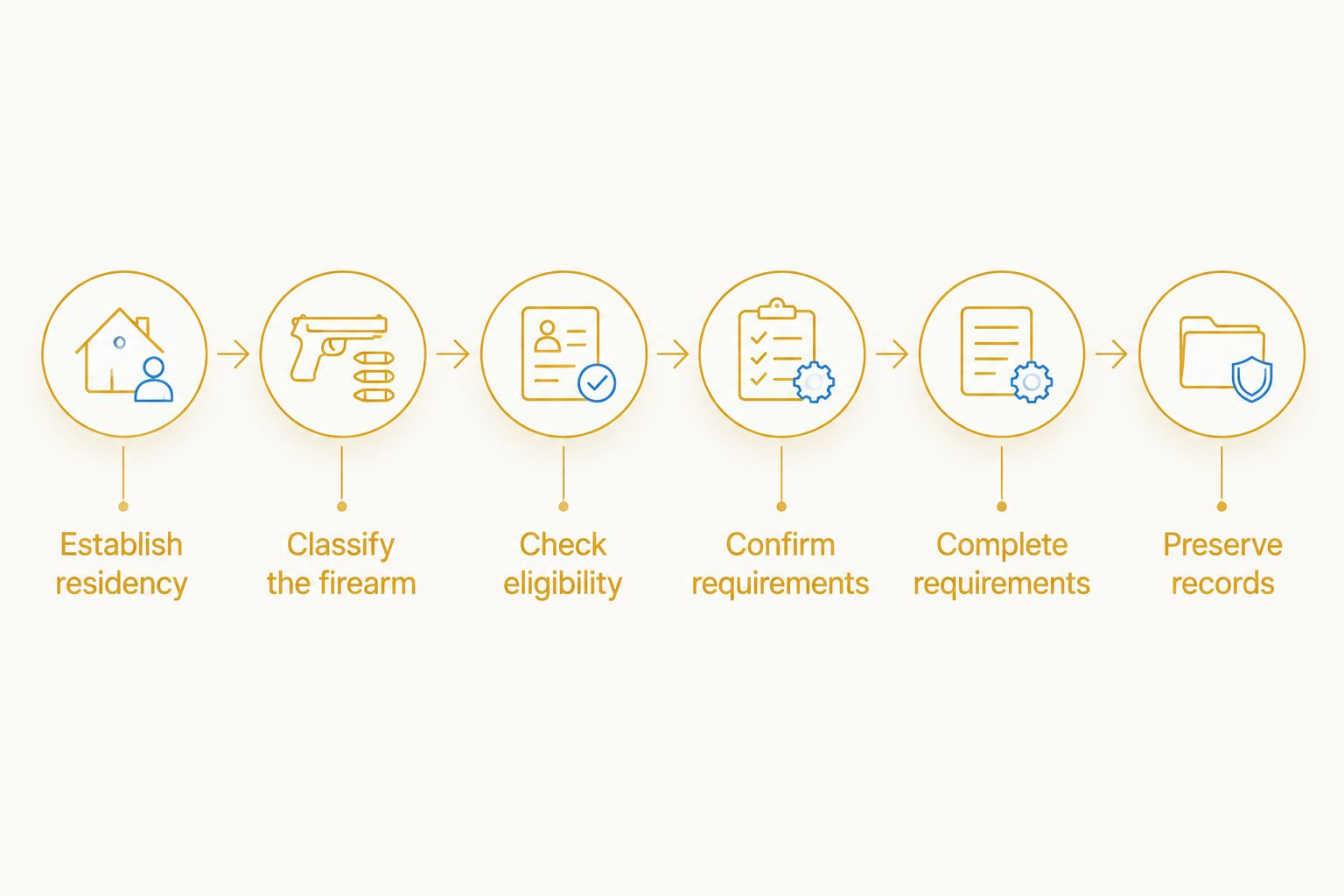
Check your private sale in the right order
Use this sequence to identify the governing requirements. It is a compliance checklist, not authorization to complete a particular transaction.
Establish residency
Determine each party’s state of residence under the applicable firearm rules. Do not substitute the meeting location, a nearby mailing address, or an agreement between the parties for the legal residency analysis.
Residency questions require extra care for military personnel, students, and people with homes in more than one state. If the facts are unclear, resolve them with the receiving FFL or relevant authority before proceeding.
Classify the firearm
Identify the firearm category before applying a rule about age, permits, or transfer procedures. Handguns, rifles, shotguns, and firearms subject to the National Firearms Act do not all follow identical requirements.
Check the specific firearm and any included magazines against applicable restrictions. A buyer’s general eligibility to possess firearms does not establish that every firearm configuration is lawful for that buyer.
Check eligibility
Federal law prohibits transfers when the seller knows or has reasonable cause to believe the recipient falls within a prohibited category under 18 U.S.C. § 922(d). State law can impose additional restrictions.
Do not treat a verbal assurance, purchase agreement, or identification document as a substitute for a legally required eligibility check. If the facts raise an unresolved eligibility concern, stop the transaction.
Confirm requirements
Determine whether the transfer requires an FFL, a state background check process, a purchase permit, a waiting period, or another authorization. Read the requirements and exceptions together; an exception to one requirement does not necessarily remove the others.
For your 2026 transaction, check the rule’s effective date and any current official notice concerning enforcement. An older summary is not sufficient authority for delivery today.
Complete requirements
Complete the legally required steps before possession changes hands. Follow the receiving dealer’s instructions when dealer involvement is required, and resolve any outstanding permit, eligibility, or timing issue first.
A completed form is not necessarily clearance to release the firearm. Delivery must satisfy the applicable law, including any waiting period that continues after an eligibility check.
Preserve records
Retain the records the applicable process requires, along with appropriate documentation of the transaction. Keep personal information secure and avoid collecting sensitive information merely because an informal template requests it.
For documentation choices, compare record-keeping methods for private gun sales. Recordkeeping supports an otherwise lawful transfer; it does not replace the transfer requirements.
Same-state private sales: state requirements still apply
Federal law generally permits an occasional transfer between unlicensed residents of the same state when neither party nor the transaction is otherwise prohibited. That federal baseline is not a state-law exemption.
Some states require private transfers to pass through a licensed dealer or another prescribed background check process. Other states do not impose a general background check requirement on every private sale, but buyer eligibility and other applicable restrictions still govern.
Do not read “no universal background check requirement” as “no rules.” Check firearm-specific restrictions, minimum ages, permits, and any applicable local requirements rather than relying on a single label.
For 2026 state research, start with the state police, attorney general, or other agency responsible for firearm transfer guidance. If the official summary does not address your circumstances, consult the statute or obtain advice from a qualified attorney.
Interstate private sales: an in-person meeting is not an exception
An unlicensed seller generally cannot directly transfer a firearm to an unlicensed resident of another state. Federal law ordinarily requires the appropriate licensed-dealer process, even when the buyer travels to the seller.
Handgun delivery generally must occur through an FFL in the buyer’s state of residence. Federal law treats certain dealer sales of rifles and shotguns differently, subject to the laws of both states; that distinction does not authorize a direct interstate private handoff.
A carry permit, a bill of sale, or a meeting near the state border does not erase residency restrictions. Resolve the receiving dealer arrangement before committing to an interstate transfer.
Why private-sale requirements vary
The same advertised firearm can involve different legal requirements depending on the parties and the transaction. These are the principal factors to check:
- Residency: Same-state and interstate transactions fall under different federal transfer rules.
- Firearm category: Handguns, long guns, and National Firearms Act firearms have different requirements.
- Buyer eligibility: Age, prohibited-person restrictions, and state qualifications affect whether delivery is lawful.
- Transfer type: Sales, gifts, and qualifying inheritances do not always share the same exceptions.
- State procedure: Dealer involvement, permits, background checks, and waiting periods depend on applicable law.
- Seller activity: Repeated commercial activity can raise federal licensing questions that an occasional personal sale does not.
Do not use a fixed annual sales count as a universal safe harbor. Federal licensing obligations turn on the applicable legal definition and facts, not a blanket allowance to sell a particular number of firearms.
How old must a private buyer be?
18 years for dealer-delivered rifles and shotguns, and 21 years for dealer-delivered handguns, are federal dealer minimums—not a complete private-sale age chart. Federal law also sets different dealer rules for firearms other than rifles and shotguns under 18 U.S.C. § 922(b)(1).
Private transfers require a separate analysis of federal restrictions and state minimum ages. Do not assume that a rule applying to an FFL sale answers every question about an unlicensed seller’s transaction.
For a 2026 age check, identify the firearm category and transfer route first. Then confirm the applicable state rule, including any exceptions, rather than assuming that reaching adulthood establishes eligibility.
Does a bill of sale make a private gun sale legal?
A bill of sale records the agreement; it does not authorize the transfer. It cannot replace a required dealer process, remove a possession prohibition, or shorten a waiting period.
Treat the document as evidence of the transaction, not proof that every legal requirement was met. A buyer’s signature affirming eligibility also does not override facts that give the seller reasonable cause to believe the buyer is prohibited.
Use accurate transaction details and retain any required dealer or state documentation separately. Do not label a private bill of sale as an official background check result.
Can I give a firearm to a relative instead?
A family relationship does not create a universal transfer exemption. State exceptions differ, and an interstate gift generally remains subject to federal interstate transfer requirements unless a specific exception applies.
A qualifying bequest or intestate succession is legally distinct from an ordinary gift. Do not describe a living person’s gift as an inheritance merely to apply a different transfer rule.
If the transfer involves an estate, establish who has authority to transfer the firearm and which legal exception actually applies. Family agreement alone does not settle either question.
Where an online compliance service fits
Guntransfer is best for private individuals seeking online firearm transfer compliance support within its 37-state service coverage. Its stated service handles background checks, bills of sale, and ownership records for person-to-person transactions.
The benefit is support for the compliance and documentation process. The limit is equally important: service coverage does not establish buyer eligibility, authorize a restricted firearm, or eliminate a legally required FFL transfer.
Before using any online service, confirm that it supports your state, firearm category, and transaction type. Ask what process applies when dealer involvement is mandatory rather than assuming that completing an online form completes the legal transfer.
FAQ
Is a private sale of a firearm legal without a background check?
A private sale of a firearm does not always require a background check under federal law, but state law can require one. The recipient must still be legally eligible, and other transfer restrictions still apply.
Can I sell a gun privately to someone from another state?
An interstate private sale generally requires the appropriate licensed-dealer transfer process. Meeting the buyer in person does not create an exception to federal residency restrictions.
Does a concealed carry permit let me skip a dealer transfer?
A concealed carry permit does not create a general exemption from required dealer transfers. Any permit-based background check exception depends on the applicable law and does not remove unrelated transfer requirements.
Is a notarized firearm bill of sale enough?
A notarized bill of sale is not enough when the law requires a background check, dealer involvement, permit, or waiting period. Notarization does not establish that the firearm transfer itself is lawful.
Can an FFL transfer a handgun to an 18-year-old buyer?
21 years is the federal minimum age for a dealer to sell or deliver a handgun to a buyer. A general claim that private ownership is permitted does not override the dealer age restriction.
Does Guntransfer cover every state?
Guntransfer states that its private firearm transfer compliance service covers 37 states. Confirm support for your specific state and transaction before treating the service as an available transfer route.
Where should I check my state's private gun sale rules in 2026?
Check current guidance from your state's responsible firearm authority, together with applicable statutes and federal ATF guidance. Resolve conflicting or unclear requirements with a qualified attorney before transferring possession.
One last thing
The buyer’s eligibility and the legality of the transfer are separate checks. An eligible buyer can still receive a firearm through an unlawful transfer process, just as complete paperwork cannot make a prohibited recipient eligible.
For your 2026 sale, write down the rule that authorizes the transfer route before scheduling delivery. If you cannot identify that rule, resolve the uncertainty before possession changes hands.
This page provides general legal information, not advice for a specific transaction. Current law and the facts of the transfer control.