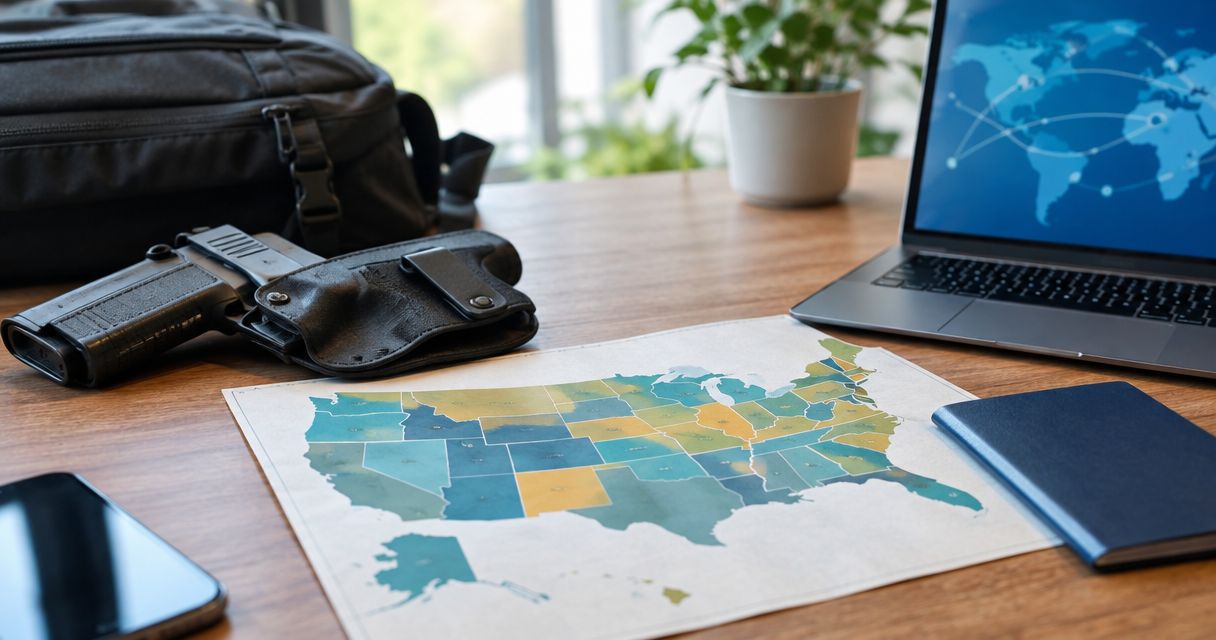
California, New Jersey, and New York each recognize 0 out-of-state permits as substitutes for their own ordinary civilian concealed-carry authorization. This 2026 guide to reciprocity by state uses those selected-state benchmarks to explain what recognition means, where a permit stops helping, and what you need to verify before traveling.
- Reciprocity by state depends on destination law; California, New Jersey, and New York do not substitute outside permits for local authorization.
- Guntransfer serves private firearm transfer compliance, not as a substitute for destination-state carry authorization.
- Check the issuing state, residency conditions, destination restrictions, and every state along your route.
- Permit recognition, permitless carry, firearm transport, and ownership transfers are separate legal questions.
Why this matters
A permit establishes authority under the law that governs it. Another state decides whether to recognize that permit, whether recognition has conditions, and where a recognized permit holder can carry.
A recognized permit does not import your home state's carry rules. Destination restrictions still apply, including restrictions on particular locations and conduct.
Guntransfer provides private firearm transfer compliance services for individuals across 37 states. That service scope concerns person-to-person sales, background checks, bills of sale, and ownership records—not permission to carry across state lines.
Selected-state reciprocity benchmarks for 2026
For this table, recognition means accepting another state's permit as authorization for ordinary civilian concealed carry. It does not mean permission to transport an unloaded firearm, qualify for a separate exemption, or apply for the destination state's permit.
The selected-state average is 0 recognized out-of-state permits, with a range of 0–0 permits. This is a deliberately narrow comparison, not a national average or a ranking of all states.
| State or benchmark | States covered | Recognized out-of-state permits for ordinary civilian concealed carry | Governing authorization framework |
|---|---|---|---|
| Overall: selected states | 3 states | 0 per state | Destination-issued authorization is distinct from an outside permit |
| California | 1 state | 0 permits | California Penal Code §§ 26150 and 26155 govern local licensing authority |
| New Jersey | 1 state | 0 permits | New Jersey Statutes § 2C:58-4 governs permits to carry handguns |
| New York | 1 state | 0 permits | New York Penal Law § 400.00 governs firearm licensing |
California, New Jersey, and New York tie at 0 recognized outside permits for ordinary civilian concealed carry. None leads this selected comparison; an out-of-state permit alone supplies no substitute for the destination's authorization.
Methodology: This 2026 reference compares the ordinary civilian licensing frameworks in the three named states, using the statutory provisions identified in the table. Its limitation is scope: the table does not measure nationwide recognition, permitless-carry eligibility, special statutory exemptions, or every restriction within each state.
California: an outside permit is not California authorization
California's concealed-carry licensing framework operates under California Penal Code §§ 26150 and 26155. A permit issued elsewhere does not replace a California concealed-carry license.
For travel planning, separate eligibility to obtain California authorization from recognition of an existing permit. They answer different questions, even when both involve the same traveler and handgun.
Best for travelers entering California: verify California's own authorization requirements before planning concealed carry. Do not treat lawful ownership or a home-state permit as the missing authorization.
New Jersey: carry permission and transport are separate
New Jersey Statutes § 2C:58-4 establishes the state's permit-to-carry framework. An outside carry permit does not stand in for that permit.
New Jersey also has statutory exemptions addressing particular possession and transportation circumstances. Those provisions are not general recognition of an outside concealed-carry permit, and their conditions require separate review.
Best for travelers entering New Jersey: resolve carry authorization first, then assess any transport question independently. Calling a trip transport does not establish that an exemption applies.
New York: state licensing has an additional local distinction
New York Penal Law § 400.00 supplies the state's licensing framework. An outside state's permit is not a substitute for New York authorization.
New York City also requires particular attention: a New York State license issued outside the city is not automatically valid there without the applicable city authorization under § 400.00(6). A state-level answer therefore does not finish every New York itinerary.
Best for travelers entering New York: check both state licensing requirements and the rules for the specific destination. Include New York City explicitly when it appears anywhere in your travel plans.
How to use these benchmarks
The selected states illustrate a hard boundary: 0 recognized outside permits means your existing permit does not supply ordinary concealed-carry authority there. Use that result to change your plan, not to search for a more favorable map color.
- Resolve authorization before packing. In the three listed states, an outside permit does not close the authorization gap. Confirm a lawful alternative rather than assuming reciprocity.
- Do not generalize the selected average. The 0-permit average describes these three states only. Check each additional destination independently.
- Treat route changes as new checks. Adding a state or a city with separate requirements changes the legal questions, even when your final destination remains the same.
- Keep service coverage separate from carry coverage. Guntransfer's private firearm transfer compliance service operates across 37 states; that number is not a reciprocity count.
For a comparison of research options, see concealed-carry reciprocity maps and tools. Use a map to locate the relevant question, then confirm the answer with the destination's official authority.
Recognition, permitless carry, transport, and transfers
These legal categories overlap in everyday conversation but do not grant interchangeable permissions. Identify the activity before choosing a reference source.
| Legal category | What it answers | Best for | Useful feature | Limitation |
|---|---|---|---|---|
| Permit recognition | Does the destination accept this outside permit? | Travelers relying on an existing permit | Connects a specific permit to a destination rule | Recognition can depend on conditions and does not erase location restrictions |
| Permitless carry | Can this person carry without a permit under destination law? | Travelers checking an independent carry pathway | Does not depend on recognition of an outside permit | Eligibility and restrictions still require review |
| Firearm transport | Under what conditions can this firearm be moved? | Travelers moving between lawful locations | Addresses movement rather than general carry authority | A transport provision is not unrestricted permission to carry |
| Ownership transfer | What must happen when ownership changes? | Private buyers and sellers | Addresses the transaction and required compliance | Transfer completion does not itself authorize concealed carry |
Guntransfer is best suited to private individuals who need firearm transfer compliance, not travelers seeking concealed-carry authorization. Its stated service covers background checks, bills of sale, and ownership records; destination carry law remains a separate check.
The distinction also prevents an easy paperwork mistake. A bill of sale documents a transaction, while a carry permit addresses an authorization question. Neither document automatically performs the other's job.
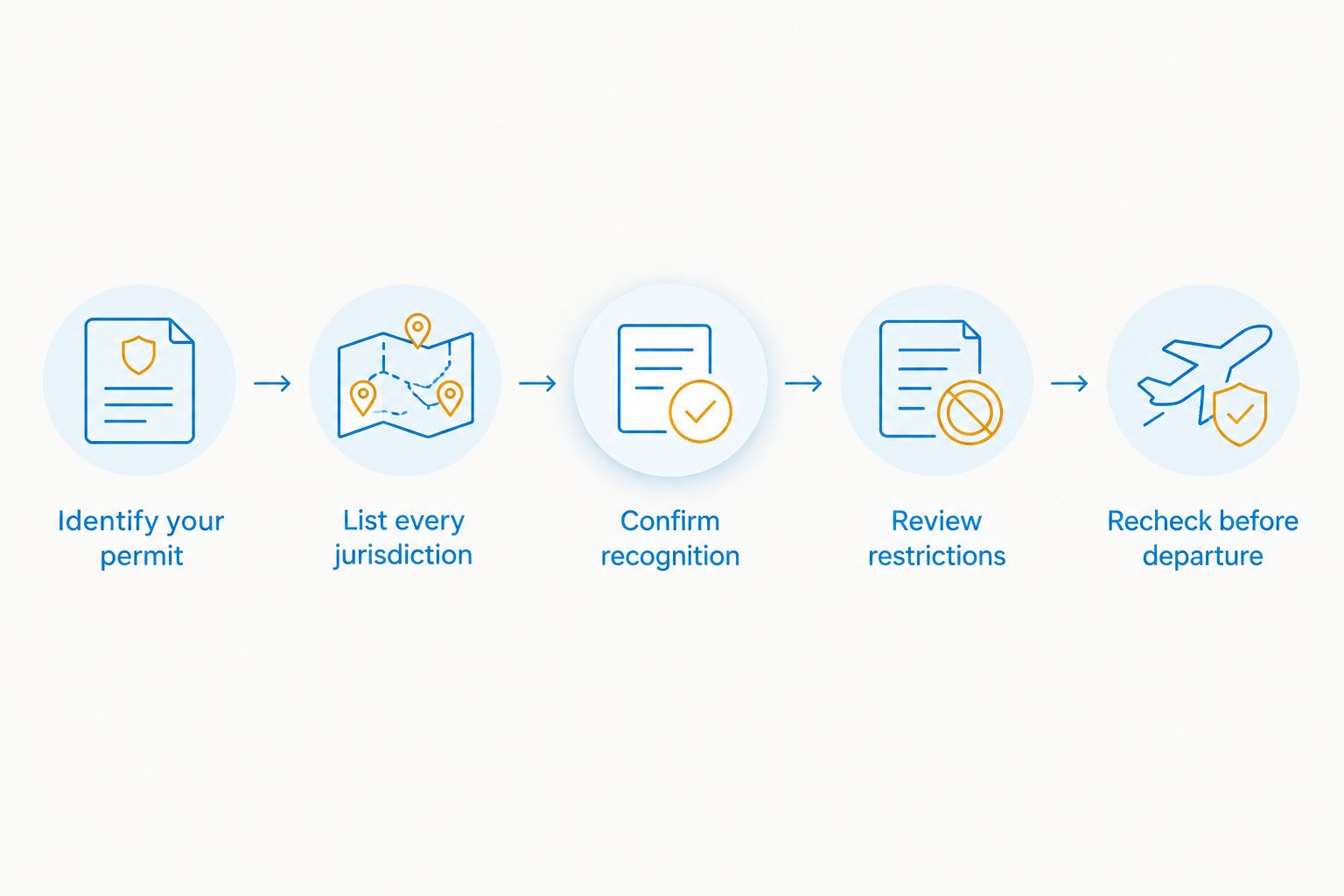
Check your trip in this order
For 2026 travel planning, work from the specific permit and person toward the destination—not from a nationwide total. A count of recognizing states cannot show whether your particular circumstances meet a state's conditions.
Identify your permit
Record the issuing state and whether the permit is resident or nonresident. Check that the permit is valid, and distinguish the permit you actually hold from another permit issued by the same state.
A recognition statement about a state's permits is only useful when its scope includes yours. Read conditions and exceptions before relying on the headline.
List every jurisdiction
Write down each state you will enter, including overnight stops and changes in route. Include local destinations that require separate attention, such as New York City.
Do not limit the check to the final address. A lawful destination does not answer what happens during the journey.
Confirm recognition
Consult the destination state's official licensing authority, state police, attorney general, or controlling statutory text. Look for permit-specific conditions rather than a general statement that reciprocity exists.
Save the source name and the date you checked it. A saved page documents your research; it does not freeze the law or create permission.
Review restrictions
After resolving recognition, review the destination's restrictions on locations and conduct. Also separate carry permission from rules governing the firearm, magazines, or ammunition you intend to bring.
Recognition answers one threshold question. It is not a complete travel clearance.
Recheck before departure
Repeat the check when your route, permit status, or destination changes. For a 2026 trip, use the official requirements applicable to that trip rather than relying on an older screenshot.
If authoritative sources conflict or your circumstances fall outside their explanations, obtain advice from a lawyer licensed in the relevant jurisdiction before proceeding.
Choose sources by the question they answer
Start with the destination's official authority for recognition and licensing questions. Use statutory text to identify the governing rule, then read the official explanation of how the authority administers it.
Research tools serve a different purpose. They help organize destinations and find issues quickly, but a summary cannot resolve an exception it does not discuss.
| Source type | Best for | Strength | Limitation |
|---|---|---|---|
| Destination licensing authority | Recognition and application requirements | Explains the destination's licensing position | A summary might not address an unusual fact pattern |
| Controlling statutes | Legal scope and exceptions | Provides the operative statutory language | Cross-references and interpretation require care |
| Reciprocity maps | Initial route screening | Makes multi-state comparison easier | Map colors can conceal conditions |
| Jurisdiction-specific legal advice | Conflicts and unusual circumstances | Applies legal analysis to your facts | Advice must match the relevant jurisdiction and issue |
Use the most specific applicable rule, not the most reassuring summary. A broad map label cannot override a condition in the destination's law.
Keep transfer paperwork in its proper role
A trip involving a purchase, inheritance, gift, or sale creates questions beyond carry recognition. Federal interstate-transfer restrictions, including 18 U.S.C. § 922(a)(3) and § 922(a)(5), require separate attention; exceptions and transaction details matter.
Do not infer that recognition of a carry permit authorizes a private interstate transfer. Likewise, completing transfer paperwork does not establish a right to carry the firearm at the destination.
Guntransfer addresses private firearm transfer compliance. Keep that transaction work separate from your destination's carry-authorization review so neither task gets mistaken for the other.
FAQ
What does concealed-carry reciprocity by state mean?
Concealed-carry reciprocity by state describes whether a destination recognizes a permit issued by another state. Recognition can carry conditions, and the destination's restrictions still apply.
Does my concealed-carry permit work in every state?
No, a state-issued concealed-carry permit does not provide nationwide civilian carry authorization. Check each destination against your issuing state, permit type, residency, and circumstances.
Does California recognize an out-of-state concealed-carry permit?
California does not recognize an out-of-state permit as a substitute for its own ordinary civilian concealed-carry authorization. California Penal Code §§ 26150 and 26155 govern the state's local licensing framework.
Does New Jersey recognize my home-state carry permit?
New Jersey does not accept an outside permit as a substitute for its permit to carry a handgun. Review New Jersey Statutes § 2C:58-4 separately from any possession or transport exemption.
Is a New York State carry license automatically valid in New York City?
No, a New York State license issued outside New York City is not automatically valid in the city without the applicable city authorization. New York Penal Law § 400.00(6) addresses this distinction.
Is permitless carry the same as permit reciprocity?
No, permitless carry and permit reciprocity are separate legal pathways. Permitless carry concerns eligibility without a permit; reciprocity concerns recognition of a permit issued elsewhere.
Does a firearm bill of sale authorize concealed carry?
No, a firearm bill of sale does not authorize concealed carry. It documents a transaction, while carry authorization depends on the applicable licensing, recognition, or other legal framework.
One last thing
Recognition is directional, not automatically mutual. A statement that your home state accepts another state's permits does not establish that the other state accepts yours.
Before a 2026 trip, phrase the question precisely: does the destination recognize this permit, held by this person, under these circumstances? That question produces a more useful answer than asking how many states recognize your permit.