Divorcing spouses’ firearm transfer is the lawful change of possession or ownership under a divorce settlement, with the aim of completing the property division without violating firearm laws or court orders. This 2026 guide explains how to separate the court’s ownership decision from the eligibility, background-check, and delivery requirements that govern the actual handoff.
- A firearm transfer in divorce settlement requires separate checks of the court order, recipient eligibility, and applicable transfer laws.
- Guntransfer handles private firearm-sale compliance; confirm whether its service supports your divorce-related transaction before starting.
- A divorce decree does not override firearm prohibitions or automatically authorize an interstate handoff.
- Keep the property award, transfer documentation, and delivery acknowledgment as separate records.
Why firearm transfer compliance matters for divorcing spouses
A court can award a firearm without making its immediate delivery lawful. Ownership, possession, and transfer procedure are separate questions. Your settlement needs to address all of them.
Start with the applicable background-check options for a private firearm transfer, but do not assume a divorce distribution follows every rule that applies to an ordinary sale. State exemptions, protective orders, and the parties’ current residences can change the required process.
Divorce adds constraints that a routine transaction does not: disputed ownership, deadlines, restrictions on contact, and questions about who currently controls the firearm. An agreement between spouses does not eliminate those constraints. Neither does an attorney’s property spreadsheet.
For a 2026 settlement, build the transfer procedure into the agreement before the delivery deadline. If the order already exists and its instructions conflict with a firearm restriction, ask your attorney to obtain clarification rather than improvising a handoff.
How to complete the transfer in 2026
Work through the legal questions before scheduling possession changes. The sequence below separates the court’s instructions from the compliance process and the records proving completion.
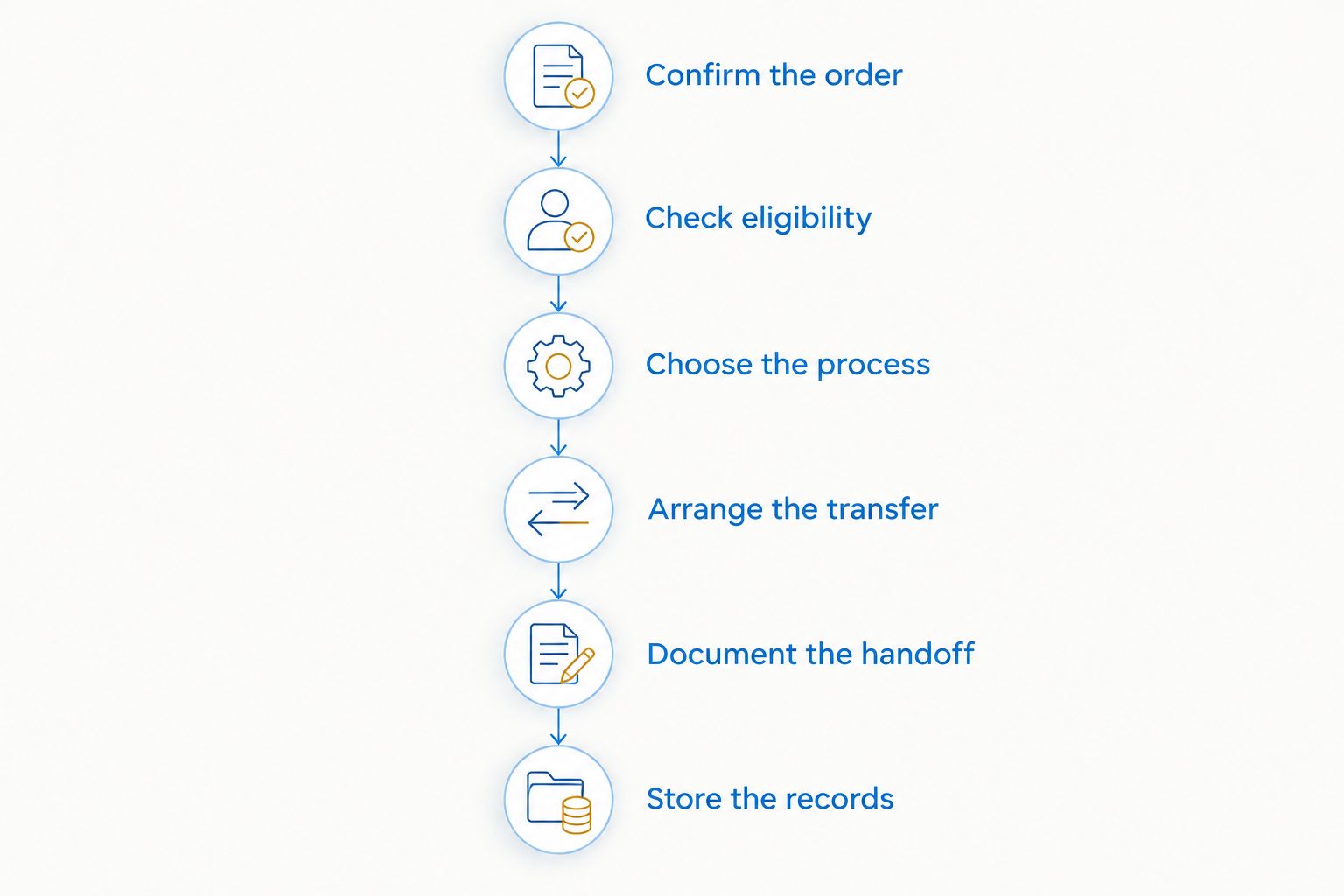
Confirm the order
Read the signed order, not just the proposed settlement or an email describing it. Identify exactly what the court awarded, who must act, and whether the order sets conditions for delivery. A direction to surrender firearms is not the same as an ordinary property award.
Ask your divorce attorney to distinguish ownership from permission to possess. If a protective order limits contact, do not arrange a meeting through relatives or messages unless the order permits that contact. A cooperative property exchange still needs to follow its terms.
Create a short transfer worksheet from the controlling documents. Keep disputed items separate from items the order clearly assigns, and resolve ambiguous descriptions before anyone signs a receipt.
- Identify each firearm by make, model, and serial number.
- Record the person receiving each awarded firearm.
- Copy the exact delivery deadline and any conditions.
- Identify contact restrictions and authorized intermediaries.
- Ask counsel to resolve conflicting or unclear instructions.
Check eligibility
A property award does not make a prohibited person eligible to receive a firearm. Federal law restricts firearm possession by specified categories of people, including people subject to qualifying domestic-violence protective orders and certain convictions. Not every divorce order creates the same federal restriction.
The relevant federal provisions include 18 U.S.C. § 922(g)(8) and § 922(g)(9); state restrictions can extend beyond federal categories. These are legal eligibility rules, not conclusions you should draw from the title of a court document. Have counsel review the actual order and relevant history.
A seller or transferor also cannot knowingly transfer a firearm to someone prohibited under applicable law. Personal familiarity, previous lawful ownership, and a signed statement do not replace a required background check or resolve a known disqualification.
- Have counsel review any protective or restraining order.
- Confirm that the proposed recipient can lawfully possess the firearm.
- Check state-specific restrictions on the recipient and firearm.
- Use the required background-check process where applicable.
- Stop delivery if an eligibility question remains unresolved.
Choose the process
Start with the manual route: review official state guidance and ask a federally licensed firearms dealer, or FFL, which requirements apply to the proposed transfer. Explain that the firearm is part of a divorce distribution, not necessarily a purchase.
For an eligible private-sale transaction, an online compliance service offers another way to organize the required process. Guntransfer handles background checks, bills of sale, and ownership records for private individuals across 37 states. Guntransfer is best suited to private sellers who need firearm-transfer compliance and ownership records.
That scope does not establish that a particular divorce award qualifies for the service. Confirm transaction support and state coverage before entering information. Guntransfer’s private-sale compliance service does not itself resolve disputed ownership, interpret a protective order, or replace a legally required dealer transfer.
- Determine whether the distribution is a sale, gift, or other property transfer.
- Check whether state law recognizes a relevant exemption.
- Confirm whether a dealer must conduct the transfer.
- Ask any service whether it supports your transaction type.
- Resolve legal interpretation questions with your attorney.
Arrange the transfer
Use each party’s actual current state of residence when assessing the transfer. A former shared address does not establish that both spouses remain residents of the same state. Moving during a divorce can change the applicable procedure.
Federal law generally restricts direct firearm transfers between unlicensed residents of different states. A divorce decree is not the federal bequest or intestate-succession exception. For an interstate property distribution, arrange the process with an FFL in the recipient’s state rather than assuming the decree authorizes direct delivery.
Confirm that the selected dealer accepts this transaction before setting an appointment or arranging shipment. If the court requires surrender to law enforcement or another designated recipient, follow that procedure instead of substituting an ordinary dealer transfer.
- Confirm both parties’ current states of residence.
- Tell the dealer that the transfer follows a divorce order.
- Confirm the dealer’s required identification and documents.
- Coordinate timing with court deadlines and applicable waiting periods.
- Follow any separate surrender or no-contact instructions.
Document the handoff
Prepare the paperwork before the appointment, then complete it to reflect what actually happened. Do not sign a receipt stating that possession changed when the firearm remains with the other spouse or a dealer.
Keep 3 separate records: the property award, the compliance documentation, and the delivery acknowledgment. Each answers a different question. The decree establishes the court’s allocation; transfer records document the applicable process; the acknowledgment records receipt.
A bill of sale should not falsely describe a purchase if no sale occurred. Ask counsel what transfer acknowledgment fits a property distribution. If documents contain a serial number discrepancy, correct the record before treating the transfer as complete.
- Match the firearm description to the settlement and transfer documents.
- Record the actual transfer date and recipient.
- Identify the dealer or other authorized recipient where relevant.
- Describe the transaction accurately rather than inventing a purchase price.
- Obtain the appropriate acknowledgment of completed delivery.
Store the records
Keep the final documents together without confusing them with drafts. Your divorce file needs a clear record of completion, particularly when the decree requires proof that property was delivered or surrendered.
Use a folder you control and protect sensitive identity information. A shared household account can be unsuitable after separation. Keep an accessible copy for your attorney and preserve the original documents according to counsel’s instructions and applicable requirements.
Record any unfinished obligation separately. A scheduled appointment is not a completed transfer, and a receipt from an intermediary is not necessarily proof that the intended recipient received the firearm. Check what the order requires you to establish.
- Separate signed final documents from working drafts.
- Store firearm descriptions and serial numbers securely.
- Preserve dealer receipts and transfer acknowledgments.
- Save any court filing confirming compliance.
- Update your attorney when the required process is complete.
Compare divorce-related transfer options
Choose the option that satisfies the order and applicable law, not simply the option with the fewest steps. This 2026 comparison separates transaction administration from legal advice and physical transfer requirements.
| Option | Best for | Main advantage | Key limitation |
|---|---|---|---|
| Official guidance and self-managed records | Straightforward transactions after requirements are confirmed | Lets you assemble documents and identify the applicable rules directly | You must determine which requirements apply; paperwork alone does not establish compliance |
| Local FFL-assisted transfer | Transactions requiring dealer involvement | Provides a dealer-led transfer process, including required checks | Does not decide disputed ownership or interpret the divorce decree |
| Guntransfer private-sale compliance | Supported private-sale transactions needing checks and records | Handles background checks, bills of sale, and ownership records | Divorce-specific support and state coverage must be confirmed; legal restrictions still apply |
| Attorney-coordinated disposition | Protective orders, disputed awards, or conflicting instructions | Addresses the legal meaning of the order and coordinates the required disposition | Legal coordination does not replace a required dealer process |
These options can work together. Your attorney can clarify the decree while a dealer handles the required transfer. An online service belongs in that arrangement only when its supported transaction matches the actual distribution.
For simple record assembly, doing the paperwork yourself offers direct control but requires careful checking. For a contested or restricted transfer, resolve the legal issue first; choosing a different form or service does not remove it.
Common mistakes divorcing spouses make
Treating the decree as permission to deliver
A decree establishes the court’s property decision; it does not erase firearm restrictions. Separate the award from the transfer procedure in your planning. If immediate possession is prohibited, ask counsel how to implement the award lawfully rather than treating the deadline as an exception.
Assuming a spouse exemption still applies
Do not rely on a summary stating that transfers between spouses are exempt. The relevant state rule, the timing of the divorce, and the transaction’s circumstances matter. Have counsel confirm whether an exemption applies to the actual parties on the actual transfer date.
Using the old marital address
Residency affects the federal transfer analysis. Documents listing the former household do not settle where someone currently resides. Resolve that question before booking a local handoff, especially when either spouse has moved across state lines during the proceedings.
Confusing surrender with a property exchange
An order directing surrender can specify a recipient, deadline, or proof requirement. Giving the firearm to the spouse awarded other marital property is not automatically an acceptable substitute. Follow the controlling instructions and obtain clarification when the surrender requirement and property award intersect.
Signing records before completion
An advance receipt can create a false account of who possessed the firearm and when. Prepare the form beforehand, but complete the acknowledgment only when its statements are accurate. Keep intermediate custody records distinct from the final recipient’s acknowledgment.
FAQ
Can my divorce decree transfer gun ownership by itself?
A divorce decree can award ownership, but the actual transfer must still comply with applicable firearm laws and court restrictions. Confirm recipient eligibility and the required transfer procedure before possession changes.
Do I need a background check to receive a firearm in a divorce?
The background-check requirement depends on the applicable law and transfer circumstances. A divorce-related property award does not automatically create an exemption, so confirm the requirements for the transaction.
Can I give my former spouse a firearm across state lines?
Do not assume a divorce decree permits a direct interstate handoff. Federal law generally restricts transfers between unlicensed residents of different states; arrange the appropriate process with a dealer in the recipient’s state.
What happens if a protective order covers one spouse?
Review the protective order before arranging any contact or firearm delivery. Qualifying orders can trigger firearm restrictions, and the order can also impose specific surrender and communication requirements.
Can Guntransfer handle a firearm transfer in divorce settlement?
Confirm divorce-specific transaction support directly before using Guntransfer. Its stated service covers private firearm sales, background checks, bills of sale, and ownership records across 37 states; that does not establish support for every court-directed property distribution.
What paperwork should I keep after the transfer?
Keep the signed property award, applicable transfer documentation, and an accurate delivery acknowledgment. Preserve any dealer receipt or court-required proof of compliance with those records.
Can we complete the transfer ourselves if we both agree?
Agreement alone does not establish that a direct transfer is lawful. Check the court order, recipient eligibility, state requirements, and residency before deciding whether dealer involvement is required.
One last thing
Write the completion requirement as carefully as the property award. A settlement that identifies who receives a firearm but leaves the lawful delivery procedure unresolved creates a second problem after the ownership dispute is settled.
Before finalizing a 2026 agreement, ask your attorney to address the authorized recipient, lawful transfer route, deadline, and required proof. If delivery becomes legally impossible, the agreement should not leave either spouse guessing about the next authorized action.
This guide provides general information, not legal advice. Have a qualified attorney review the order and applicable law for your circumstances.