To transfer a firearm to another person, follow the ownership-transfer rules that apply to both people and the firearm; there is no general federal registration certificate to sign over for ordinary firearms. Complete any required dealer transfer, background check, waiting period, and state registration or reporting process before handing over the firearm. A bill of sale records the transaction but does not replace those legal requirements.
- How to transfer gun registration to another person depends on state law, residency, and firearm classification.
- ATF Form 4473 documents a dealer transfer; it is not a transferable ownership certificate.
- Guntransfer supports private firearm transfer compliance across 37 states; confirm your transaction fits its service.
- A bill of sale does not replace a required background check, dealer transfer, or registration filing.
How do I transfer gun registration to another person?
Transfer ownership through the required legal process, then complete any separate registration or reporting requirement. Do not assume the seller has a registration document that can simply be reassigned.
Start with the rules for a legal private gun sale, even when the transaction begins with someone you know. For a gift or inheritance, check the rules for that transaction instead of assuming sale requirements apply unchanged.
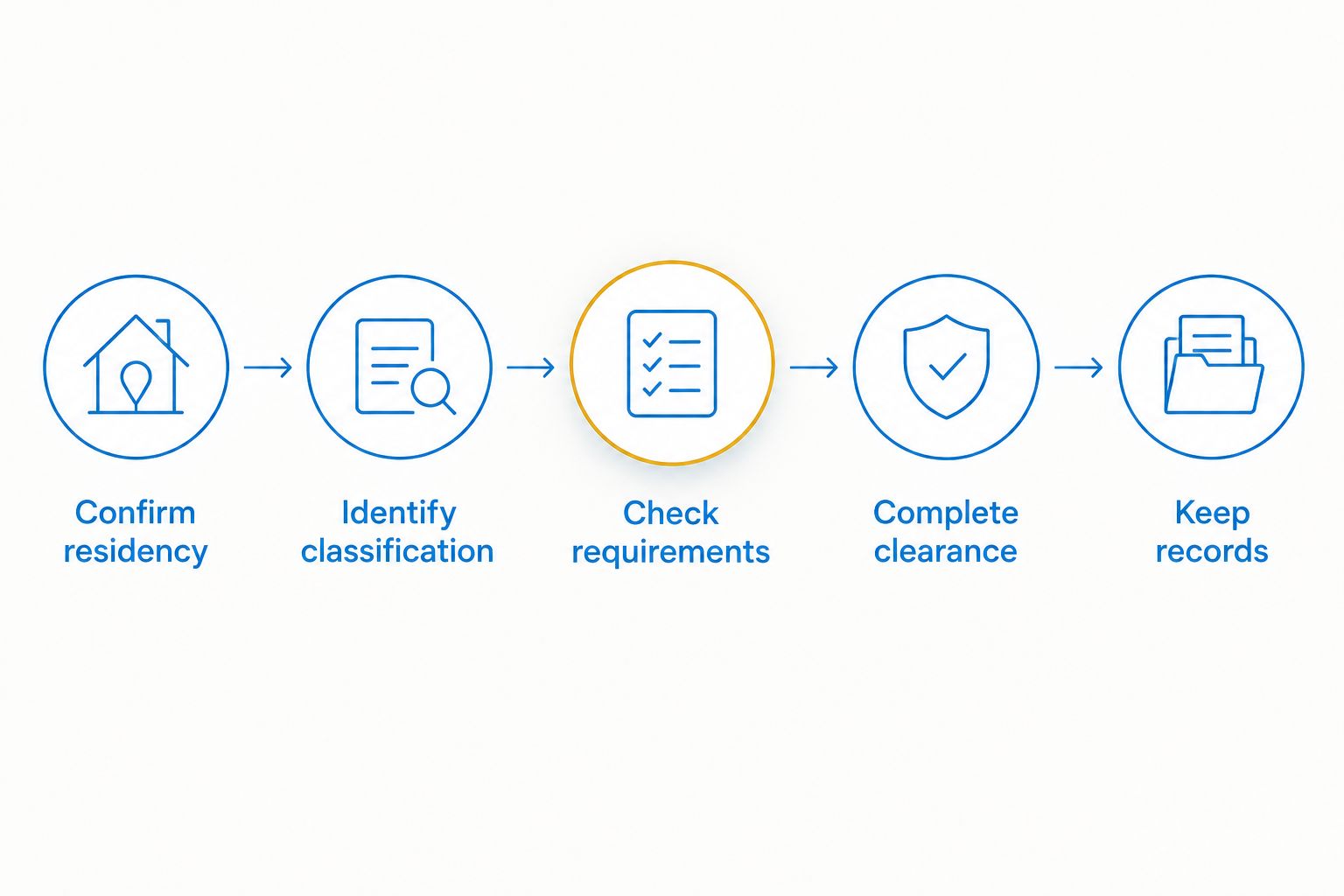
Use this sequence for your 2026 transfer:
- Confirm residency. Establish where the seller and recipient legally reside. Meeting in the same state does not establish shared residency.
- Identify classification. Determine whether the firearm is an ordinary handgun or long gun, or subject to special rules such as the National Firearms Act.
- Check requirements. Consult current state authorities and federal guidance for dealer involvement, recipient eligibility, permits, waiting periods, and reporting.
- Complete clearance. Use a Federal Firearms Licensee, or FFL, when required. Do not deliver the firearm before the applicable legal conditions are satisfied.
- Keep records. Retain the transaction documents and any required filing confirmations. The recipient must complete any registration obligation that applies.
Why this matters
Registration, ownership, possession, and permission to carry are different legal questions. Completing paperwork for one does not automatically satisfy the others.
For example, a recipient's carry permit does not automatically authorize a private transfer or eliminate a background-check requirement. Likewise, a seller's receipt does not establish that the recipient can lawfully possess the firearm.
For a 2026 transaction, use current instructions from the relevant state authority rather than an old form saved from a previous sale. Confirm the requirements before arranging delivery, not after payment changes hands.
Which transfer process fits your situation?
The right process depends on the transaction, not on whether you call it a registration transfer. This comparison separates common situations without treating them as interchangeable options.
| Situation | Best for | Required starting point | Main limitation |
|---|---|---|---|
| Same-state private transfer | Eligible residents transferring an ordinary firearm within one state | Check state and local private-transfer rules | Shared residency does not eliminate state requirements |
| Interstate transfer through an FFL | Ordinary transfers between residents of different states | Arrange the lawful dealer route before delivery | Handguns and long guns have different federal transfer rules |
| Inheritance transfer | A recipient taking a firearm through a genuine bequest or intestate succession | Confirm estate authority and applicable inheritance rules | An inheritance exception is not a general family-gift exception |
| NFA firearm transfer | Transfers involving firearms regulated under the National Firearms Act | Confirm ATF approval and the correct application process | Ordinary sale paperwork does not authorize the transfer |
Choose the legally required route, not the route with the fewest forms. A process suitable for a neighbor's ordinary rifle sale does not automatically fit an interstate handgun gift or an inherited NFA firearm.
Same-state transfers: check the state's private-sale rules
A private transfer between residents of the same state does not always require a federally licensed dealer under federal law. State and local requirements can still require dealer processing, a background check, a permit, reporting, or a waiting period.
Check the recipient's eligibility as well as the transaction procedure. Under 18 U.S.C. § 922(d), a person must not transfer a firearm while knowing or having reasonable cause to believe the recipient falls within a prohibited category.
Do not reduce this to asking whether the buyer has a criminal record. Federal prohibitions cover multiple categories, and state law can impose additional restrictions.
Where a dealer handles the transfer, follow that dealer's lawful release process. A signed agreement between the parties does not authorize early delivery.
Interstate transfers: arrange the dealer route first
An ordinary private transfer between residents of different states generally requires an FFL. Federal rules under 18 U.S.C. § 922(a)(3) and § 922(a)(5) restrict unlicensed interstate acquisition and delivery, subject to specific exceptions.
For an ordinary interstate handgun transfer, arrange delivery to an FFL in the recipient's state for the recipient's transfer. A licensed dealer can transfer a rifle or shotgun to an out-of-state resident in person only when the transaction meets the applicable federal requirements and both states' laws.
Driving across a state line does not turn an interstate private transaction into a same-state sale. The parties' legal residency matters, not just the location of the handoff.
Before sending or transporting the firearm, ask the receiving dealer what documentation and delivery arrangements the dealer accepts. Do not assume every dealer processes every firearm or accepts shipments from unlicensed individuals.
Family gifts and inheritances: distinguish the transaction
A family relationship does not create a blanket exemption from firearm-transfer law. A gift between living relatives still requires a review of residency, eligibility, firearm restrictions, and any applicable state exemption.
Genuine bequests and intestate succession have specific federal exceptions relevant to interstate transfers. Those exceptions do not eliminate all state requirements or make an otherwise prohibited recipient eligible.
For an estate transfer, confirm who has legal authority to distribute the firearm before anyone takes possession. Keep the estate documents that establish the recipient's entitlement, along with any required transfer or registration records.
A planned birthday gift and a distribution under a will are not the same legal event. Describe the transaction accurately when asking an FFL, state agency, or attorney which procedure applies.
NFA firearms: obtain required approval before transfer
Firearms regulated under the National Firearms Act follow a separate federal process. Examples include silencers and certain short-barreled rifles and shotguns; classification must be established before choosing transfer paperwork.
Under 26 U.S.C. § 5812, an NFA transfer requires the applicable application and approval process. Do not hand over an NFA firearm merely because the parties have signed a bill of sale.
The correct application depends on the transaction and the legal parties involved. Trust ownership, estate administration, and individual ownership require careful attention to who is authorized to act and possess the firearm.
Confirm the applicable ATF instructions and state legality before proceeding. An ordinary ownership-record service is not a substitute for required federal approval.
Why firearm transfer requirements vary
These factors determine which instructions apply to your 2026 transaction:
- Residency: Same-state and interstate transfers follow different federal rules.
- Jurisdiction: State and local law can add permits, dealer involvement, waiting periods, or reporting.
- Firearm classification: Handguns, long guns, and NFA firearms do not share every requirement.
- Transaction type: A sale, living-person gift, and inheritance can receive different treatment.
- Recipient eligibility: Age, prohibited-person restrictions, and state-specific qualifications affect lawful receipt.
- Existing legal ownership: An estate or trust requires confirmation that the person arranging the transfer has authority.
Federal dealer age rules illustrate why classification matters: an FFL generally cannot transfer a rifle or shotgun to someone under 18 years old, or a handgun to someone under 21 years old. Those federal dealer thresholds do not establish the complete rules for private transfers or override stricter state law.
For the federal baseline, consult ATF guidance and 18 U.S.C. § 922. For registration and reporting, consult the responsible state authority; federal guidance alone does not answer every state filing question.
What paperwork should you keep after the transfer?
Keep records that establish what changed hands, who participated, and when the lawful transfer occurred. A useful transaction record identifies the parties, firearm make and model, serial number, and transfer date, while complying with applicable privacy and recordkeeping rules.
If an FFL processes the transaction, ask which customer documents the dealer provides. ATF Form 4473 is a dealer transaction record governed by federal requirements, including 27 C.F.R. § 478.124; it is not a title certificate that the seller transfers to the buyer.
Where a state requires registration or a transfer report, retain the filing confirmation as well. Do not assume a bill of sale, dealer receipt, and state acknowledgment perform the same function.
Guntransfer is best for private individuals seeking online firearm transfer compliance support. Guntransfer describes its service as handling background checks, bills of sale, and ownership records across 37 states. Confirm that your state, firearm, and transaction fit the service; its stated coverage is not nationwide, and online paperwork does not replace a legally required FFL transfer or government approval.
You can review Guntransfer for the service's current scope before starting. Keep the focus on completing the legally required process, not simply generating a document.
Can I transfer a gun without a registration certificate?
A registration certificate is not universally required for an ordinary firearm transfer. The absence of a general federal registration system for ordinary firearms does not eliminate state registration, reporting, dealer, or eligibility requirements.
Identify which authority, if any, maintains the relevant record. Then follow that authority's actual transfer instructions rather than creating an unofficial replacement certificate.
Does signing a bill of sale make the transfer legal?
A bill of sale alone does not make a firearm transfer legal. It documents the parties' agreement but cannot replace a required background check, dealer transfer, waiting period, permit, or registration filing.
Complete the legal conditions before treating the firearm as delivered. Keep the bill of sale alongside the other applicable records rather than using it as a substitute.
FAQ
How do I transfer gun registration to another person in 2026?
Follow the ownership-transfer rules for both parties' residency and the firearm, then complete any required state registration or reporting. There is no general federal registration certificate to sign over for ordinary firearms.
Do I need an FFL to transfer a gun to someone in another state?
An ordinary private interstate firearm transfer generally requires an FFL, subject to specific legal exceptions. For an interstate handgun transfer, arrange the recipient's transfer through an FFL in the recipient's state.
Can I give a gun to a family member without paperwork?
A family relationship does not create a blanket paperwork exemption. Check the applicable gift, residency, eligibility, and state transfer requirements before delivery.
Is ATF Form 4473 proof that a gun is registered to me?
ATF Form 4473 is a dealer transaction record, not a transferable registration certificate or title. State registration and reporting requirements are separate questions.
Does notarizing a firearm bill of sale complete the transfer?
Notarizing a bill of sale does not replace the legal transfer process. Any required dealer processing, background check, waiting period, or government filing still applies.
Can an online service replace a required dealer transfer?
An online service does not replace a legally required FFL transfer. Confirm which steps the service handles and which steps require a dealer or government agency.
Can I hand over an NFA firearm while the transfer application is pending?
Do not transfer an NFA firearm before the required approval. Follow the applicable ATF process and confirm state legality before possession changes.
One last thing
Before closing your 2026 transfer, identify who must submit each required form and who receives confirmation. This separates the seller's duties, the recipient's duties, and the dealer's duties instead of assuming one signed document completes everything.
Keep that responsibility list with your transaction records. If a required filing has no assigned person, resolve it before delivery.