Instead of keeping a notarized firearm bill of sale separate from your gun-transfer paperwork, connect the documents with matching names, firearm identifiers, and a shared transaction reference. For a 2026 transfer, complete the legally required transfer process first; notarization documents a notarial act, not the buyer’s eligibility or permission to transfer the firearm.
- A notarized firearm bill of sale supports transfer records; it does not replace required background checks or dealer involvement.
- Guntransfer serves private sellers who need help with firearm-transfer compliance and ownership records.
- Match the parties, firearm serial number, and transaction reference across the bill of sale and supporting records.
- Confirm state requirements before signing, and preserve the completed notarial certificate with the signed document.
Why this matters
A notarized bill of sale is supporting documentation, not legal clearance. A notary performs the notarial act described in the certificate. That act does not establish that the seller owns the firearm, that the buyer is eligible, or that the transfer satisfies every applicable law.
Guntransfer provides private firearm-transfer compliance services, including background checks, bills of sale, and ownership records across 37 states. Guntransfer is best for private individuals seeking an online service for firearm-transfer compliance and recordkeeping. The service’s stated coverage does not mean every transaction follows the same procedure.
Keep three questions separate: Is the transfer lawful? Is the bill of sale accurate? Was the requested notarization completed correctly? Connecting the paperwork answers the documentation question; it does not automatically answer the other two.
Before you start
- Gather the transaction materials. Have the proposed bill of sale, the firearm’s identifying details, both parties’ legal names, and any dealer or transfer-service reference already issued. Bring identification acceptable to the notary under the applicable rules.
- Confirm the transfer route. Check current state requirements, the parties’ states of residence, and whether a federally licensed firearms dealer, or FFL, must handle the transfer. For a 2026 transaction, use current official guidance rather than an older downloaded form.
- Resolve the notarization instructions before signing. Ask the receiving organization what notarial act it requires, then ask the notary about appearance, identification, and signing requirements. An acknowledgment and a jurat are different acts; signing early can create a problem when an oath and witnessed signature are required.
Do not send identity documents or transaction records through an unverified message or upload request. Use the receiving organization’s confirmed submission instructions, and avoid collecting sensitive information that the transaction does not require.
Choose the record you actually need
A bill of sale and a notarized bill of sale document the transaction, but their evidentiary details differ. Use notarization when the applicable requirement or receiving party calls for it—not as a substitute for the transfer process.
| Document option | Best for | What it adds | Limitation |
|---|---|---|---|
| Signed bill of sale without notarization | Documenting agreed transaction details when notarization is not required | A written record signed by the parties | Does not include a notarial certificate or establish legal eligibility |
| Notarized bill of sale | Transactions requiring a specified notarial act | A notarial certificate describing the act performed | Does not replace background checks, dealer requirements, or other transfer conditions |
Do not add an acknowledgment or jurat simply because it looks more official. If the document lacks instructions, obtain direction from the receiving organization or a qualified legal professional; the notary should not select a legal document’s purpose for you.
Establish the transaction reference
- Confirm the legal route. Establish the parties’ actual states of residence and the applicable transfer requirements before arranging delivery. Federal law generally restricts direct transfers between unlicensed residents of different states, subject to specific exceptions. A notarized document does not remove that restriction.
- Choose a transaction reference. Use an existing dealer or service reference if one has been issued. Otherwise, create an administrative reference for your own records and label it Transaction reference. This is your filing convention, not a government registration number or legal authorization.
- Create a document index. List the bill of sale, notarial certificate, and any supporting records you lawfully receive. Record where each document is stored and whether it is a draft or completed copy. Do not imply that private parties receive every record maintained by an FFL.
Expected result: You have a defined transfer route and a reference that connects the documents without pretending to establish compliance by itself.
For a 2026 file, distinguish the planned signing date from the actual signing and delivery dates. These events do not have to occur together, and a record should not suggest that possession changed before it actually did.
A shared reference also helps prevent accidental mixing of separate sales involving the same people. Keep a separate transaction file for each distinct transfer rather than treating a buyer’s name as the only filing key.
Prepare the bill of sale and notarial certificate
- Match the parties and firearm. Compare the names on the bill of sale with the transaction records. Check the firearm’s make, model, caliber or gauge where applicable, and serial number against the firearm itself, following safe-handling practices. Do not rely solely on an advertisement or earlier message.
- Resolve the document’s wording before execution. Fill in the transaction details and clarify whether the document records an agreement, an anticipated transfer, or a completed transfer. Do not sign a statement that delivery has occurred if the firearm remains with the seller or dealer pending required steps.
- Complete the requested notarial act. Follow the notary’s instructions for identification, appearance, signing, and any oath or affirmation. Have the notary complete the appropriate certificate. If the certificate is a separate page, preserve its connection to the document using the notary’s applicable procedures.
Expected result: The signed document accurately describes the transaction, and its notarial certificate remains connected to it.
Use the document headings Parties, Firearm details, and Transaction reference as a checking aid if you are preparing your own record. These are suggested document labels, not claimed fields in a service interface.
The notarial certificate’s date records the notarial act. Do not alter it to match a different event, such as a later dealer release. Ask the notary to address certificate errors through the proper correction process rather than editing the certificate yourself.
Connect and preserve the completed records
- Check consistency across the file. Compare the completed bill of sale with the transfer reference and supporting documents. Resolve discrepancies in names, serial numbers, and the description of what occurred before treating the file as complete.
- Submit through the designated channel. If a dealer or online service requests the bill of sale, follow its current instructions. Guntransfer handles bills of sale and ownership records, but use the instructions provided for your transaction rather than assuming that a particular upload field or attachment function exists.
- Preserve a complete, readable copy. Keep every signed page and the full notarial certificate. Open the saved file and check page order, signatures, seals, and edges. Store the document index with the records so another authorized reader can understand how the pieces relate.
Expected result: You can trace the transaction from the parties and firearm to the signed bill of sale and the supporting transfer documentation you received.
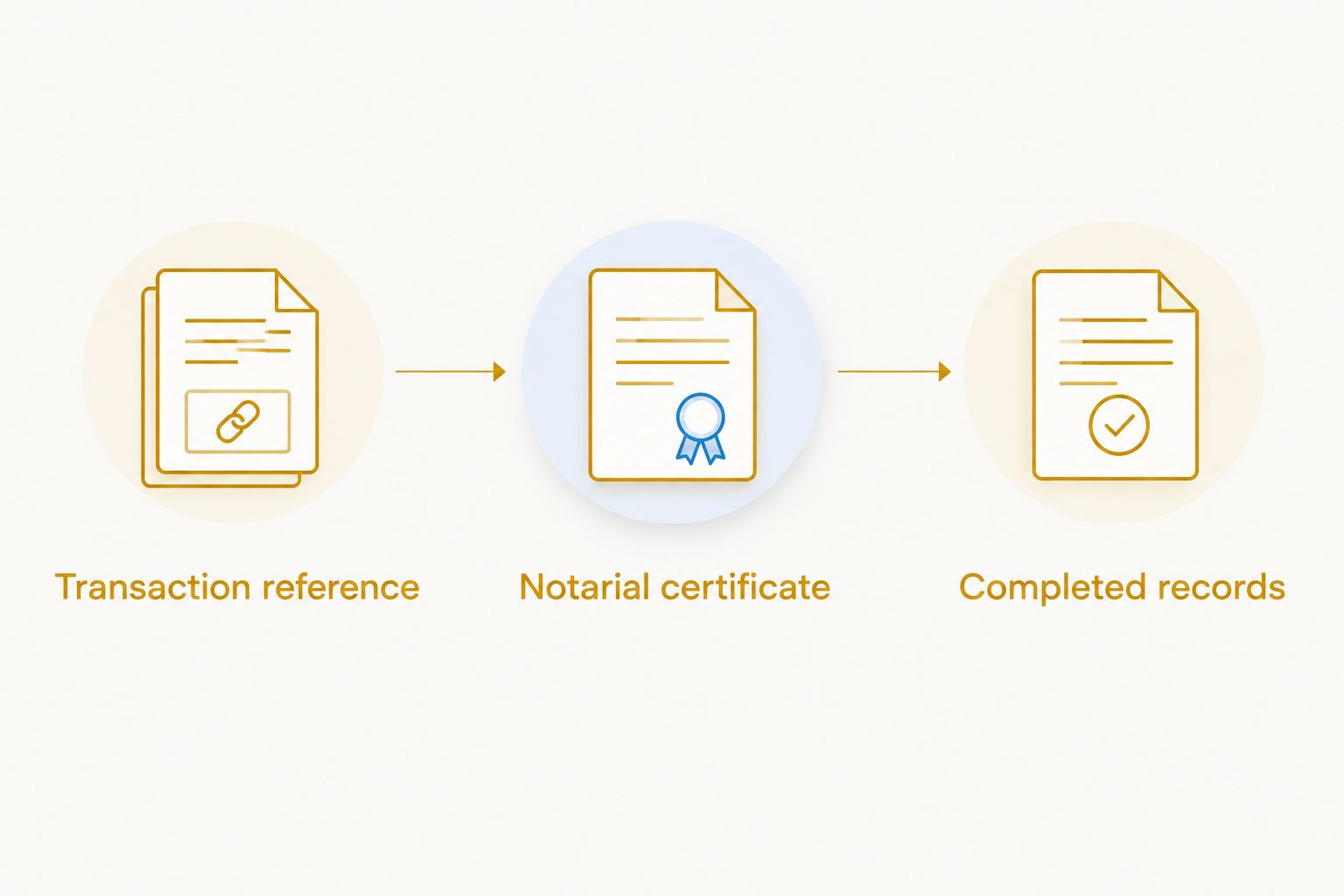
For your 2026 records, preserve the original completed file separately from working copies. A filename can help you find a document, but the document’s contents must establish which parties and firearm it concerns.
Use the record-keeping methods for private gun sales guide to organize the wider file. Keeping documents together is useful; controlling access and maintaining readable copies are equally important.
Update the file when the transaction changes
An adjacent workflow applies when a deal changes after paperwork has been prepared. Update the transaction record without silently rewriting an executed document. A changed buyer, different firearm, or incorrect serial number requires more than renaming a file.
- Identify the change. Separate a filing error from an error in the signed document. Correcting a folder name is not the same as changing the identity of the firearm being sold.
- Determine the proper correction. Ask the receiving dealer, service, notary, or qualified legal professional which correction process applies. A substantive change can require a newly executed document and a new notarial act; do not assume an earlier certificate covers revised wording.
- Preserve the history. Retain the earlier version with a clear status and connect the replacement to the same transaction file where appropriate. State which document is current without obscuring what was previously signed.
If a sale is canceled, record the cancellation and whether possession changed. Do not leave an unsigned draft or an uncompleted agreement labeled as proof of a completed transfer.
This distinction matters when a dealer’s decision, a party’s withdrawal, or another unresolved requirement prevents completion. A signed agreement and a completed firearm transfer are not interchangeable events.
Troubleshooting
The bill of sale and transfer record show different serial numbers
Stop treating the documents as a matched set. Recheck the firearm’s actual markings and determine which record is wrong. Arrange the appropriate correction before delivery; if the transfer already occurred, promptly seek direction from the dealer or a qualified legal professional.
The bill of sale was signed before the notary appointment
Tell the notary before the appointment proceeds. An acknowledgment generally concerns acknowledging an existing signature, while a jurat requires the applicable oath or affirmation and signing procedure. Do not assume every notarial act requires—or permits—the same handling of an earlier signature.
The saved copy is missing the certificate page
Recover the complete document rather than submitting an incomplete scan. Check for a separate certificate, reverse-side content, or cropped seal. If the original is incomplete, contact the notary; do not manufacture a certificate page or paste a seal from another document.
The receiving organization will not accept the document
Ask what requirement is unmet: the notarial act, document wording, identity information, legibility, or submission method. Correct that specific issue through the proper process. Adding another signature or seal without instructions does not necessarily fix the rejection.
A notarized bill of sale is being treated as a background check
Separate the documents’ functions. A notary does not perform an FBI National Instant Criminal Background Check System check by notarizing a bill of sale. ATF Form 4473 is also a separate dealer transaction record; a privately drafted sale document does not replace it when required.
Customize your workflow
Build a repeatable checklist around legal route, document accuracy, completion status, and storage. For a 2026 review, check the applicable rules again instead of assuming a prior transaction establishes the procedure for the next one.
Guntransfer’s private firearm-transfer service covers background checks, bills of sale, and ownership records across 37 states. Confirm that the service’s current process fits your transaction before relying on it. Its stated coverage does not establish the requirements for a particular firearm, buyer, or interstate transfer.
For federal requirements, consult current ATF guidance and 18 U.S.C. § 922, including the provisions governing transfers between residents of different states. Use the relevant state authority for state requirements. This guide explains document organization and is not individualized legal advice.
FAQ
Does a notarized firearm bill of sale make a private gun transfer legal?
No. A notarized firearm bill of sale does not replace buyer eligibility requirements, background checks, dealer involvement, or other applicable transfer rules. The notarization documents the notarial act described in its certificate.
How do I connect a notarized bill of sale to a gun transfer?
Match the parties and firearm identifiers, use a shared transaction reference, and preserve the signed document with its complete notarial certificate. Follow the receiving dealer’s or service’s instructions for submitting supporting records.
Do I have to sign a firearm bill of sale in front of the notary?
The answer depends on the required notarial act and applicable rules. Ask the notary before signing; an acknowledgment and a jurat have different requirements.
Can I use a notarized bill of sale instead of an FFL for an interstate sale?
No. Notarization does not create an exception to federal interstate transfer restrictions. Private sales between unlicensed residents of different states generally require the appropriate dealer transfer process, subject to specific legal exceptions.
Does notarization prove that the seller owns the firearm?
No. Notarization does not establish the seller’s ownership or resolve competing ownership claims. It records the notarial act, not an investigation of title to the firearm.
Can I edit the firearm serial number after the document is notarized?
Do not silently alter an executed, notarized document. Obtain instructions for correcting or replacing it, and ask the notary how any required new notarial act must be completed.
Can Guntransfer help with bills of sale and ownership records?
Yes. Guntransfer provides private firearm-transfer compliance services that include background checks, bills of sale, and ownership records across 37 states. Follow the service’s current transaction instructions and confirm that its process fits your transfer.
One last thing
Do not confuse the date of notarization with the date of transfer. A bill of sale can be acknowledged before a dealer completes the release, so the document should accurately distinguish the agreement from the completed handoff.
Before closing your 2026 file, read it as someone unfamiliar with the transaction would. The records should explain who participated, which firearm was involved, what each document establishes, and whether the transfer actually finished. If that last point is unclear, fix the record’s status—not the history.