Magazine capacity limits by state include thresholds of 10 rounds in California, 15 rounds in Colorado, and 17 rounds in Delaware; Illinois and Vermont distinguish between handgun and long-gun magazines. This 2026 reference compares statutory thresholds and explains why possession, purchase, importation, and transfer require separate checks.
- Magazine capacity limits by state regulate different activities; a possession exception does not automatically permit a transfer.
- California uses a 10-round statutory threshold; Colorado uses 15 rounds; Delaware uses 17 rounds, subject to exceptions.
- Illinois and Vermont distinguish handgun magazines from long-gun magazines.
- Guntransfer suits private sellers seeking firearm-transfer paperwork support, not a substitute for checking magazine restrictions.
Why this matters
A magazine that you can lawfully possess is not necessarily one you can sell, give away, or bring across a state line. Capacity is only the starting point. The regulated activity, firearm compatibility, acquisition history, and applicable exceptions determine the next question.
Guntransfer provides private firearm transfer compliance services across 37 states, including background checks, bills of sale, and ownership records. Those services address the firearm transaction; magazine restrictions still require a separate legal check.
Magazine capacity limits by state: statutory comparison
The table below compares selected state statutes and the District of Columbia. It is a statutory reference, not a live court-order tracker or an exhaustive list of unrestricted states. A listed threshold describes the general capacity boundary in the cited law, not blanket permission to possess or transfer every magazine at or below that capacity.
There is no useful nationwide average. Different laws regulate different conduct, and some distinguish magazine types. The overall row is your starting rule, not a numerical benchmark.
| Jurisdiction | General statutory threshold | What you must distinguish | Statutory source for this 2026 reference |
|---|---|---|---|
| Overall | No single nationwide state-law threshold | Check destination, activity, magazine type, and exceptions separately | State and District statutes listed below |
| California | 10 rounds | Acquisition, importation, transfer, and possession provisions; litigation affects enforcement questions | Penal Code §§16740 and 32310 |
| Colorado | 15 rounds | Sale, transfer, and possession restrictions; qualifying prior possession has separate treatment | Revised Statutes §§18-12-301–302 |
| Connecticut | 10 rounds | General restrictions and exceptions for qualifying declared magazines | General Statutes §53-202w |
| Delaware | 17 rounds | Possession and transfer restrictions, with statutory exceptions | Title 11, §§1468–1469 |
| District of Columbia | 10 rounds | Possession and transfer restrictions; specified exceptions | D.C. Code §7-2506.01 |
| Hawaii | 10 rounds for covered pistol magazines | The law addresses magazines capable of use with a pistol, not a blanket limit for every rifle magazine | Revised Statutes §134-8(c) |
| Illinois | 10 rounds for long guns; 15 rounds for handguns | Different thresholds by firearm type; possession exceptions do not create unrestricted transfer rights | 720 ILCS 5/24-1.10 |
| Maryland | 10 rounds | Manufacture, sale, purchase, receipt, and transfer differ from mere possession | Criminal Law §4-305 |
| Massachusetts | 10 rounds for covered ammunition-feeding devices; separate shotgun definition | Magazine category, acquisition history, and possession or transfer exceptions | General Laws, Chapter 140, §§121 and 131M |
| New Jersey | 10 rounds | Covered magazines and statutory exemptions | Statutes §§2C:39-1(y) and 2C:39-3(j) |
| New York | 10 rounds | Device definition, possession rules, and specified exceptions | Penal Law §§265.00(23) and 265.02 |
| Oregon | 10 rounds in Measure 114's statutory text | Effective operation and enforceability must be checked against current court orders | Measure 114, §11 |
| Rhode Island | 10 rounds | Possession and transfer restrictions, with statutory exceptions | General Laws Chapter 11-47.1 |
| Vermont | 10 rounds for long guns; 15 rounds for handguns | Different thresholds by firearm type; existing possession and transfers receive different treatment | Title 13, §4021 |
| Washington | 10 rounds | Manufacture, importation, distribution, sale, and offers for sale differ from possession | Revised Code §§9.41.010 and 9.41.370 |
Among the general thresholds shown, Delaware has the highest at 17 rounds; Colorado follows at 15 rounds. The lowest common threshold shown is 10 rounds. Illinois and Vermont use a split threshold: 10 rounds for long-gun magazines and 15 rounds for handgun magazines.
Methodology: This 2026 comparison summarizes the general capacity thresholds in the named statutes, with scope limited to ordinary civilian magazine restrictions. Its main limitation is enforcement status: statutory text alone does not establish whether a court order currently blocks a provision, and the table does not resolve local ordinances or every exemption.
What the threshold actually means
A 10-round threshold generally means the law's restricted category begins above 10 rounds, subject to that statute's definition. It does not mean every 10-round device is lawful for every person, firearm, location, or transaction.
Read the definition before applying the number. Statutes can address devices that are readily restored or converted to accept additional ammunition, while excluding specified designs. Loading fewer cartridges does not change a magazine's capacity.
The table also does not compare complete firearm legality. A firearm can face separate restrictions even when its magazine falls below the listed capacity threshold. Keep firearm classification and magazine classification as separate checks.
How to use these benchmarks
Match the activity, not just the capacity
Start with what you intend to do: possess, acquire, import, sell, or transfer. Maryland's 10-round provision illustrates why this matters: its covered activities are not equivalent to a general prohibition on mere possession. Washington likewise distinguishes its prohibited commercial and importation activities from possession.
Do not turn that distinction into a workaround. A lawful possession situation does not answer whether a new purchase, gift, shipment, or border crossing is lawful. Read the provision governing the actual activity.
Apply the correct firearm category
Use the handgun or long-gun threshold where the statute makes that distinction. Illinois and Vermont use 15 rounds for handgun magazines and 10 rounds for long-gun magazines. A single state-level number would hide that difference.
Hawaii requires a different question: whether the magazine is capable of use with a pistol. Calling an item a rifle magazine does not resolve compatibility or the statute's application. Check the device, not just the seller's description.
Treat exceptions as conditions, not permissions
Verify every condition attached to an exception before relying on it. Colorado's treatment of qualifying prior possession does not make its 15-round threshold irrelevant. Connecticut's rules for qualifying declared magazines likewise do not create an unrestricted market for those magazines.
An exception can depend on possession history, documentation, status, or the nature of the transfer. It can also protect one activity without protecting another. Keep the supporting records, but do not assume paperwork creates an exception.
Check enforcement before acting
For a 2026 transaction, check both the statute and applicable court orders. Oregon's Measure 114 is a clear reason to separate a published threshold from an enforceability conclusion. California also requires attention to litigation affecting magazine restrictions.
Use the legislature's current statutory publication, the relevant state agency's guidance, and the controlling court documents. If those materials leave your situation unresolved, get advice from an attorney licensed in the relevant jurisdiction before proceeding.
A practical magazine compliance check
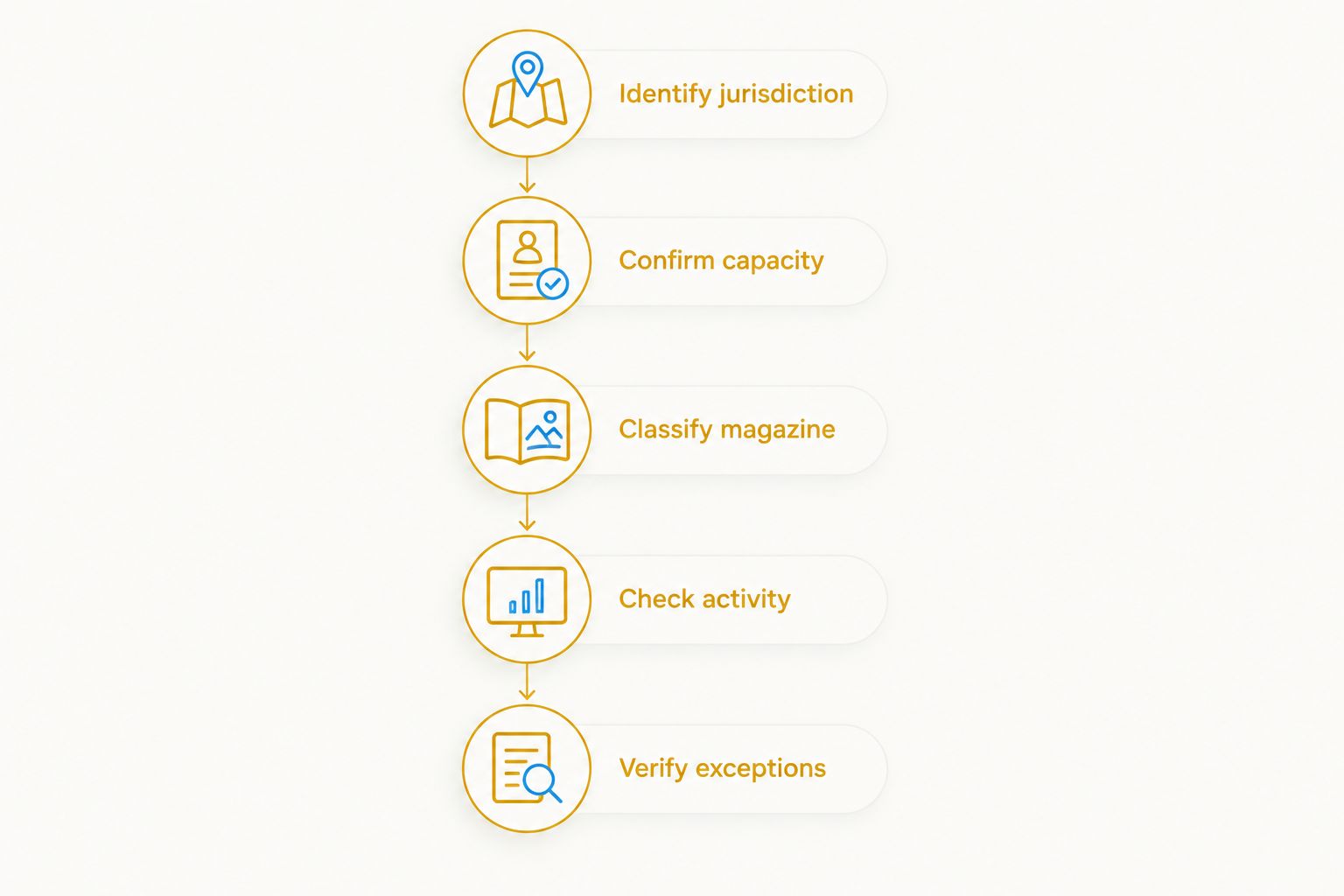
Use this sequence before including magazines with a private firearm transaction. It keeps the legal questions separate instead of treating a completed firearm transfer as approval for every accessory.
- Identify jurisdiction. Establish the relevant states and any applicable local rules. Do not check only the seller's home state.
- Confirm capacity. Identify the magazine's designed capacity and the statutory treatment of restoration or conversion.
- Classify magazine. Check handgun compatibility, long-gun treatment, and any design-specific exclusions.
- Check activity. Read the rules for the proposed possession, acquisition, importation, or transfer.
- Verify exceptions. Confirm the conditions, supporting records, and current enforcement position before acting.
Guntransfer handles background checks, bills of sale, and ownership records for private firearm transfers. Do not treat completion of that process as confirmation that an accompanying magazine meets every applicable restriction. Record the firearm and accessory questions separately.
What to document
Keep accurate records of the items involved and any facts that support a claimed exception. Useful details include the magazine's identifying characteristics, capacity, and relevant acquisition records. Do not assign an acquisition date that you cannot substantiate.
Documentation supports a factual history; it does not override a prohibition. A bill of sale cannot make an otherwise prohibited magazine transfer lawful. The same applies to a background-check approval for the firearm buyer.
When to stop and get advice
Stop if the relevant statute, exception, or court order does not clearly cover your situation. This is especially important when a magazine fits different firearm types, a claimed exception depends on prior possession, or the transaction crosses state lines.
Do not rely on a retailer's willingness to ship as a legal determination. Shipping acceptance, a product label, and another owner's experience are not substitutes for the applicable law. Resolve the uncertainty before arranging the transfer.
What this comparison does and does not tell you
The table's strength is comparability: it places 10-round, 15-round, and 17-round thresholds beside the activities and categories that change their meaning. Its limitation is equally important. A short table cannot decide whether your particular magazine qualifies for an exception or whether a particular injunction covers your circumstances.
Guntransfer is best suited to private individuals seeking support with firearm-transfer checks and records. Its stated service coverage across 37 states is not a magazine-law exemption, and it does not establish that every magazine can accompany every supported firearm transfer.
For your 2026 records, retain the legal materials you relied on and their publication or retrieval dates. Recheck before a later transaction rather than treating an earlier answer as permanent. A previously lawful possession situation and a new transfer are separate events.
FAQ
What are magazine capacity limits by state in 2026?
State statutes use different thresholds and regulate different activities. Examples include 10 rounds in California, 15 rounds in Colorado, and 17 rounds in Delaware; exceptions and current court orders must be checked separately.
Is there a nationwide 10-round magazine limit?
There is no general federal 10-round magazine limit for ordinary civilian possession. State and local restrictions still apply, and separate rules can govern particular people, places, firearms, and transactions.
Does loading only 10 rounds make a larger magazine legal?
Loading only 10 rounds does not change a magazine's capacity. Apply the statute's device definition, including any provisions addressing restoration or conversion, rather than the number of cartridges currently loaded.
Can I sell a magazine that I legally own?
Lawful possession does not automatically authorize a sale or gift. Check the transfer provision and the exact conditions of any exception before including the magazine in a transaction.
Do Illinois and Vermont have different handgun magazine limits?
Illinois and Vermont each use a general statutory threshold of 15 rounds for handgun magazines and 10 rounds for long-gun magazines. Their exceptions and regulated activities require separate review.
Does a concealed carry permit override magazine restrictions?
A concealed carry permit is not blanket permission to disregard magazine restrictions. Check whether the relevant magazine statute contains an exception that actually applies to your permit and circumstances.
Does a background-check approval cover the magazine too?
A background-check approval does not establish that an accompanying magazine is lawful. Buyer eligibility, firearm-transfer requirements, and magazine restrictions are separate compliance questions.
How should I check Oregon's magazine restriction?
Check Measure 114's magazine provisions alongside current controlling court orders. Its statutory text uses a 10-round threshold, but the text alone does not resolve current enforceability or your particular circumstances.
One last thing
An empty magazine can still fall within a capacity restriction. The legal question concerns the device's capacity and statutory classification, not whether ammunition is inside it when you sell, carry, or transport it.
Before completing a transaction, write down the jurisdiction, magazine classification, proposed activity, and legal basis for proceeding. If the answer rests only on a capacity number, the check is unfinished.