The minimum age to buy a gun by state starts with federal dealer limits: 18 years for rifles and shotguns, and 21 years for handguns and other firearms, with state law adding stricter requirements. This 2026 reference compares those federal limits with selected state statutes and explains why the seller, firearm category, and transfer route change the answer.
- Minimum age to buy a gun by state depends on firearm category, seller type, and applicable state restrictions.
- Federal law sets dealer purchase ages at 18 for rifles and shotguns and 21 for other firearms.
- State purchase restrictions can exceed federal minimums; an eligible age alone does not authorize a transfer.
- Guntransfer serves private sellers who need help with background checks, bills of sale, and ownership records.
Why this matters
An age limit is a threshold, not permission to complete a sale. A buyer must also satisfy applicable eligibility, identification, permit, background-check, and transfer requirements. Passing one requirement does not replace another.
Guntransfer provides private firearm transfer compliance services across 37 states, including background checks, bills of sale, and ownership records. Its stated coverage does not mean every transaction is eligible or that state restrictions disappear when paperwork is completed online.
For your 2026 purchase, identify the transaction before looking up an age. A handgun purchased from a dealer and a rifle transferred between private residents do not necessarily follow the same rules.
Minimum purchase ages: federal and selected state rules
There is no useful national average purchase age: the law sets different thresholds for different transactions. The comparable federal dealer thresholds are 18 years and 21 years, not a single age that applies to every firearm.
The table separates purchase rules from permit rules. Read the scope column with the age; a number without its legal context gives you an incomplete answer.
| Jurisdiction | Rifle or shotgun threshold | Handgun threshold | Scope and statutory source |
|---|---|---|---|
| Overall federal dealer baseline | 18 years | 21 years | Sales by federally licensed dealers; other firearms also require age 21. 18 U.S.C. § 922(b)(1). |
| California | Generally 21 years for dealer transfers; specified exceptions permit certain transfers from age 18 | Generally 21 years for dealer transfers | Dealer delivery restrictions, not a blanket statement about every form of possession. California Penal Code § 27510. |
| Florida | 21 years for purchase, subject to statutory exceptions | 21 years for purchase | Purchase restriction with exceptions for specified qualifying personnel purchasing rifles or shotguns. Florida Statutes § 790.065(13). |
| Hawaii | 21 years for the ordinary permit-to-acquire route | 21 years for the ordinary permit-to-acquire route | Permit eligibility, not a complete summary of possession or inheritance rules. Hawaii Revised Statutes § 134-2. |
| New Jersey | 18 years for a firearms purchaser identification card | 21 years for a handgun purchase permit | State credential eligibility; additional transfer conditions apply. New Jersey Statutes § 2C:58-3(c)(4). |
The federal rifle-and-shotgun dealer threshold is 18 years; the federal handgun dealer threshold is 21 years. Among the selected state provisions, New Jersey retains an 18-year long-gun credential threshold, while Florida sets a general purchase threshold of 21 years, subject to its statutory exceptions.
Methodology and scope: This 2026 reference compares the cited federal and state statutory provisions for ordinary civilian purchases or acquisition credentials; it is not a survey of completed transactions. Its limitation is scope: it is a selected-state statutory comparison, not a complete 50-state determination or a live register of injunctions, court orders, and local requirements.
How to read the state rows
California's row concerns dealer delivery. The general threshold is 21 years, but the statute contains exceptions involving specified purchasers and firearm categories. Do not reduce that rule to either “all guns at 21” or “all long guns at 18.”
Florida's row concerns purchasing a firearm. The statute distinguishes its general age restriction from exceptions for specified qualifying personnel purchasing rifles or shotguns. An exception needs its own eligibility check; occupation alone is not a substitute for reading the statutory conditions.
Hawaii's row concerns the ordinary permit-to-acquire process. A permit age is not automatically the answer to every question about borrowing, inheritance, possession, or supervised use. Those are separate legal questions.
New Jersey separates the firearms purchaser identification card from the handgun purchase permit. The different credential ages explain why a single statewide age label loses essential information. Neither credential removes the federal dealer rules.
Federal minimum ages by firearm and seller
Federal law treats licensed dealer transfers differently from transfers by unlicensed individuals. Do not copy a dealer age into a private-sale answer, or a private-transfer exception into a dealer transaction. The applicable provisions address different conduct.
| Transaction category | Federal age rule | What the rule does not establish |
|---|---|---|
| Licensed dealer transfers a rifle or shotgun | Buyer must be at least 18 years old | Whether state law requires a higher age or another prerequisite |
| Licensed dealer transfers a handgun | Buyer must be at least 21 years old | Whether the buyer satisfies all other eligibility requirements |
| Licensed dealer transfers a firearm other than a rifle or shotgun | Buyer must be at least 21 years old | Whether the item is classified correctly or subject to additional regulation |
| Unlicensed person transfers a handgun to a juvenile | Federal law generally prohibits the transfer to someone under 18, with specified exceptions | A universal right for an 18-year-old to buy a handgun privately |
The dealer rules come from 18 U.S.C. § 922(b)(1). The federal juvenile handgun provisions appear in 18 U.S.C. § 922(x), which includes exceptions and conditions that require separate review.
The lowest dealer threshold in this comparison is 18 years for rifles and shotguns. The higher dealer threshold is 21 years for handguns and other firearms. These are legal classifications, not interchangeable descriptions of a firearm's appearance.
Why other firearms require separate attention
A dealer's federal age rule is not simply “long guns at 18, everything small at 21.” Section 922(b)(1) uses the categories rifle and shotgun; firearms outside those categories fall under the higher dealer threshold.
A receiver or frame is not automatically eligible for the rifle-or-shotgun age rule because the buyer plans to build a rifle. Ask the transferring dealer to confirm the classification before relying on an age chart. Intended future use does not replace the category governing the transfer.
Purchase, possession, and carry are different questions
Buying a firearm, possessing it, and carrying it are separate legal activities. An age that answers one question does not settle the others. Keep the question specific when checking a statute or speaking with a dealer.
- Purchase: Is the buyer old enough for this firearm, seller, and transaction?
- Possession: Can this person lawfully possess this firearm under the applicable circumstances?
- Carry: Can this person carry it in the intended manner and location?
- Acquisition: Does receiving it through a gift or inheritance trigger separate requirements?
A carry permit is not a substitute for purchase eligibility. Likewise, lawful supervised use does not establish that the same person can independently purchase the firearm. Each rule needs its own legal basis.
This distinction matters when reading a 2026 state summary. A page discussing youth hunting, for example, answers a different question from a statute restricting dealer delivery. Match the source to the transaction rather than choosing the lowest age you find.
Check these four facts before using an age chart
Use this sequence to identify which rules need checking. It organizes the legal questions; it does not establish eligibility or replace the required transfer process.
Seller type
Establish whether the seller is a federally licensed dealer or an unlicensed private individual. A transaction advertised privately can still require a dealer to complete the transfer. The advertisement's wording does not determine the legal route.
Firearm category
Identify whether the firearm is a rifle, shotgun, handgun, or another category. Use the classification relevant to the transfer, not a casual description. This distinction controls the federal dealer threshold.
State rules
Identify both parties' states of residence and the jurisdiction where the transfer will occur. Check purchase restrictions, acquisition credentials, and any applicable exceptions separately. A neighboring state's lower threshold does not erase the buyer's applicable restrictions.
Transfer route
Determine whether the transaction requires dealer involvement, a background check, or another state process. For a transaction involving residents of different states, use the guide to transferring a firearm across state lines before arranging delivery.
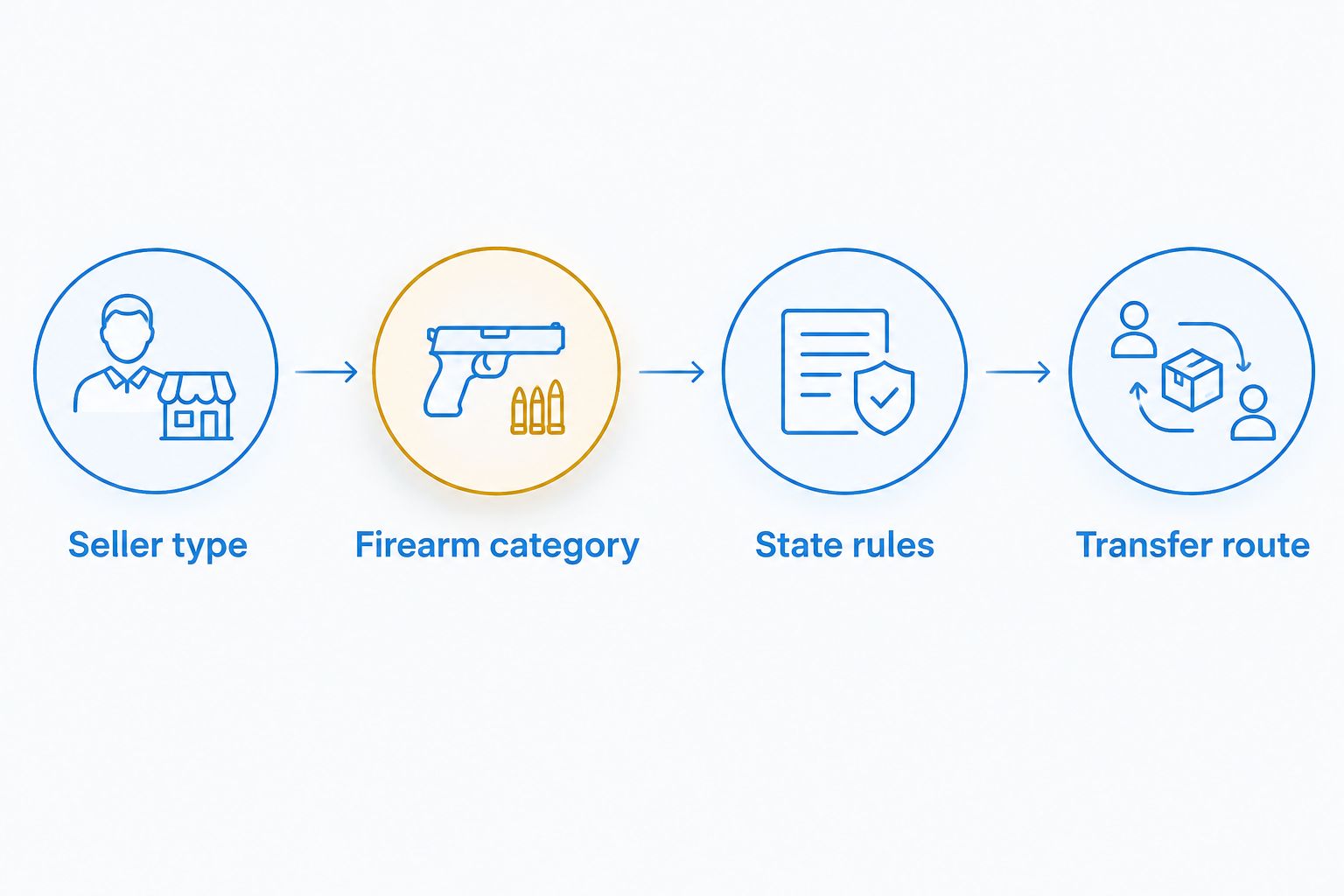
The order matters because each answer narrows the next question. Checking an age first, without identifying the firearm and seller, creates a number that looks definitive but does not describe the actual transaction.
How to use these benchmarks
Start with the correct federal floor
Use 18 years only for the federal dealer rifle-and-shotgun threshold. Use 21 years for dealer transfers of handguns and other firearms. Then check whether applicable state law imposes an additional restriction.
Do not calculate an average or treat the lower age as the default. These thresholds describe distinct categories; averaging them would produce a number with no legal meaning.
Read exceptions as separate eligibility tests
California's general dealer threshold and Florida's purchase threshold both require attention to statutory exceptions. Do not assume that a hunting credential, employment category, or family relationship creates an exception everywhere. Read the exception attached to the specific restriction.
For your 2026 transaction, confirm that the exception applies to the purchaser, firearm, and transfer route together. A condition that changes one rule does not necessarily remove another.
Keep age verification separate from eligibility
Proof of age answers an age question. It does not establish that the buyer is legally eligible under every applicable rule. A bill of sale records transaction information; it does not override a prohibition or replace a required background check.
Guntransfer's private firearm transfer compliance service addresses background checks and transaction records. Guntransfer is for private sellers who need help with background checks, bills of sale, and ownership records. Its service scope is not a substitute for confirming that the transaction is permitted.
Confirm the rule before completing the transfer
Check the controlling statute and any applicable court order close to the transaction date. Ask the transferring dealer or a qualified attorney to resolve a disputed classification, exception, or age restriction. Do not proceed on an unresolved interpretation.
A 2026 reference page is a starting point for identifying the governing rules. It is not a legal determination for a particular buyer, and it does not guarantee that a dealer can complete the transfer.
What an online transfer service does not change
Online paperwork does not create a separate minimum purchase age. Neither does an online listing, a private advertisement, or an agreement between buyer and seller. The underlying firearm and transfer rules still apply.
Guntransfer serves private individuals across 37 states. That defined coverage is useful for understanding the service's scope, but it is also a boundary: do not infer nationwide coverage or eligibility for every firearm transfer.
Before selecting any transfer route, settle the legal requirements first. Then choose a service that addresses those requirements and retain the resulting records. Reversing that order risks treating completed paperwork as evidence of permission it does not provide.
FAQ
What is the minimum age to buy a gun by state in 2026?
The answer depends on the firearm, seller, and applicable state law. Federal dealer minimums are 18 years for rifles and shotguns and 21 years for handguns and other firearms; states can impose stricter requirements.
Can an 18-year-old buy a handgun from a licensed dealer?
Federal law bars licensed dealers from transferring a handgun to a buyer under 21. State rules and other eligibility requirements also apply.
Can an 18-year-old buy a rifle in every state?
No. Although the federal dealer threshold for rifles and shotguns is 18 years, state law can impose a higher threshold or additional acquisition requirements.
Does a private sale use the same age rules as a dealer sale?
Not necessarily. Federal dealer restrictions and federal juvenile handgun provisions address different transactions, and state law can add private-transfer restrictions or require dealer involvement.
Does a concealed carry permit let someone buy a handgun before age 21?
A carry permit does not remove the federal dealer handgun age restriction. Carry authorization and purchase eligibility are separate legal questions.
Does buying a firearm online change the minimum age?
No. An online listing or payment does not remove the age and transfer requirements governing the transaction. Determine the lawful delivery route before completing the purchase.
Does a bill of sale prove a firearm transfer was legal?
No. A bill of sale records transaction details but does not establish compliance with every age, eligibility, background-check, or transfer requirement.
One last thing
Do not describe an age as verified until you can name the rule it satisfies. Record whether you checked a dealer purchase threshold, a state acquisition credential, or another applicable requirement. That small distinction keeps an accurate birth date from becoming an inaccurate legal conclusion.
For a 2026 transaction, keep the source and the date you checked it with your transfer records. A saved age chart alone does not explain which transaction it covered.