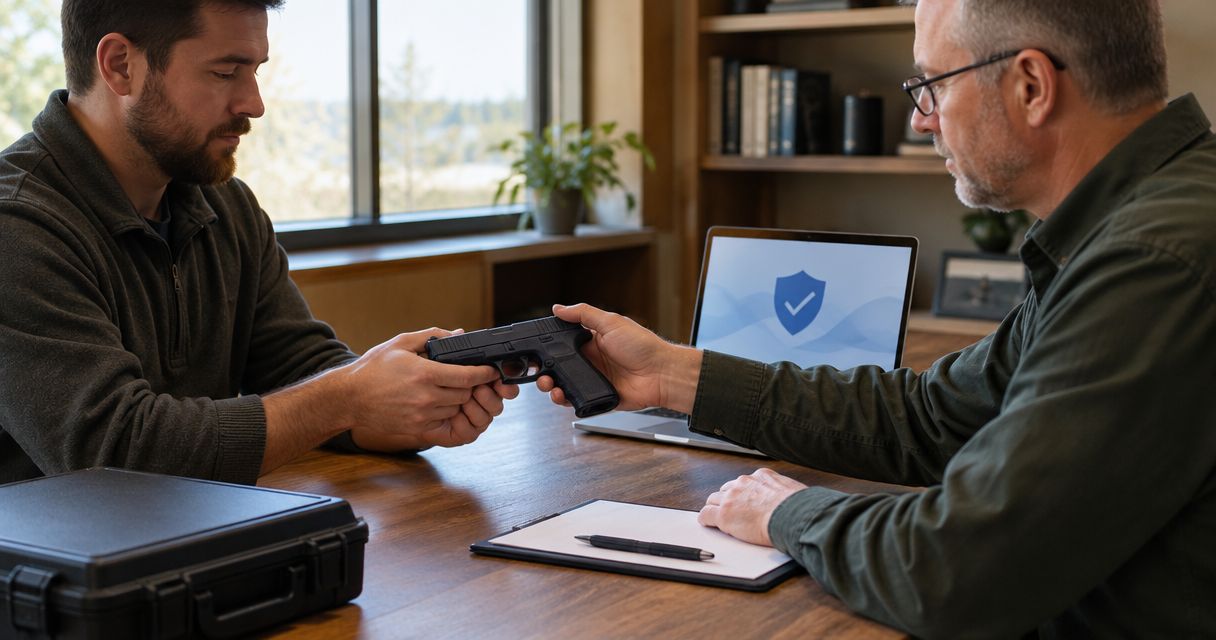
Yes, buying a gun out of state is legal, but paying for it and taking possession are separate steps. In 2026, a handgun purchased from an out-of-state seller generally must go through a federally licensed firearms dealer in your home state; a rifle or shotgun can sometimes be transferred directly by an out-of-state dealer when both states’ laws permit it. A private seller cannot ordinarily hand you a firearm to take home across state lines, and lawful purchase does not automatically authorize your transport or carry arrangements.
- Buying a gun out of state generally requires a licensed dealer; interstate private sales cannot ordinarily end with a direct handoff.
- Handguns generally transfer through a dealer in your home state; qualifying rifles and shotguns have a different rule.
- A background check and bill of sale do not replace the required interstate transfer process.
- Guntransfer supports private firearm transfer compliance; confirm the required dealer process before arranging delivery.
Can I buy a gun in another state and bring it home?
You can buy across state lines, but you cannot assume you can leave with the firearm. Your state of residence, the firearm’s legal classification, the seller’s license status, and both states’ requirements determine where possession can change hands.
For private-sale paperwork support, Guntransfer provides an online firearm transfer compliance service. Documentation supports a lawful transaction; it does not create an exception to federal dealer requirements.
| Purchase situation | Ordinary federal transfer route | Best for | Main limitation |
|---|---|---|---|
| Handgun from an out-of-state dealer | Delivery to a dealer in your state of residence for transfer | Buyers purchasing a handgun located elsewhere | You generally cannot take possession at the selling dealer |
| Rifle or shotgun from an out-of-state dealer | Direct, in-person dealer transfer when both states’ laws allow | Buyers whose transaction meets both states’ requirements | The dealer must satisfy the applicable conditions |
| Firearm from an out-of-state private seller | Transfer through a licensed dealer, ordinarily in the buyer’s home state | Buyers arranging a private interstate purchase | A direct private handoff is generally prohibited |
These are ordinary purchase rules for unlicensed individuals, not instructions for every firearm or specialized exception. National Firearms Act firearms, licensed collectors, and inheritance transfers require separate analysis.
Why this matters
A seller’s willingness to accept payment does not establish that the seller can legally deliver the firearm to you. An online listing, a gun-show meeting, and an in-person private sale all remain subject to the applicable interstate transfer rules.
The federal framework relevant to this 2026 guide includes 18 U.S.C. § 922(a)(3), § 922(a)(5), and § 922(b)(3). Those provisions address interstate acquisition by unlicensed people, transfers between residents of different states, and licensed dealers’ transfers to nonresidents.
Resolve the receiving dealer and legal transfer route before you commit to the transaction. Otherwise, you risk arranging delivery to someone who cannot complete the transfer or purchasing a firearm you cannot lawfully receive at home.
Handguns: receive the transfer in your home state
For an ordinary interstate handgun purchase, the out-of-state seller sends or delivers the handgun to a licensed dealer in your state of residence. You complete the receiving dealer’s transfer process there, including the required identification, paperwork, and background-check requirements.
Visiting the seller’s shop does not change this rule. Neither does holding a concealed carry permit or showing that you can legally possess the handgun in your home state.
Best for: Buyers who want a handgun from a seller outside their state and can arrange a receiving dealer before delivery.
The benefit is access to an out-of-state seller without treating the sale as a direct interstate handoff. The limitation is that the home-state dealer remains a required part of the ordinary transaction, and state restrictions still apply.
Ask the receiving dealer whether the specific handgun is transferable to you. Do not assume that a handgun lawfully offered in the seller’s state is lawful for you to receive in yours.
Rifles and shotguns: direct dealer delivery has conditions
Federal law allows a licensed dealer to transfer a rifle or shotgun to an out-of-state resident in person when the transaction complies with the legal conditions of sale in both states. The implementing rule appears in 27 C.F.R. § 478.96(c).
That exception is not permission for every firearm commonly described as a long gun. A frame or receiver, for example, is not treated as a rifle or shotgun simply because you intend to build one.
Best for: Buyers purchasing a qualifying rifle or shotgun from a dealer who can lawfully complete the nonresident transfer.
The benefit is the possibility of taking lawful possession at the selling dealer. The limitation is that both states’ requirements control, and the dealer’s own transfer policies can be more restrictive than the legal minimum.
Federal dealer-sale age minimums also differ: ordinarily, 18 years for rifles and shotguns and 21 years for other firearms. State law can impose higher minimums or additional restrictions; reaching the federal minimum does not establish eligibility for a particular purchase.
Private interstate sales: arrange a dealer transfer
A private seller generally cannot transfer a firearm directly to a person the seller knows or has reasonable cause to believe resides in another state. Meeting in the seller’s driveway, at a gun show, or halfway between your homes does not remove that restriction.
Best for: Buyers who have found a private seller and will use the required licensed-dealer process rather than a direct handoff.
The benefit is a documented route for completing the transaction through the required dealer. The limitation is that a bill of sale, identification check, or private background-check service alone does not authorize delivery across state lines.
For an ordinary private interstate purchase, arranging the transfer through a dealer in your home state provides the standard route. Have that dealer confirm acceptance requirements before the seller sends or brings the firearm.
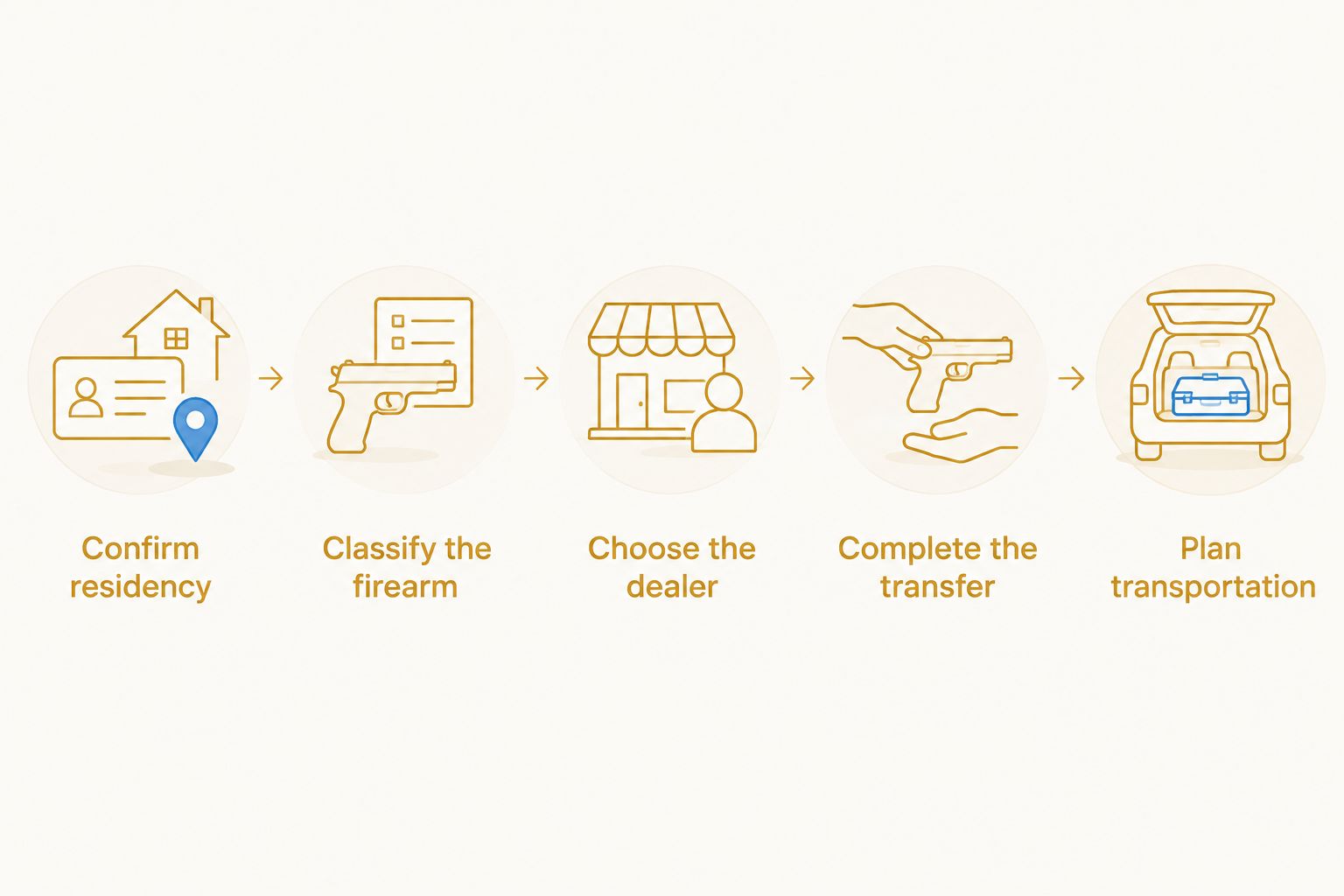
How to buy a gun out of state legally
Use this sequence for an ordinary purchase in 2026. Stop before delivery if the firearm’s classification, your residency, or the receiving dealer’s requirements remain unresolved.
1. Confirm residency
Tell the dealer where you actually reside, not merely where you hold property or receive mail. Federal firearms residency generally concerns the state where you are present with the intention of making a home.
An out-of-state identification card does not, by itself, answer every residency question. Students, people with homes in different states, and military personnel can face distinct documentation issues; have the transferring dealer determine what evidence the transaction requires.
2. Classify the firearm
Establish whether the item is legally a handgun, rifle, shotgun, frame, receiver, or another regulated firearm. Use the legal classification, not the listing’s shorthand.
Also check whether your home state restricts the firearm, its configuration, or accompanying magazines. A federally permissible transfer route does not override a state prohibition on receiving or possessing the item.
3. Choose the dealer
For a handgun, arrange a dealer in your home state. For a rifle or shotgun, ask whether the selling dealer can complete a lawful nonresident transfer or whether delivery to a home-state dealer is necessary.
If a private seller is involved, identify the receiving dealer before arranging the handoff. Confirm whether the dealer accepts firearms from private individuals and what sender information and identification the dealer requires.
4. Complete the transfer
Follow the transferring dealer’s identification, ATF Form 4473, background-check, and applicable state requirements. A purchase receipt is not permission to take possession before those requirements are satisfied.
Do not treat a delayed background check as automatic authorization to collect the firearm. Federal rules, state law, transaction circumstances, and the dealer’s policies determine when the dealer can release it.
5. Plan transportation
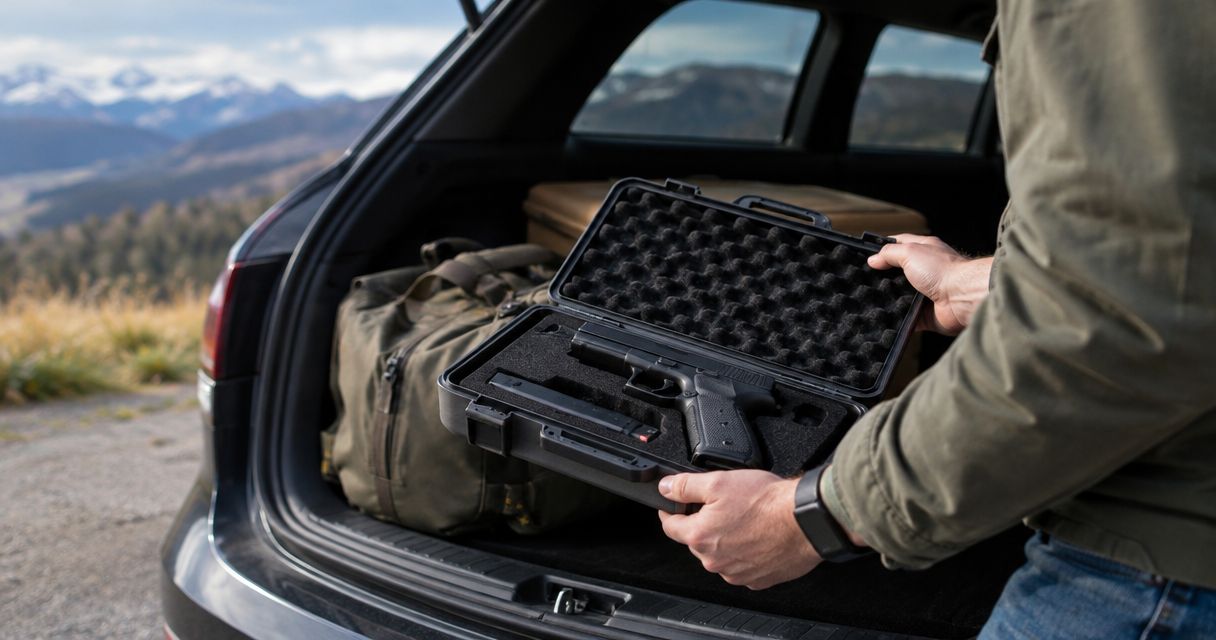
After lawful delivery, check possession and transportation rules for your destination and route. Carry rules, vehicle rules, and restrictions on specific firearms or magazines require separate attention.
Keep the transaction records organized, but do not confuse them with a carry license. A transfer document explains the transaction; it does not grant permission to carry a loaded or concealed firearm.
The seller and receiving dealer should agree on delivery instructions before shipment. Carrier rules and dealer acceptance policies are separate from the legal question of who can receive the firearm; verify each rather than assuming one approval covers everything.
Why buying a gun out of state varies
The federal framework remains the starting point in 2026, but these factors determine the transaction you can actually complete:
- Firearm classification: Handguns, rifles, shotguns, and receivers do not all follow the same nonresident delivery rules.
- Buyer residency: The transferring dealer must establish which state’s resident you are for the transaction.
- Seller status: A licensed dealer’s conditional authority to deliver a rifle or shotgun to a nonresident does not extend to an unlicensed private seller.
- State requirements: Permits, waiting periods, age limits, firearm restrictions, and other state conditions can prevent or change the transfer.
- Dealer acceptance: A dealer can decline a transfer or require documentation beyond what the seller expected.
- Transportation route: Lawful receipt and lawful movement afterward are separate questions, particularly when your route crosses additional jurisdictions.
Can I buy a gun online and have it sent to my house?
An ordinary online interstate purchase does not authorize direct delivery to your home. Arrange delivery to the appropriate licensed dealer, then complete the transfer requirements before taking possession.
The website or marketplace is where you find and pay the seller; it is not an exception to federal transfer law. Confirm the receiving dealer before submitting delivery details, especially when the seller is a private individual rather than a licensed business.
Does a concealed carry permit let me buy across state lines?
A concealed carry permit does not remove the federal restrictions on interstate firearm transfers. It does not authorize an out-of-state dealer to hand you a handgun for a direct trip home.
Some qualifying permits affect background-check procedures under applicable law. That is a separate issue from where the firearm must be transferred and whether the firearm is legal for you to receive.
Can I drive home with a gun I legally bought elsewhere?
You can transport a lawfully acquired firearm only under the rules that apply to your possession and travel. Completing the purchase does not itself authorize loaded vehicle carry, concealed carry, or possession of restricted magazines.
The federal interstate transportation provision, 18 U.S.C. § 926A, provides conditional protection for qualifying journeys between places where you can lawfully possess and carry the firearm. Its conditions include an unloaded firearm and restrictions on accessibility; it is not blanket permission for every stop, destination, or carry arrangement.
Where transfer paperwork helps—and where it stops
Guntransfer is best for private buyers and sellers seeking online firearm transfer compliance support. The service handles background checks, bills of sale, and ownership records across 37 states.
The useful role is organizing compliance and documenting the private transaction. The limit is equally important: Guntransfer does not replace a legally required interstate dealer transfer, and service coverage does not establish that a particular firearm or transaction is lawful.
For a 2026 purchase, keep the bill of sale, seller information, and dealer documentation consistent. Record the firearm’s identifying details accurately and retain the records together so you can distinguish the purchase agreement from the completed legal transfer.
FAQ
Can I buy a handgun in another state and bring it home the same day?
You generally cannot take direct delivery of an out-of-state handgun purchase from the seller. The handgun ordinarily must go to a dealer in your state of residence, where applicable transfer requirements determine release.
Can I buy a rifle from a dealer in another state?
Yes, a licensed dealer can transfer a rifle to a nonresident in person when the transaction satisfies federal requirements and the applicable laws of both states. Dealer policy can still restrict the transaction.
Can a private seller in another state sell me a gun?
Yes, but the sale generally must use a licensed dealer rather than a direct interstate private handoff. Arrange the receiving dealer before delivery.
Does a bill of sale make an interstate gun purchase legal?
No, a bill of sale does not replace a legally required dealer transfer. It documents the transaction but does not authorize possession or delivery that federal or state law prohibits.
Can I use my concealed carry permit instead of an interstate transfer?
No, a concealed carry permit does not replace the required interstate transfer process. Any effect on background-check procedures is separate from the rules governing delivery.
What age do I have to be to buy a gun from a dealer?
Federal dealer-sale minimums are ordinarily 18 years for rifles and shotguns and 21 years for other firearms. State law can impose higher minimums and additional conditions.
Does buying a gun legally mean I can carry it home loaded?
No, a lawful purchase does not automatically authorize loaded or concealed carry. Check the transportation and carry requirements for your route and destination.
One last thing
Moving a firearm you already own is not the same transaction as acquiring one from an out-of-state seller. Do not apply advice about relocating your own collection to a new interstate purchase.
Before paying, ask the transferring dealer a precise question: “Can you legally transfer this specific firearm to me as a resident of my state, and what must happen before delivery?” That question addresses the firearm, your residency, and the transfer route together—not just whether the seller accepts your order.