Yes. In 2026, Washington residents can buy guns in Idaho, but handguns generally must go to a Washington federally licensed firearms dealer (FFL) for delivery; an Idaho FFL can deliver an eligible rifle or shotgun only when the transaction complies with both states’ laws. Buying in Idaho does not bypass Washington’s background-check, waiting-period, firearm, or magazine restrictions.
- Can Washington residents buy guns in Idaho? Yes, but federal law controls where you can take delivery.
- Handguns generally require delivery through a Washington FFL, even when purchased from an Idaho seller.
- An Idaho FFL can deliver eligible rifles or shotguns only when both states’ requirements are satisfied.
- Guntransfer supports private firearm transfer documentation; paperwork does not replace a required dealer transfer.
Can Washington residents buy guns in Idaho?
Yes—but agreeing to buy a gun and legally taking possession are separate steps. Federal law generally prevents an unlicensed buyer from acquiring a firearm outside the buyer’s home state and bringing it home, except through a lawful exception or dealer transfer.
For private-sale documentation, Guntransfer provides an online firearm transfer service. An online record does not authorize an interstate handoff that federal law otherwise prohibits.
For an ordinary purchase in 2026, the firearm’s legal classification determines the route:
| Purchase | Can an Idaho dealer deliver it directly? | Required approach | Main limitation |
|---|---|---|---|
| Handgun | Generally no | Arrange delivery through a Washington FFL | Buying in Idaho does not authorize Idaho pickup |
| Eligible rifle or shotgun | Only if both states’ laws are satisfied | Ask the Idaho FFL whether it can complete a compliant nonresident transfer | Federal permission alone is insufficient |
| Frame or receiver | Generally no | Arrange delivery through a Washington FFL | A receiver is not treated as a rifle or shotgun for this exception |
| Firearm from an unlicensed Idaho resident | No direct interstate private handoff | Arrange the appropriate FFL transfer | A bill of sale cannot replace dealer involvement |
| Firearm Washington prohibits importing | Not through an ordinary consumer purchase route | Do not arrange importation without a specific lawful exception | Dealer involvement does not remove the prohibition |
These are transfer categories, not product recommendations. The controlling federal provisions include 18 U.S.C. § 922(a)(3), § 922(a)(5), and § 922(b)(3); the dealer regulation for qualifying out-of-state rifle and shotgun transfers is 27 C.F.R. § 478.96(c).
Why this matters
An Idaho seller’s willingness to accept payment does not establish that you can take the firearm home. The receiving dealer still needs to determine whether the firearm, buyer, and transfer satisfy applicable law.
Set the delivery route before paying. Otherwise, you risk arranging a purchase that requires a different dealer, additional coordination, or a firearm configuration that Washington does not allow you to import.
Washington’s permission for residents to purchase rifles and shotguns outside the state appears in RCW 9.41.122. That provision does not erase federal requirements or Washington restrictions applicable to the transaction.
Handguns: use a Washington receiving FFL
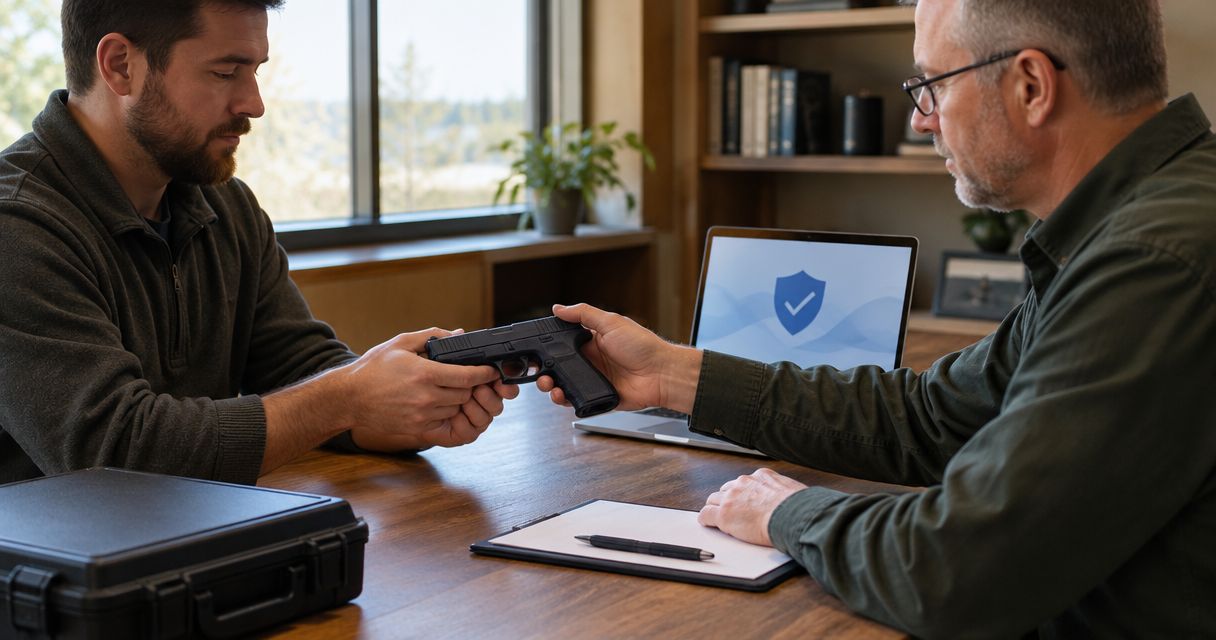
For an ordinary handgun purchase, a Washington resident must take delivery through a Washington FFL—not across an Idaho dealer’s counter. You can select and pay for a handgun in Idaho, but the seller must arrange a lawful transfer to the receiving dealer.
The same basic restriction applies when the Idaho seller is a private individual. Meeting the seller at a gun show, signing a receipt, or presenting a Washington concealed pistol license does not create a direct-transfer exception.
Before committing, ask the Washington FFL:
- Will the dealer accept this particular handgun?
- Will the dealer accept a shipment from this seller?
- What identification and training documentation must you provide?
- What delivery restrictions apply to the handgun and accompanying magazines?
Best for handgun buyers: arrange the Washington receiving dealer first. This route puts delivery with the dealer in your state, but it requires coordination between the seller and receiving FFL.
Do not confuse payment confirmation with transfer approval. You take possession only when the receiving dealer can lawfully release the firearm.
Rifles and shotguns: Idaho pickup is conditional
Federal law permits an FFL to sell and deliver a rifle or shotgun to a resident of another state when the buyer appears in person and the transaction fully complies with the legal conditions of sale in both states. That is a limited exception—not general permission to buy any long gun in Idaho.
For a Washington resident buying in 2026, an Idaho dealer must account for Washington requirements as well as Idaho requirements. A dealer that cannot satisfy those conditions cannot use the federal long-gun exception to deliver the firearm directly.
Best for an eligible long-gun buyer seeking Idaho pickup: confirm compliance with the Idaho FFL before traveling. The benefit is a potentially lawful direct dealer transfer; the limitation is that the dealer must satisfy both states’ rules and agree to handle the transaction.
A Washington receiving FFL is the alternative when direct Idaho delivery is unavailable. That route still requires the firearm to be lawful for the Washington transfer and importation.
A receiver is not a long gun for this exception
A bare frame or receiver does not qualify for the interstate rifle-or-shotgun delivery exception merely because you intend to build a rifle. Dealers record the firearm’s actual classification, not your future plans.
Ask the dealer to identify the transfer classification before purchase. The same caution applies to firearms classified as something other than a handgun, rifle, or shotgun.
Why the legal transfer route varies
The answer changes with the transaction—not simply with the distance between the seller and the state line.
- Buyer residency: Federal interstate-transfer rules follow your state of residence. A shopping trip does not establish Idaho residency.
- Firearm classification: Handguns, rifles, shotguns, and receivers do not share the same interstate delivery rules.
- Seller status: A licensed dealer and an unlicensed private seller have different transfer obligations.
- Washington eligibility: A firearm or magazine lawful to possess or sell in Idaho is not automatically lawful to import into Washington.
- Dealer compliance: A dealer must satisfy the applicable transfer conditions, not just agree that the sale looks permissible.
- Transfer purpose: An ordinary purchase is different from a qualifying inheritance or another narrow statutory exception.
For a standard purchase, use the ordinary purchase rules. Do not apply an inheritance, temporary sporting-loan, or other exception to a sale merely because the parties know each other.
How to arrange the purchase legally
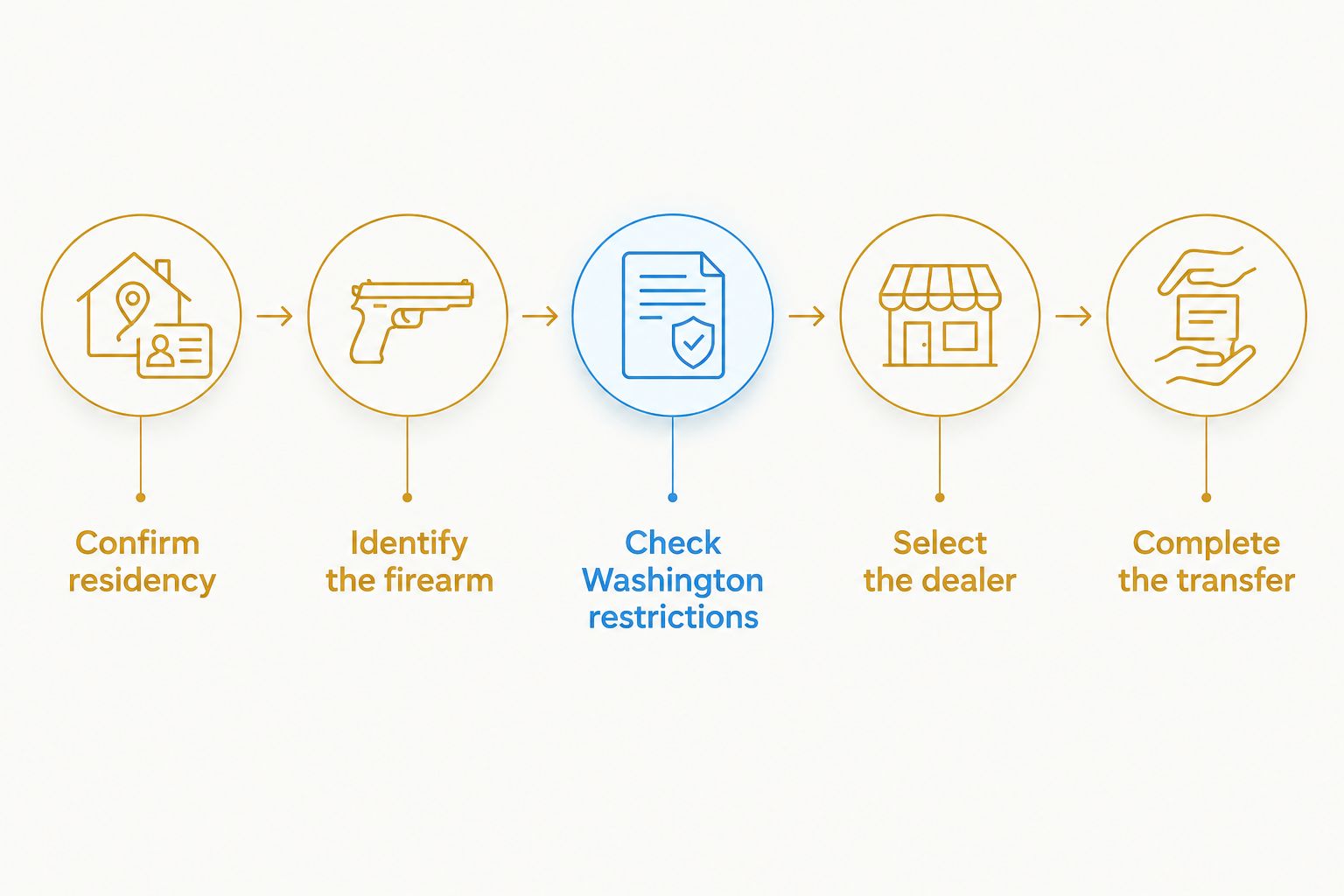
Use this sequence before making a purchase commitment. The same checkpoints apply whether you find the firearm in a shop, through an online listing, or at a gun show.
- Confirm residency. Tell the seller and receiving dealer that you are a Washington resident. Provide accurate identification and residency information.
- Identify the firearm. Confirm whether the item is a handgun, rifle, shotgun, receiver, or another classification. Identify the exact model and configuration for dealer review.
- Check Washington restrictions. Ask whether the firearm and included magazines can lawfully be transferred and imported. Resolve this before shipment or pickup.
- Select the dealer. For a handgun, arrange a Washington receiving FFL. For a qualifying rifle or shotgun, ask whether the Idaho FFL can satisfy both states’ requirements.
- Complete the transfer. Follow the dealer’s identification, background-check, training, and waiting-period requirements. Take possession only after lawful release.
The sequence matters: choosing a dealer after paying leaves important compliance questions unresolved. For the broader process, see the guide to transferring a firearm across state lines.
What Washington requirements still apply in 2026?
An Idaho purchase does not turn off Washington law. Several separate requirements affect whether and when a Washington resident can receive a firearm.
Background check and waiting period
Washington’s dealer-delivery requirements under RCW 9.41.092 include a completed background check establishing eligibility and a 10-business-day waiting period measured from the dealer’s request for the background check. The passage of 10 business days alone does not authorize release without the required eligibility result.
Do not treat a quick federal background-check response as permission to ignore Washington’s delivery conditions. Ask the transferring dealer what must be completed before release.
Safety training documentation
Under RCW 9.41.1132, Washington dealer transfers generally require proof of qualifying firearm safety training completed within the previous 5 years, subject to statutory exceptions. Confirm that your documentation meets the requirements before starting the transfer.
A concealed pistol license and a qualifying training record are different documents. Do not assume one substitutes for the other.
Firearm and magazine restrictions
Washington’s assault-weapon restrictions appear in RCW 9.41.390, with definitions in RCW 9.41.010. An ordinary out-of-state purchase does not create an exception to prohibited importation.
Washington also restricts importing large-capacity magazines under RCW 9.41.370. The statutory definition generally covers magazines capable of accepting more than 10 rounds, with specified exclusions; check the actual magazine rather than assuming everything packaged with a firearm is lawful to bring home.
Federal dealer age requirements
Federal law generally sets dealer-transfer minimums at 18 years for rifles and shotguns and 21 years for other firearms, including handguns and receivers. Washington imposes additional age restrictions for certain firearms.
These federal thresholds are not a complete eligibility test. The dealer must apply the rules governing your specific firearm and transaction.
Can I buy from a private seller in Idaho?
Yes, but you cannot use a direct private handoff to bypass interstate-transfer rules. For an ordinary sale between an Idaho resident and a Washington resident, arrange the appropriate licensed-dealer transfer before possession changes.
An online listing does not change this rule. Neither does meeting in a parking lot, at a gun show, or just inside Washington.
A bill of sale records the transaction; it does not supply legal authority for delivery. Keep the seller’s transaction documentation separate from the dealer’s transfer and background-check records, and make sure the records describe the same firearm.
Does a Washington concealed pistol license allow Idaho pickup?
No. A Washington concealed pistol license does not authorize an Idaho dealer to deliver a handgun directly to a Washington resident. Carry privileges and interstate purchase rules address different legal questions.
The federal handgun delivery restriction still applies. For an eligible rifle or shotgun, the Idaho dealer must still satisfy both states’ applicable conditions.
Can I drive the gun back to Washington myself?
Only after a lawful delivery and only when bringing that firearm into Washington is lawful. A qualifying rifle or shotgun lawfully delivered by an Idaho FFL presents a different situation from a handgun that requires delivery through a Washington FFL.
Transportation does not cure an unlawful transfer. Crossing the state line with a receipt does not replace the dealer involvement required before possession.
Where transfer records fit
Guntransfer is best for private firearm buyers and sellers who need transfer documentation, not a replacement for a required FFL. The service handles background checks, bills of sale, and ownership records across 37 states.
For this Washington–Idaho transaction, confirm service coverage and the required dealer workflow before relying on the service. Documentation supports the record of a lawful transaction; it cannot make an otherwise prohibited firearm, importation, or delivery lawful.
Use Guntransfer for its stated private firearm transfer functions while keeping the receiving FFL responsible for the dealer transfer it must perform. This keeps the paperwork role distinct from legal delivery authority.
FAQ
Can Washington residents buy guns in Idaho in 2026?
Yes, Washington residents can buy guns in Idaho in 2026, but the delivery route depends on the firearm and applicable law. Handguns generally require a Washington receiving FFL; eligible rifles and shotguns have a conditional interstate dealer exception.
Can I buy a handgun in Idaho and take it home the same day?
No, an ordinary handgun purchase by a Washington resident requires delivery through a Washington FFL. Paying an Idaho seller does not authorize taking possession in Idaho.
Can a Washington resident buy a rifle from an Idaho gun store?
Yes, an Idaho FFL can deliver an eligible rifle to a Washington resident only when the transaction satisfies both states’ applicable laws. Confirm that the dealer can complete that process before traveling or paying.
Can I buy a gun privately in Idaho with a Washington license?
You can arrange a purchase, but a Washington license does not authorize a direct interstate private handoff. Use the appropriate FFL transfer before taking possession.
Does Washington’s waiting period disappear if I buy in Idaho?
No, purchasing in Idaho does not bypass Washington’s applicable delivery requirements. Washington’s dealer-delivery rules include a 10-business-day waiting period and the required completed eligibility check.
Can I bring an Idaho-bought magazine into Washington?
Not if importing that magazine violates Washington law. Washington generally restricts importing magazines capable of accepting more than 10 rounds, subject to statutory definitions and exceptions.
Does a bill of sale make an interstate gun purchase legal?
No, a bill of sale documents a transaction but does not replace a required FFL transfer. The delivery itself must satisfy federal and applicable state law.
One last thing
Ask the dealer about delivery—not just whether you can buy. The useful question is: Can you lawfully deliver this exact firearm to me as a Washington resident, and what must happen first?
Get that answer before paying or traveling. This page provides general legal information, not individualized legal advice; confirm the current requirements with the transferring FFL and relevant authorities.