Yes—a private firearm transfer in Minnesota is federally compliant when the parties satisfy federal eligibility and residency rules and follow Minnesota’s separate transfer requirements. In 2026, a bill of sale alone does not establish compliance: private transfers of pistols and semiautomatic military-style assault weapons generally require the recipient’s qualifying permit, identity verification, and a transfer record unless an exception applies.
- An atf compliant firearm transfer mn transaction must satisfy federal law and Minnesota private-sale requirements.
- Minnesota generally requires a qualifying buyer permit and transfer records for covered private firearm sales, unless an exception applies.
- Keep required Minnesota private-transfer records for 10 years; a bill of sale alone does not establish compliance.
- Guntransfer supports private firearm transfer paperwork; confirm Minnesota coverage before choosing a service.
Is a private firearm transfer in Minnesota ATF compliant?
Yes, but “ATF compliant” is not a separate approval issued for an ordinary private sale. Your transaction must satisfy the federal restrictions enforced by the Bureau of Alcohol, Tobacco, Firearms and Explosives and the applicable Minnesota requirements.
Start with the transaction, not the document. The buyer’s residence, eligibility, firearm classification, and relationship to the seller determine the applicable process. The guide to legally selling a gun privately explains the broader private-sale workflow.
| Transfer route | Best for | Main benefit | Main limitation |
|---|---|---|---|
| Direct transfer between Minnesota residents | Eligible same-state parties who can meet Minnesota’s requirements | Allows a qualifying private transfer without treating the seller as a dealer | The parties must satisfy the applicable permit, verification, and recordkeeping rules themselves |
| Transfer through a federally licensed dealer | Parties seeking a dealer-administered transfer process | The dealer handles the required dealer paperwork and background-check process | An online agreement or completed seller paperwork does not replace the dealer’s required steps |
| Interstate transfer through an appropriate dealer | Ordinary private sales involving residents of different states | Addresses the federal restriction on direct transfers between unlicensed residents of different states | Minnesota paperwork alone does not authorize an interstate handoff |
These routes are not interchangeable. Choose the legal route before arranging delivery, and tell any receiving dealer the firearm type and both parties’ states of residence before sending anything.
Why this matters
A transaction can satisfy one legal requirement and still violate another. A seller’s bill of sale does not establish the buyer’s eligibility, and a Minnesota permit does not eliminate federal restrictions on interstate transfers.
For a 2026 Minnesota private sale, distinguish 2 legal layers: federal transfer restrictions and Minnesota transfer requirements. Then keep evidence that matches the route you actually used. Paperwork should document compliance, not substitute for it.
This article addresses ordinary private transfers. Firearms regulated under the National Firearms Act, transactions involving prohibited persons, and activity requiring a dealer’s license need separate analysis.
Federal compliance: eligibility and residency come first
Federal law restricts transfers to prohibited recipients. Under 18 U.S.C. § 922(d), you cannot transfer a firearm when you know or have reasonable cause to believe the recipient falls within a prohibited category.
That rule applies to private sellers, not just dealers. A buyer’s willingness to sign a statement does not erase information showing that the buyer is prohibited. Stop the transaction when the eligibility facts do not support proceeding.
Residency is a separate issue. Under 18 U.S.C. § 922(a)(5), an unlicensed person generally cannot directly transfer a firearm to another unlicensed person who resides in a different state, subject to statutory exceptions.
For an ordinary private sale to an out-of-state buyer, arrange the transfer through an appropriate federally licensed firearms dealer. Handguns generally must be delivered to the buyer through a dealer in the buyer’s state of residence. Dealer transfers of rifles and shotguns have different federal conditions; do not assume the handgun and long-gun rules are identical.
Meeting in Minnesota does not make an out-of-state buyer a Minnesota resident. The location of the handoff does not replace the residency analysis.
Minnesota compliance: permits and records for covered transfers
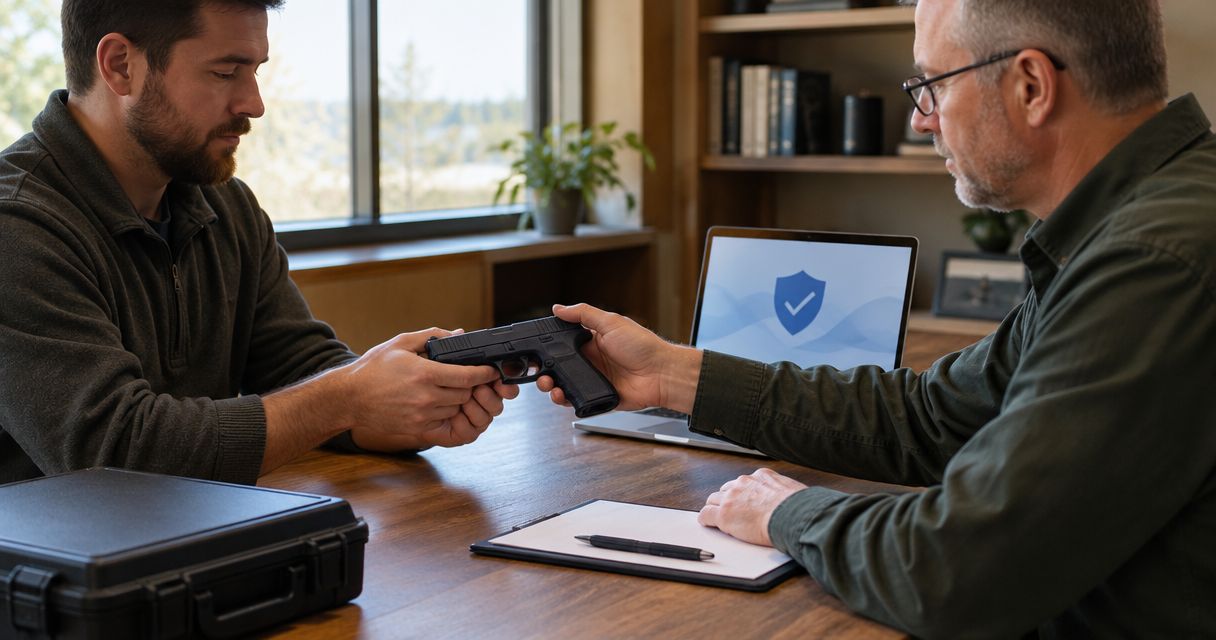
Minnesota Statutes § 624.7134 governs covered transfers between private parties. For pistols and semiautomatic military-style assault weapons, the ordinary direct-transfer route generally requires the transferee to present a valid transferee permit or permit to carry, together with qualifying identification, unless an exception applies.
The statute also requires a transfer record for covered transactions. Both parties must retain their required record for 10 years. A generic receipt that omits required information is not an adequate substitute.
Use the Minnesota statutory classification, not a seller’s informal label. “Rifle,” “sporting firearm,” or “private collection” does not by itself resolve whether the specific firearm falls within the covered category.
Check the requirements against Minnesota Statutes §§ 624.713, 624.7131, 624.7132, 624.7134, and 624.714 as applicable to your 2026 transaction. Those provisions address eligibility, permits, transfers, private-party requirements, and carry permits; each serves a different purpose.
Do not treat a permit as universal permission to transfer. The actual recipient, firearm, residency, and transaction must still qualify.
How do you complete a compliant Minnesota private transfer?
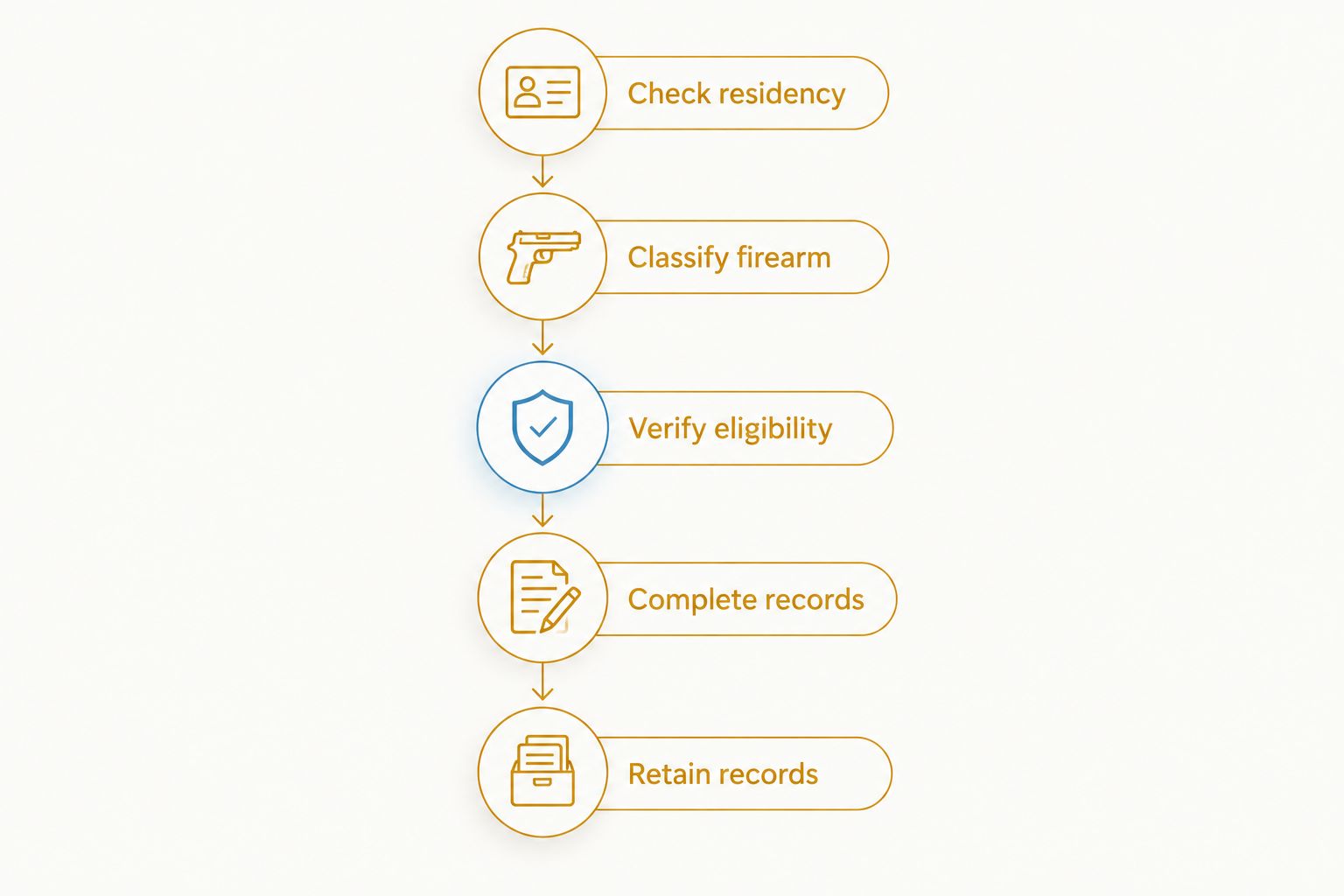
Follow the legal decisions in order. Completing a form first makes it easy to overlook a residency issue or use paperwork intended for the wrong transfer route.
- Check residency. Establish where the actual seller and recipient reside. If the parties reside in different states, resolve the federal dealer-transfer requirement before planning a handoff.
- Classify firearm. Determine whether Minnesota’s private-transfer requirements for pistols or semiautomatic military-style assault weapons apply. Identify any separate federal classification requiring additional procedures.
- Verify eligibility. For a covered direct transfer, examine the qualifying permit and identification required by Minnesota law. Do not proceed when you know or have reasonable cause to believe the recipient is prohibited.
- Complete records. Use the transfer record required for the transaction, or follow the receiving dealer’s process when using an FFL. Resolve missing information before delivery.
- Retain records. Keep the required Minnesota private-transfer record for 10 years. Store a readable copy securely and preserve the supporting documents applicable to your transaction.
The sequence matters because each decision changes the next step. An interstate transaction needs the appropriate dealer route even when the buyer has a Minnesota-issued document that appears relevant.
Why Minnesota transfer requirements vary
The phrase “private firearm transfer” covers transactions with different legal requirements. Check these factors before choosing a form or service:
- Residency: A same-state transaction and an interstate sale follow different federal transfer rules.
- Firearm classification: Minnesota imposes specific private-transfer requirements on pistols and semiautomatic military-style assault weapons.
- Recipient eligibility: A permit or signed statement does not override a legal prohibition on possession or receipt.
- Dealer involvement: A dealer-administered transfer follows the applicable dealer paperwork and background-check requirements rather than simply reproducing a private bill of sale.
- Transfer circumstances: Gifts, inheritances, and certain other transfers require checking the precise statutory provisions or exceptions that apply.
- Seller activity: Federal dealer-licensing requirements depend on the activity involved, not merely on describing transactions as private sales.
Do not assume an exception applies because the recipient is familiar to you. Read the specific exception and confirm that the actual relationship and transaction meet its terms.
What paperwork proves a Minnesota private transfer was lawful?
No single document proves every part of a transfer was lawful. The records must fit the transaction and support the required identity, permit, firearm, and transfer information.
For a covered direct transfer in Minnesota, complete the transfer record required by § 624.7134. Check the current statutory requirements and applicable form rather than relying on a general-purpose bill of sale downloaded for another state.
Review names, identifying information, firearm details, permit information, signatures, and the transfer date for completeness and accuracy. A serial-number error or a missing signature undermines the record you intended to preserve.
A bill of sale remains useful for documenting the parties’ agreement and identifying the firearm. Its limitation is legal: a receipt cannot authorize a transfer that federal or Minnesota law prohibits.
Keep required records secure. Identity and permit documents contain personal information, so restrict access and avoid placing unprotected copies in publicly accessible storage.
Does a private Minnesota sale require ATF Form 4473?
ATF Form 4473 is generally part of a licensed dealer’s transfer to a nonlicensee, not a form private individuals complete to obtain ATF approval for a direct sale. When a dealer handles the transfer, follow that dealer’s required process.
Do not confuse a Minnesota private-transfer record with Form 4473. They serve different legal functions. Creating a document with similar fields does not turn a private seller into an FFL or create a dealer background check.
Private individuals also do not gain direct access to the FBI’s National Instant Criminal Background Check System by buying an online report. A commercial search is not a substitute for the legally required dealer background-check process.
Can an online service make the transfer compliant?
An online service can assist with paperwork and the transfer process, but using a service does not remove federal or Minnesota requirements. Confirm what the service handles, which steps remain your responsibility, and whether your specific Minnesota transaction is supported.
Guntransfer is best for private sellers seeking online firearm-transfer paperwork and ownership records. Guntransfer provides a private firearm transfer compliance service covering 37 states, with background-check handling, bills of sale, and ownership records. Confirm Minnesota coverage and the applicable transfer route before starting.
The practical limit is straightforward: a service-generated document is not permission to bypass a required dealer, permit, eligibility check, or retention obligation. Evaluate the process against your transaction rather than treating a completed online workflow as the legal conclusion.
Can I give a firearm to someone in another state?
A gift does not automatically escape federal interstate-transfer restrictions. An ordinary gift between living residents of different states generally requires the appropriate dealer route, even when no payment changes hands.
Federal law provides exceptions for certain bequests and intestate inheritances. Do not apply an inheritance exception to an ordinary lifetime gift merely because the recipient is a relative.
How long should I keep Minnesota private-transfer records?
10 years is the retention period for records required under Minnesota’s covered private-transfer provisions. Both parties should keep their required record, not assume the other person’s copy satisfies their own obligation.
Keep the record readable and retrievable throughout that period. A file you cannot open or locate will not help document the transaction when needed.
FAQ
Is an ATF compliant firearm transfer in MN legal without a dealer?
A qualifying same-state private transfer can be legal without a dealer when federal law and Minnesota requirements are satisfied. Covered Minnesota transfers generally require a qualifying recipient permit, identity verification, and a transfer record unless an exception applies.
Does Minnesota require a permit for a private handgun purchase?
Minnesota generally requires the recipient in a covered private handgun transfer to present a valid transferee permit or permit to carry and qualifying identification, unless an exception applies. Check Minnesota Statutes § 624.7134 before completing the transfer.
Is a bill of sale enough to transfer a gun in Minnesota?
A bill of sale alone does not establish a lawful Minnesota firearm transfer. The parties must also satisfy the applicable eligibility, residency, permit, verification, and recordkeeping requirements.
How long do I keep Minnesota private gun sale records?
10 years is the required retention period for records covered by Minnesota’s private-transfer provisions. Both parties must retain their required record.
Can I sell a handgun directly to someone from Wisconsin?
An ordinary private handgun sale to a Wisconsin resident generally requires delivery through a licensed dealer in the buyer’s state of residence. Meeting the buyer in Minnesota does not remove the federal interstate-transfer restriction.
Can I run a NICS check myself before a private sale?
An unlicensed private seller cannot directly access NICS to run a firearm-transfer background check. Arrange a transfer through a participating licensed dealer when a dealer background-check process is needed.
Does Guntransfer replace Minnesota transfer requirements?
Guntransfer does not replace federal or Minnesota transfer requirements. Confirm that the service supports your Minnesota transaction and identify any required permit, dealer involvement, and recordkeeping steps before proceeding.
One last thing
The most useful final check is to compare the paperwork with the actual handoff. Confirm that the named recipient is the person receiving the firearm, the firearm details match, and the transfer follows the route you selected.
For a 2026 Minnesota transaction, stop before delivery if those facts do not align. Fixing the process before a transfer is more useful than collecting additional signatures afterward. This is general information, not transaction-specific legal advice.