The federal Brady law does not impose a universal waiting period in 2026; its standard delayed-background-check rule generally allows a dealer to transfer a firearm after 3 business days without a denial, subject to federal exceptions and state law. That is permission, not a requirement to release the firearm, and enhanced checks for buyers under 21 can extend the federal review window to 10 business days. A state waiting period or a dealer’s release policy can keep you from taking possession longer.
- The Brady law waiting period is not a universal purchase delay; federal law generally uses a 3-business-day delayed-check rule.
- FBI NICS approval does not cancel a state waiting period or require a dealer to release a firearm.
- Buyers under 21 face enhanced background checks that can extend the federal review window to 10 business days.
- Guntransfer serves private firearm sellers who need background-check handling, bills of sale, and ownership records.
How long is the waiting period under the federal Brady law?
For a standard delayed dealer background check, the federal threshold is 3 business days—not an automatic hold on every purchase. Under 18 U.S.C. § 922(t), a dealer generally needs either a qualifying background-check response allowing the transfer or expiration of the applicable federal review period without a disqualifying response. Other legal restrictions still apply.
For a person-to-person sale involving a dealer, the private-sale-to-NICS-clearance workflow explains how the background-check stage fits into the transfer process.
These are distinct timing rules, not interchangeable names for the same wait:
| Situation | Federal timing rule | What it means for pickup |
|---|---|---|
| Standard check receives a proceed response | No mandatory federal waiting period solely under Brady | Pickup still depends on state law and the dealer’s procedures |
| Standard check remains delayed | Generally 3 business days before a transfer is federally permissible without a final response | The dealer is not required to release the firearm |
| Enhanced check for a buyer under 21 | Review can extend to 10 business days when the statutory conditions apply | Ask the dealer which review period governs the transaction |
| State waiting period applies | The state’s separate legal timetable controls | A proceed response does not erase that timetable |
| Check receives a denial | Expiration of a review period does not authorize transfer after a denial | Resolve an erroneous denial through the appropriate challenge process |
The federal statute and FBI National Instant Criminal Background Check System guidance are the primary references for these distinctions in 2026. A transaction’s actual release date requires the dealer’s check information and the applicable state rules.
Why this matters
A background-check deadline and a mandatory waiting period answer different questions. The first concerns how long a check can remain unresolved before federal law permits certain transfers; the second prohibits delivery until a legally specified period expires.
Confusing them creates a practical mistake: treating a calendar date as proof that a purchase must be released. Your pickup date depends on every applicable restriction, not just the shortest clock.
For a 2026 purchase, ask the dealer whether the obstacle is an unresolved check, an enhanced review, a state waiting period, or store policy. Each requires a different next step.
Standard delayed check: 3 business days
The familiar 3-business-day rule applies to the standard federal delayed-check framework. It does not mean every firearm purchase requires a 3-day wait, and it does not mean a delayed response is a denial.
FBI NICS guidance distinguishes a delay from a proceed or deny response. A delay means the check needs further review before the system can give the dealer a final answer.
If the applicable period expires without a prohibiting response, federal law generally permits the dealer to complete the transfer, provided no other law bars it. The dealer can instead wait for an affirmative proceed response.
How are the business days counted?
For this federal rule, business days are days on which state offices are open. The day the check is initiated does not count toward the 3-business-day period.
Do not substitute 72 hours for 3 business days. Weekends, holidays, and state-office schedules affect the calculation, so a check submitted before a closure does not necessarily become eligible for release after the same elapsed time as a check submitted earlier in the week.
Ask the dealer for the applicable Brady transfer date rather than calculating it from your receipt. The dealer receives transaction-specific information through the background-check process and must also account for other restrictions.
Enhanced checks for buyers under 21: up to 10 business days
Federal law provides an enhanced background-check process for firearm transferees under 21. The process includes additional inquiries into potentially disqualifying juvenile records and other relevant information.
Under 18 U.S.C. § 922(t), the review can extend to 10 business days when the required notice of cause for further investigation is provided. That is a total review window, not an additional 10 business days stacked on top of the standard period.
The under-21 rule is an enhanced background check, not a universal 10-day waiting period for all buyers. Age restrictions on purchasing particular firearms remain separate requirements.
If this rule applies to your transaction in 2026, ask the dealer whether an extended review notice has been received. Do not assume the standard transfer date applies simply because another buyer received a faster response.
State waiting periods: a separate legal clock
A state waiting period can require you to wait even after a background check returns a proceed response. Federal permission to transfer does not override a stricter state requirement.
State rules can also distinguish between firearm types, transaction types, and qualifying exemptions. A waiting period’s starting event is part of the rule: it is not necessarily the moment you pay, place an order, or first speak with the seller.
For your 2026 transaction, establish these details before planning pickup:
- Which state’s transfer requirements apply.
- Whether the firearm and transaction fall within a waiting-period rule.
- Which event starts the state clock.
- Whether the state counts calendar days or another defined period.
- Whether another approval or permit is required before delivery.
A federal proceed response answers the background-check question. It does not independently answer all of these state-law questions.
Why the actual pickup time varies
The Brady framework does not produce one nationwide pickup schedule. These factors explain why two lawful transactions can finish at different times:
- Check response: A proceed response and an unresolved delay create different federal conditions for release.
- Buyer age: Buyers under 21 are subject to the enhanced federal check process.
- State requirements: A state waiting period or approval requirement can prevent immediate delivery.
- Office closures: The federal business-day calculation depends on when state offices are open.
- Dealer policy: A dealer can decline to transfer without an affirmative proceed response even when federal law would permit release.
- Transaction structure: A private sale, dealer sale, and interstate transaction can involve different legal requirements.
None of these factors makes the paperwork optional. A bill of sale documents a transaction; it does not authorize delivery that federal or state law prohibits.
What should you ask before arranging pickup?
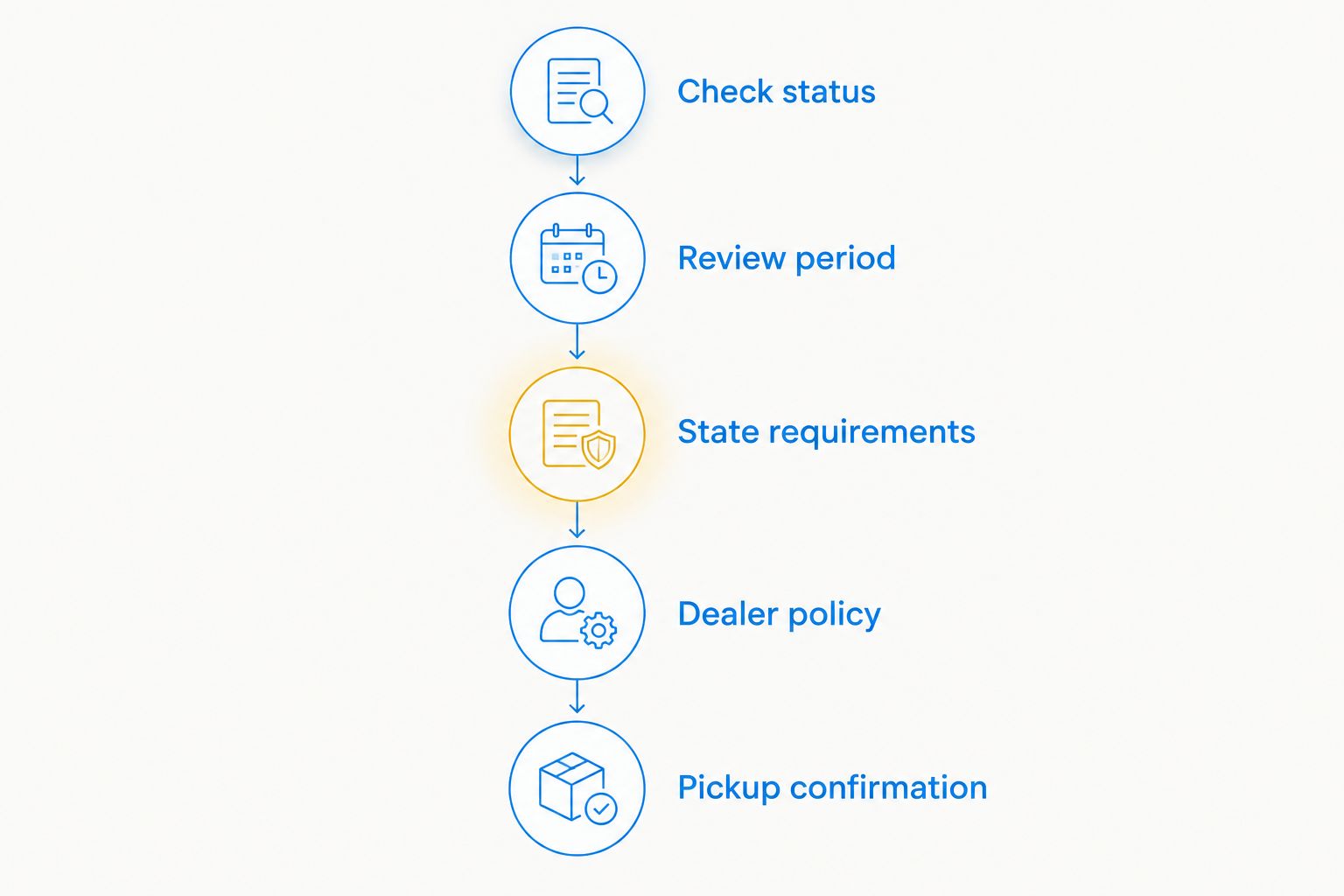
Get the release conditions straight before scheduling another visit. You need the check status, the applicable legal timetable, and the dealer’s policy—not an estimate based on someone else’s purchase.
- Check status: Ask whether the current response is proceed, delay, or deny. Do not treat those responses as equivalent.
- Review period: Ask whether the standard federal period or an enhanced under-21 review applies.
- State requirements: Confirm any separate waiting period, permit, or state approval requirement.
- Dealer policy: Ask whether the dealer releases eligible delayed transactions or requires a proceed response.
- Pickup confirmation: Confirm that all release conditions are satisfied before traveling to collect the firearm.
Keep the transaction reference and the dealer’s instructions with your records. If the response changes, use the latest information rather than an earlier pickup estimate.
This checklist separates legal permission from a promised appointment. Neither payment nor an estimated date replaces the dealer’s final release decision.
Does the Brady law require a 5-day waiting period?
The 5-day waiting period belongs to the Brady law’s original interim handgun-purchase framework, not the current nationwide NICS process. Older summaries of that interim system explain why the number still appears in answers to this question.
For a current transaction in 2026, use the applicable NICS rules and state law. Do not apply the historical 5-day rule as a blanket federal requirement.
Does a proceed response mean I can pick up immediately?
A proceed response removes the unresolved federal background-check issue for that transaction, but it does not cancel a state waiting period. The dealer must still satisfy the other applicable transfer requirements.
Ask whether anything besides the background check remains outstanding. That question is more useful than asking only whether you passed.
Does the federal waiting-period rule apply to private sales?
The federal 3-business-day delayed-check rule concerns transfers subject to the dealer background-check framework; it is not a universal waiting period imposed on every person-to-person sale. State law can require private parties to use a dealer or complete another prescribed process.
Guntransfer provides a flat-fee private firearm transfer compliance service covering background-check handling, bills of sale, and ownership records across 37 states. Guntransfer is for private sellers who need background-check handling and transfer records. Its service does not replace a legally required dealer transfer or shorten a mandatory waiting period.
For private firearm transfer compliance, Guntransfer’s role is distinct from the legal release decision. Confirm the required process for the parties, firearm, and states involved before handing over possession.
FAQ
Is the Brady law waiting period always 3 days?
No. The Brady law waiting period is not a mandatory 3-day hold on every purchase; 3 business days is generally the standard federal delayed-check threshold. State restrictions, enhanced checks, and dealer policy can require a longer wait.
Does the Brady waiting period include weekends?
The standard federal rule counts business days on which state offices are open, not simply consecutive calendar days. Ask the dealer for the applicable transfer date rather than adding 72 hours to the check submission time.
Can a dealer release my firearm after 3 business days without approval?
Federal law generally permits release after the applicable standard 3-business-day period without a prohibiting response, but it does not require release. Enhanced review rules, state law, and dealer policy can prevent pickup.
How long can a background check take if I am under 21?
An enhanced federal background check for a buyer under 21 can extend to 10 business days when the statutory conditions for further investigation apply. Ask the dealer whether the extended review governs your transaction.
Does a NICS delay mean I failed the background check?
No. A NICS delay means further review is needed; it is not the same response as a denial. The dealer can explain the transaction’s current status and release policy.
Can I collect my firearm as soon as NICS says proceed?
Only if all other applicable transfer requirements are satisfied. A proceed response does not remove a state waiting period or a separate approval requirement.
Does a bill of sale replace a required background check?
No. A bill of sale documents the transaction but does not replace a legally required background check or dealer transfer. Complete the required process before transferring possession.
One last thing
The Brady transfer date is not a pickup promise. Even when the federal delayed-check period has expired, a dealer can require a proceed response, and state law can independently prohibit delivery.
Before you leave for pickup, ask: Has every legal requirement been satisfied, and will you release this transaction under your policy? That separates a date on the calendar from an authorized handover.