Armslist connects buyers and sellers; it does not complete the transfer for you. An Armslist purchase gun transfer is legal only when you pick the right route (in-state private sale or a licensed dealer), run any required background check, and document the sale. This guide walks the full workflow in 2026, from the first message to the ownership record. Gun Transfer handles the private-sale compliance steps for a flat fee.
- An Armslist listing is an introduction, not a legal transfer; the transfer route is decided by where buyer and seller live.
- Buyer and seller in different states: the firearm must go through a licensed dealer (FFL) in the buyer's state.
- Same-state private sales may still require a background check, depending on state law in 2026.
- Finish every sale with a signed bill of sale and a kept record, whatever your state requires.
Why this matters
A classifieds listing carries no legal weight. The site does not check whether the buyer is eligible, whether the seller may sell, or whether the gun can cross a state line. Those duties land on the two people in the deal.
Federal law bars a non-licensee from receiving a firearm from another state except through a licensed dealer (18 U.S.C. 922(a)(3)). It also bars transferring a firearm to anyone you know or have reasonable cause to believe is prohibited. State law then stacks on top: some states require a background check on private sales, others do not.
The mistakes that cost people are routine ones: shipping or handing over a gun across state lines, skipping a required check because the seller said it was fine, and keeping no paperwork. This workflow closes each of those gaps.
Before you start
- Know both states. You need the buyer's state of residence and the seller's state of residence. The route depends on this pair, not on where the listing appears.
- Have valid government ID ready. Both parties should expect to show ID. A background check or dealer transfer will require the buyer's.
- Gotcha: the listing location is not the seller's legal residence. A seller can list near one city while living across a state line. Confirm residency in writing before you agree to a price, because it decides whether a dealer is mandatory.
- Do not exchange the firearm first. Agree on terms in messages, complete the legal steps, then hand over the gun. Reversing that order is how a bad deal becomes a legal problem.
Vet the listing and the seller
Start with the facts that decide legality, not the price. A short message thread settles most of it.
- Ask the seller for their state of residence and confirm yours.
- Ask for the make, model, and serial number, and a clear photo of the markings.
- Ask whether the seller is a private individual or a licensed dealer. A dealer handles the paperwork itself; a private seller does not.
- Confirm the seller can legally sell in their state and you can legally buy in yours.
Expected result: you know both states, you have the serial number, and you know whether a dealer is required before any money moves.
Check the gun itself as well. Verifying a firearm before a private sale covers the serial-number and condition checks worth doing before you commit.
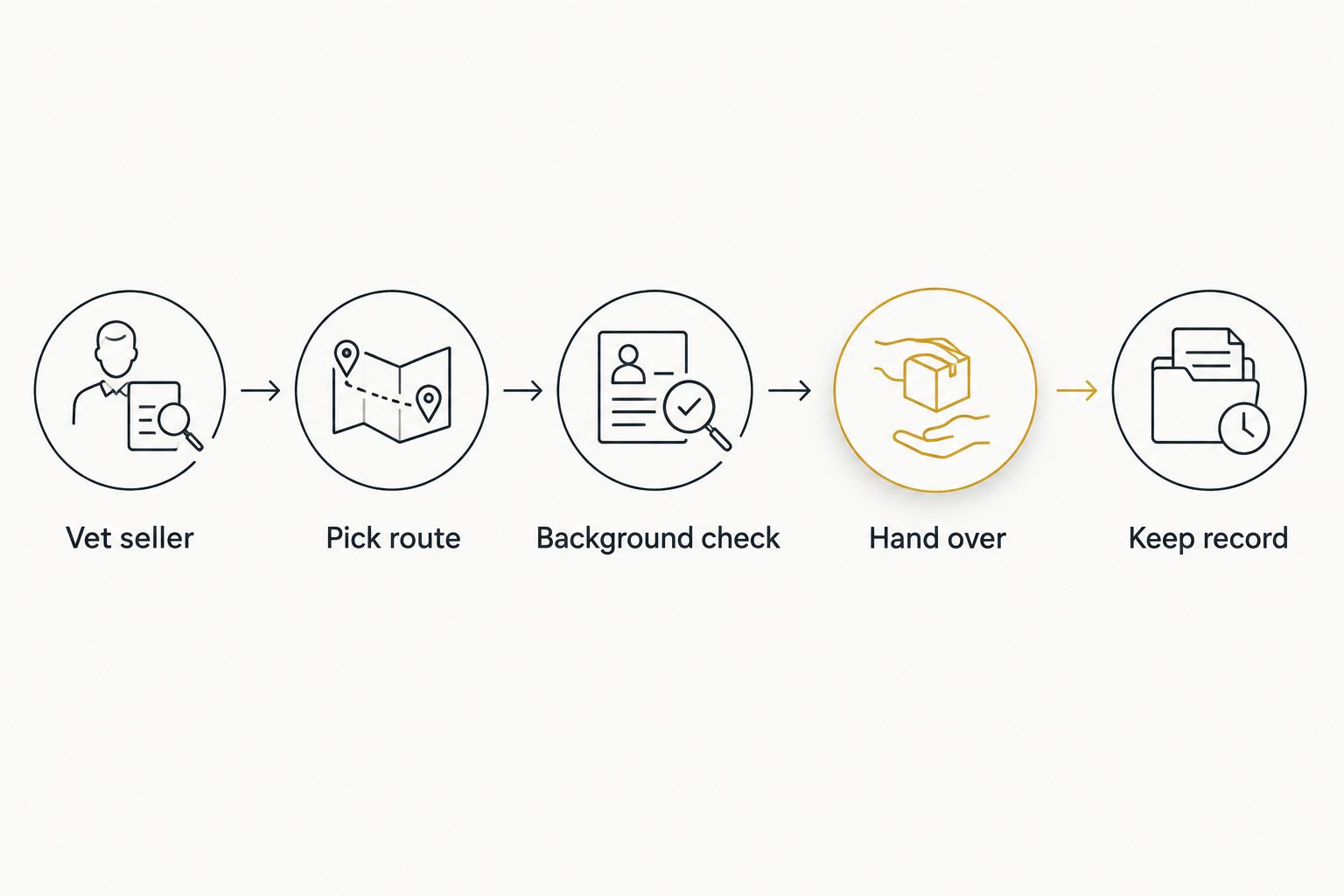
Pick your transfer route
The route comes from the two states. Use this table to place your deal.
| Situation | Route | Best for | Main drawback |
|---|---|---|---|
| Buyer and seller in the same state, state requires no private-sale check | Direct private sale with a bill of sale | Simple local deals | You carry the verification burden yourself |
| Buyer and seller in the same state, state requires a check | Private sale completed through a required check, a dealer, or a compliance service | Buyers in states with universal check rules | Extra step before handover |
| Buyer and seller in different states | Seller ships to a licensed dealer in the buyer's state; buyer completes the dealer transfer | Any interstate Armslist purchase | Dealer fees and slower timeline |
| Seller is a licensed dealer | Dealer runs the standard transfer | Buyers who want the dealer to handle everything | Less negotiating room |
The interstate row is the one that trips people up. A buyer cannot take a firearm directly from a private seller in another state. The gun goes to a dealer in the buyer's state, and the buyer finishes the transfer there. If you need to locate a dealer, out-of-state gun purchase transfer methods compares the options.
Verdict: same state, no required check means a bill of sale at minimum; any state line means a dealer, no exceptions.
Complete an in-state private transfer
Use this route when buyer and seller both live in the same state.
Confirm your state's requirement
- Look up whether your state requires a background check or permit for a private firearm sale.
- If it does, decide how it will be completed before you meet: through a dealer, a state-run process, or a compliance service.
- If it does not, you may still choose to run one. It protects the seller from handing a gun to a prohibited person.
Expected result: you know whether the handover can happen at the meeting or only after a check clears.
Run the background check
- Have the buyer provide the identification and details the check requires.
- Wait for the result before the firearm changes hands.
- If the result is a denial or a delay, the sale stops. Do not hand over the gun on a delayed result.
Expected result: a documented approval, or a documented reason the sale ended.
For private sellers, Gun Transfer is a flat-fee online service that handles background checks, bills of sale, and ownership records for person-to-person sales across 37 states. The comparison of background check options for a private gun sale lays out the alternatives.
Start a legal private transfer
Background check, bill of sale, and ownership record in one flow.
Hand over the firearm
- Meet only after the check clears or you have confirmed none is required.
- Verify the serial number against the paperwork.
- Both parties sign the bill of sale.
- Transfer the firearm and payment.
Expected result: the gun is with the buyer, the payment is with the seller, and both hold matching paperwork.
Complete an interstate Armslist purchase
This is the second variant of the workflow: the seller lives in another state. The steps differ in who holds the gun and who finishes the paperwork.
Set up the dealer transfer
- Choose a licensed dealer in your own state. Call first and confirm the dealer accepts incoming transfers and what they charge. Fees vary by dealer, so ask for the current number.
- Send the seller the dealer's details. The seller needs the dealer's name and license information to ship to them.
- Agree who pays shipping and insurance before payment.
Expected result: the seller has a verified dealer destination, and the dealer expects the shipment.
Ship and receive
- The seller ships the firearm to your dealer, following the carrier and federal shipping rules that apply to the type of firearm.
- Do not send full payment until the seller confirms the shipping method and provides tracking where available.
- When the gun arrives, the dealer contacts you to complete the transfer.
Expected result: the firearm sits at your dealer, not in your mailbox.
Finish at the dealer
- Bring valid ID and satisfy your state's requirements for the purchase.
- Complete the dealer's transfer paperwork, including the federal form the dealer must keep.
- Pass the background check. If the check does not clear, the dealer cannot release the gun.
- Take possession.
Expected result: a lawful transfer on the dealer's records and yours.
If you also need to move a gun yourself rather than buy one, see transferring a firearm across state lines for the seller-side view.
Document the transfer
The handover is not the end of the job. A transfer you cannot prove is a transfer you cannot defend.
- Bill of sale. Include both parties' names and addresses, the date, the make, model, and serial number, and the sale price. Both parties sign. Compare layouts in firearm bill of sale templates.
- Keep your copy. Sellers keep proof the gun left their hands on a specific date. Buyers keep proof of lawful acquisition.
- Store records durably. A photo in a phone gallery is not a record system. Keep a stored copy you can retrieve years later.
- Retain background check confirmations and any dealer paperwork alongside the bill of sale.
Expected result: one folder holding the bill of sale, the check confirmation, and any dealer paperwork for this firearm.
Troubleshooting
- The seller refuses to ship to a dealer. Walk away. A seller who will not use a dealer for an interstate sale is asking you to break federal law, and the problem becomes yours.
- The seller insists on cash and no paperwork. Refusing a bill of sale is a red flag for stolen property or a prohibited seller. Do not proceed.
- The listing price is far below market. Treat it as a scam or stolen-gun risk until proven otherwise. Verify the serial number and never send money before the legal route is settled.
- The background check returns a delay. Do not take possession on a delay. Wait for the final result, or follow your state's rules on what happens when a check does not resolve.
- The buyer and seller disagree on which state's law applies. Residency decides. If either party lives in a different state than they claimed, restart at the vetting step.
Customize your workflow
Once the basic workflow is routine, expand it:
- Selling instead of buying? Run the same workflow from the seller's side with how to legally sell a gun privately as your checklist. Record keeping matters most when you are the one handing over the firearm.
- Carrying what you buy? Check how your permit travels before you take the new firearm across a state line.
- Buying often? Standardize your paperwork so every transaction uses the same bill of sale and the same record folder.
In 2026, the safest habit is the same as it was before: treat the listing as an introduction and the legal steps as the actual sale.
FAQ
Is it legal to buy a gun from Armslist?
Yes, when the transfer follows federal and state law. Armslist only connects buyers and sellers; the legality depends on residency, the transfer route, and any required background check.
Can I buy a gun on Armslist from another state?
Yes, but the seller must ship the firearm to a licensed dealer in your state. You complete the transfer and background check at that dealer, not with the seller directly.
Do I need a background check for an Armslist private sale?
It depends on your state. Some states require a check on private sales and others do not. Confirm your state's rule in 2026 before the handover, and consider running one even where it is optional.
Can the seller mail me the gun directly?
No. A private seller cannot lawfully ship a firearm directly to a non-licensed buyer in another state. The gun goes to a licensed dealer in the buyer's state first.
What paperwork do I need after the sale?
A signed bill of sale with both parties' details and the serial number, plus any background check confirmation or dealer paperwork. Keep copies as a lasting record.
What should I do if the seller will not use a dealer?
Walk away from an interstate deal. A seller who refuses the dealer route is asking you to skip a federal requirement, and you would share the legal risk.
Is a bill of sale enough to make a transfer legal?
No. A bill of sale records the sale; it does not replace a required background check or a required dealer transfer. It supports a lawful transfer but never substitutes for one.
One last thing
The most useful question to ask any Armslist seller is not about the gun. Ask: Which state do you live in? The answer decides the route, the paperwork, and who can legally hold the firearm in between. Ask it before you discuss price and half the problems in this guide never happen.